
Rising Sign Quiz
How the Scales are Structured
Who Usually Takes This Test?
See How You Compare
Below is a preview of how scores are typically distributed across each scale.
Example Questions From the Test
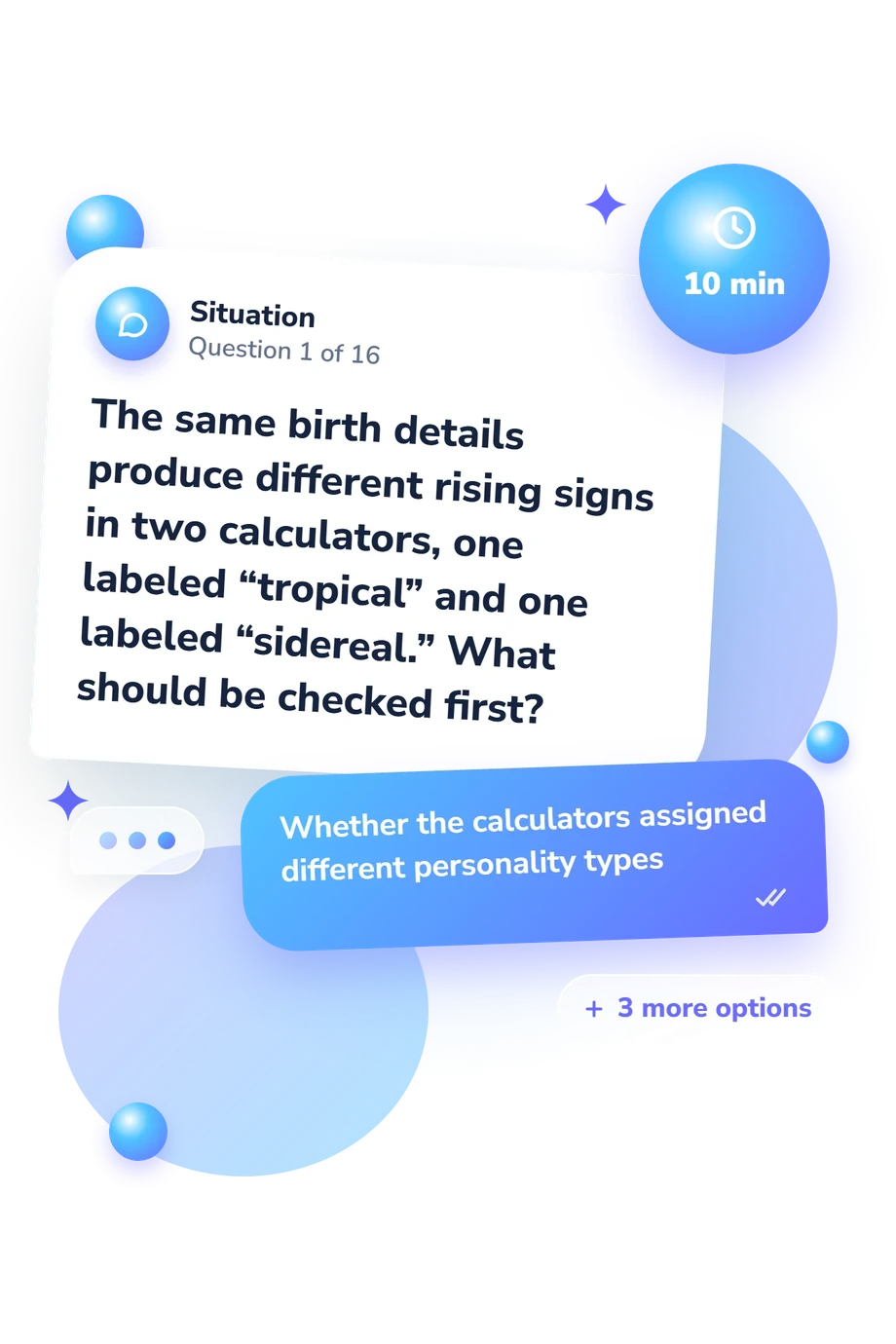
- Correct the location and recalculate before relying on the result
- Replace the birth time with noon to compensate
- Keep the result because location never affects the Ascendant
- Choose whichever result sounds more personally accurate
- Virgo, because the Ascendant degree lies within Virgo
- Libra, because it is the next sign
- Pisces, because it is opposite Virgo
- The Sun sign, regardless of the Ascendant label
- The degree occupied by the Sun
- The highest point reached by the Moon
- The Ascendant and beginning of the first-house area
- The boundary between tropical and sidereal signs
Rising Sign Quiz - Description and methodology of the test
Readers who want to understand how an Ascendant is identified can use the rising sign quiz as a focused knowledge assessment. It suits people exploring natal charts, learning terminology, or comparing calculator outputs rather than matching a sign to personality traits. The result shows how well you understand the birth data and chart settings that determine an Ascendant. As a rising zodiac sign quiz, it emphasizes chart mechanics.
What This Assessment Measures
The questions test whether you recognize the information and chart features needed for a Western astrology calculation. They cover birthplace, local time, time-zone and daylight-saving adjustments, tropical or sidereal frameworks, and the distinction between the Sun sign and the Ascendant.
For readers who want a procedural result, the assessment works as a what rising sign am i quiz: it indicates familiarity with how an Ascendant is found, not which sign best describes your personality.
The tested dimensions are these:
- Birth-data accuracy shows why date, precise time, birthplace, and time-zone details matter.
- Chart frameworks show whether you distinguish tropical and sidereal systems.
- Ascendant concepts indicate whether you understand the eastern horizon, the ASC label, and sign degrees.
- Result verification shows when conflicting records or settings require recalculation.
Together, these areas describe calculation knowledge rather than personal chart interpretation.
Methodology and Evidence Base
Each item uses multiple-choice format with one best answer. Questions address chart inputs, terminology, and calculation problems; they are not personality statements. Scoring summarizes overall tested performance.
The assessment functions as a birth chart rising sign test, applying established conventions described by March and McEvers (1999) and Sakoian and Acker (1973): the eastern horizon, recorded birth time, location, and chart framework. Meeus (1998) supplies astronomical context for time conversion and positional calculations. These works clarify the framework assessed here, but the questionnaire is not an adaptation of their instruments.
The displayed scale is Rising Sign Knowledge (0-16), with Foundation (0-6), Developing (7-12), and Strong knowledge (13-16). These bands are descriptive, not standardized population norms or clinical cutoffs; they indicate command of tested rules, not astrology’s scientific validity or the respondent’s actual Ascendant.
As an Ascendant calculation test, the result indicates knowledge, not a personal chart calculation. Performance can vary with prior exposure, technical wording, uncertainty in historical records, and self-report. Kelly (1979) underscores that familiarity with astrological procedures is separate from empirical support for astrology’s claims.
- March, Marion D., and Joan McEvers. The Only Way to Learn Astrology, Volume II: Math & Interpretation Techniques. 2nd ed., ACS Publications, 1999. ISBN 978-0-935127-68-3.
- Sakoian, Frances, and Louis S. Acker. The Astrologer's Handbook. Harper & Row, 1973. ISBN 0-06-091495-5.
- Meeus, Jean. Astronomical Algorithms. 2nd ed., Willmann-Bell, 1998. ISBN 0-943396-61-1.
- Kelly, I. W. Astrology and Science: A Critical Examination. Psychological Reports, vol. 44, 1979, pp. 1231-1240. 10.2466/pr0.1979.44.3c.1231.
Updated: