
4.1 Comprehension Quiz
How the Scales are Structured
Who Usually Takes This Test?
See How You Compare
Below is a preview of how scores are typically distributed across each scale.
Example Questions From the Test
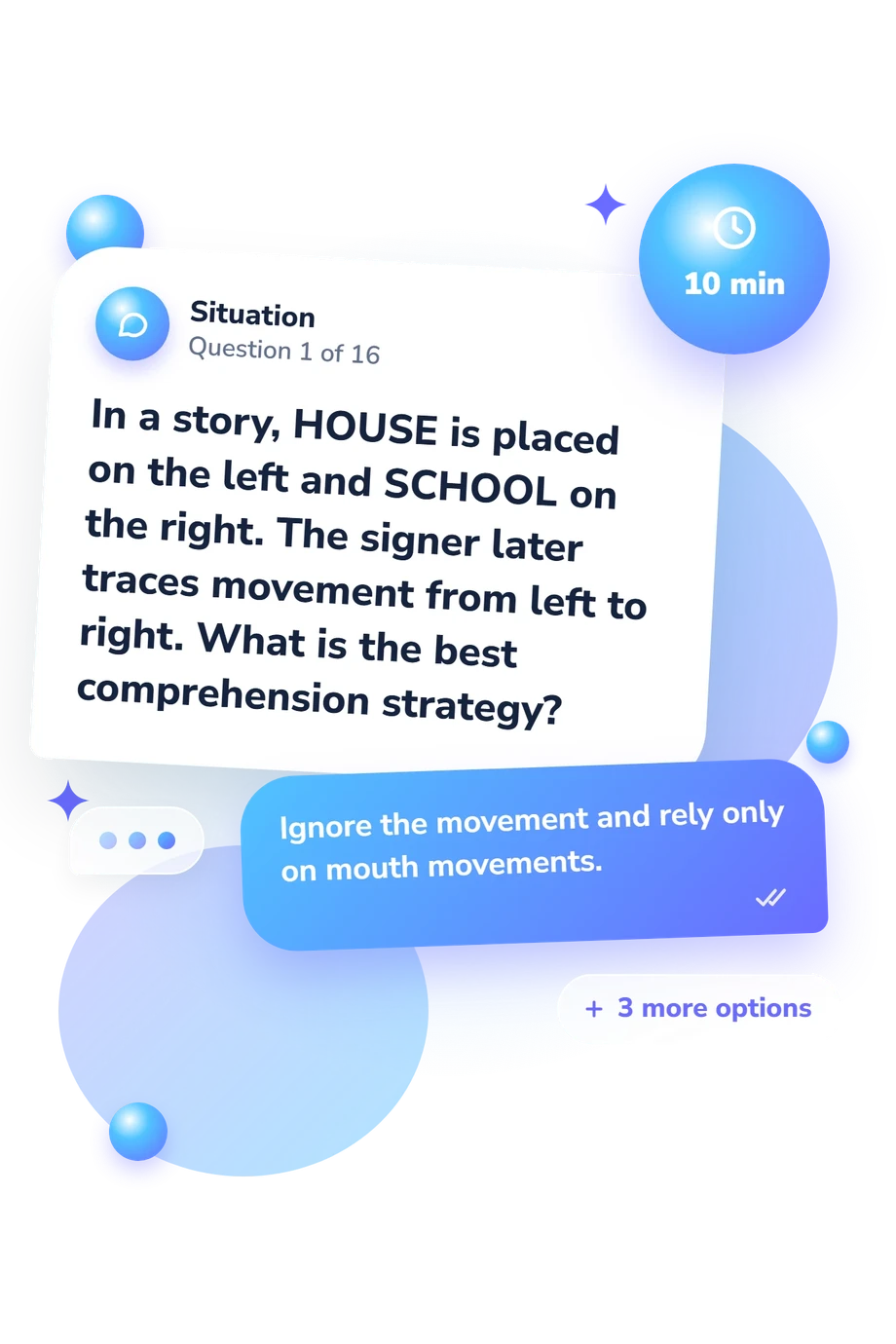
- Ignore the movement and rely only on mouth movements.
- Treat the movement as unrelated because locations reset after each sentence.
- Assume left always means west and right always means east.
- Interpret the movement using the previously established house-to-school map.
- The person being addressed
- First person, such as “I” or “me”
- An absent third person
- A location established behind the signer
- How loudly the sentence should be interpreted
- The grammatical relationship between giver and recipient
- That the object being given is large
- Whether both people are physically nearby
4.1 Comprehension Quiz - Description and methodology of the test
People who want to examine their understanding of American Sign Language can use this assessment to connect visible cues with meaning in context. The 4.1 Comprehension Quiz is useful for learners and interpreters in training. Viewers seeking an ASL comprehension quiz can examine reference, grammar, and discourse with it. It offers a text-based check of ASL comprehension principles, showing which areas they recognize and where further study may help.
What This Assessment Explores
The questions focus on how viewers combine cues instead of relying on isolated signs. Scenarios cover established locations, pointing, directional movement, handshape, fingerspelling, facial grammar, topic-comment organization, character shifts, and depicted action. These scenarios make the questionnaire useful for learners checking their foundational ASL comprehension.
The questions cover these thematic areas:
- Spatial reference shows how locations and pointing connect meaning across a discourse.
- Nonmanual grammar shows how face, head, gaze, and posture can mark sentence function.
- Form and fingerspelling show how sign features and letter sequences support identification.
- Discourse and depiction show how topics, perspectives, and visible actions organize meaning.
The displayed scale is 4.1 Comprehension Knowledge (0-16): Foundation to build (0-6), Developing knowledge (7-12), or Strong knowledge (13-16).
Methodology and Scientific Basis
Each item presents an ASL comprehension situation with four answer choices. The respondent selects the interpretation that best fits the cues and context. This forced-choice knowledge check totals the number of correct answers from 0 to 16, then assigns the displayed result band.
The questionnaire is conceptually consistent with ASL-CT, a published ASL comprehension instrument. The 4.1 questionnaire presents a text-based comprehension quiz for ASL learners; it is not an adaptation of that instrument. Aarons supports attention to syntactic organization, while Liddell explains how grammar, gesture, space, and depiction can work together in signed meaning.
Across the items, comprehension depends on integrating manual features, nonmanual signals, spatial reference, discourse context, and depicted action rather than identifying isolated signs.
Because the questionnaire presents written scenarios rather than live signing, its displayed bands describe performance on these scenarios rather than population norms and do not measure complete real-time receptive signing ability. Interpret the result as an indication of performance on the principles represented by these scenarios. Prior instruction, reading ability, attention, and familiarity with ASL conventions may affect performance.
- Hauser, Peter C., Raylene Paludneviciene, Wanda Riddle, Kim B. Kurz, Karen Emmorey, and Jessica Contreras. (2016). American Sign Language Comprehension Test: A Tool for Sign Language Researchers. Journal of Deaf Studies and Deaf Education, 21(1), 64-69. 10.1093/deafed/env051
- Aarons, Debra. (1994). Aspects of the Syntax of American Sign Language. Doctoral dissertation, Boston University Graduate School.
- Liddell, Scott K. (2003). Grammar, Gesture, and Meaning in American Sign Language. Cambridge University Press. 10.1017/CBO9780511615054
Updated: