
Which Probiotic Is Right for Me Quiz
How the Scales are Structured
Who Usually Takes This Test?
See How You Compare
Below is a preview of how scores are typically distributed across each scale.
Example Questions From the Test
- Discuss a strain- and route-specific probiotic adjunct with a qualified clinician.
- Ask a pharmacist or clinician about the evidence before deciding whether to try one.
- Focus on general wellness habits without adding a targeted probiotic.
- Use no vaginal-health probiotic because this is not a goal I want to pursue.
- A transparent label identifying strains studied for the specific vaginal-health goal.
- A product whose oral or local route, instructions, and evidence I can review with a clinician.
- A general digestive probiotic that is not specifically selected for vaginal health.
- No probiotic product; I would choose other supported approaches instead.
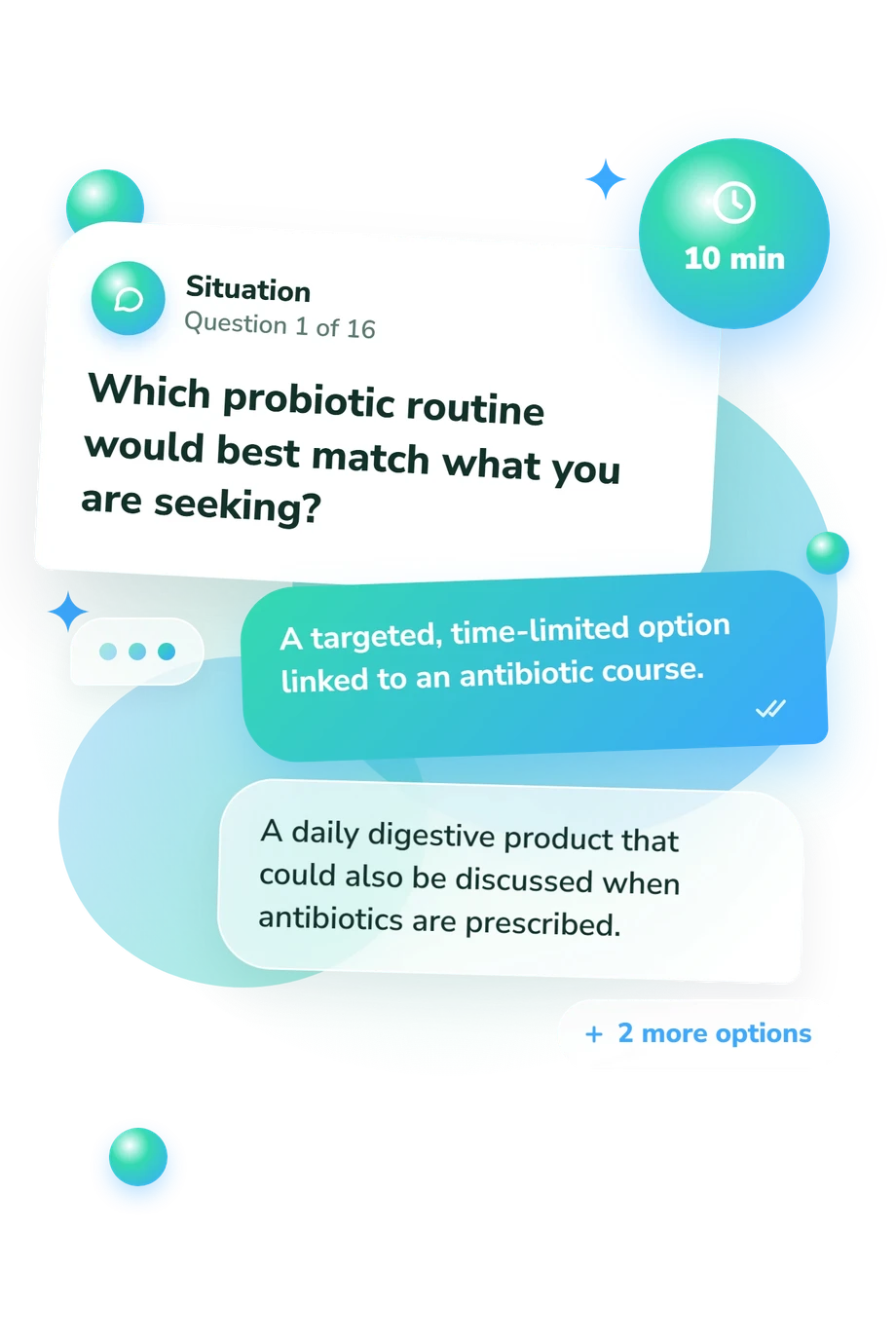
- A targeted, time-limited option linked to an antibiotic course.
- A daily digestive product that could also be discussed when antibiotics are prescribed.
- Food-based support without a dedicated antibiotic-related supplement.
- No antibiotic-related routine because that is not my current goal.
Which Probiotic Is Right for Me Quiz - Description and methodology of the test
Someone weighing whether to try a probiotic may benefit from separating an immediate concern from a general interest in supplements. This probiotic quiz is intended for readers who want to organize their priorities before choosing an approach or discussing options with a clinician or pharmacist. The Which Probiotic Is Right for Me Quiz gives them a starting point for a more focused decision without selecting a particular product.
What This Assessment Explores
The questionnaire covers digestion, antibiotic after-effects, IBS, vaginal-health goals, and readiness for targeted or food-based support. It clarifies the respondent’s support goal rather than selecting a product, strain, dose, or route.
The four result dimensions are:
- Antibiotic-Related Support (0-12) reflects targeted support after antibiotics: Limited affinity 0-4; Possible affinity 5-8; Strong affinity 9-12.
- Everyday Digestive Support (0-12) reflects monitored support for recurring mild digestive concerns: Limited affinity 0-4; Possible affinity 5-8; Strong affinity 9-12.
- IBS-Focused Probiotic Trial (0-12) reflects a cautious, strain-specific experiment: Limited affinity 0-4; Possible affinity 5-8; Strong affinity 9-12.
- Vaginal Microbiome Support (0-12) reflects targeted clinician-guided support: Limited affinity 0-4; Possible affinity 5-8; Strong affinity 9-12.
The summaries help answer this Which Probiotic Should I Take Quiz question by distinguishing the goal that most closely matches the answers; they do not compare brands, strains, doses, or routes.
Methodology and Evidence Base
Four response options cover support preferences, antibiotic timing, symptoms, evaluation status, urgency, and priorities. The format captures context as well as interest in an approach.
The result answers the Do I Need Probiotics Quiz question: whether a probiotic-related goal fits the situation and whether other steps should come first.
Responses create four summaries; displayed scores are unvalidated reflective summaries, and no point-per-answer rule is stated.
Lynch et al. (2021) is the closest match because it examined why gastroenterology patients use probiotics. Hungin et al. (2018) and Su et al. (2020) address symptom-, product-, and strain-specific gastrointestinal evidence. Cohen et al. (2020) illustrates why evidence for one vaginal strain and route should not automatically generalize to other products or uses. This questionnaire is not an adaptation of those studies.
Interpret higher affinity as closer alignment with a support goal, not proof of need or efficacy. Self-report and unvalidated bands mean results may shift with symptoms, expectations, memory, or product context. Persistent concerns warrant assessment; new vaginal symptoms need professional evaluation; severe pain, bleeding, high fever, fainting, or dehydration call for prompt care.
- Lynch E, Troob J, Lebwohl B, Freedberg DE. Who uses probiotics and why? A survey study conducted among general gastroenterology patients. BMJ Open Gastroenterology. 2021;8(1):e000742. 10.1136/bmjgast-2021-000742
- Hungin APS, Mitchell CR, Whorwell P, Mulligan C, Cole O, Agréus L, Fracasso P, Lionis C, Mendive J, Philippart de Foy JM, Seifert B, Wensaas KA, Winchester C, de Wit N; European Society for Primary Care Gastroenterology. Systematic review: probiotics in the management of lower gastrointestinal symptoms - an updated evidence-based international consensus. Alimentary Pharmacology & Therapeutics. 2018;47(8):1054-1070. 10.1111/apt.14539
- Cohen CR, Wierzbicki MR, French AL, Morris S, Newmann S, Reno H, Green L, Miller S, Powell J, Parks T, Hemmerling A. Randomized Trial of Lactin-V to Prevent Recurrence of Bacterial Vaginosis. New England Journal of Medicine. 2020;382(20):1906-1915. 10.1056/NEJMoa1915254
- Su GL, Ko CW, Bercik P, Falck-Ytter Y, Sultan S, Weizman AV, Morgan RL. AGA Clinical Practice Guidelines on the Role of Probiotics in the Management of Gastrointestinal Disorders. Gastroenterology. 2020;159(2):697-705. 10.1053/j.gastro.2020.05.059
Updated: