
Nomenclature Quiz
How the Scales are Structured
Who Usually Takes This Test?
See How You Compare
Below is a preview of how scores are typically distributed across each scale.
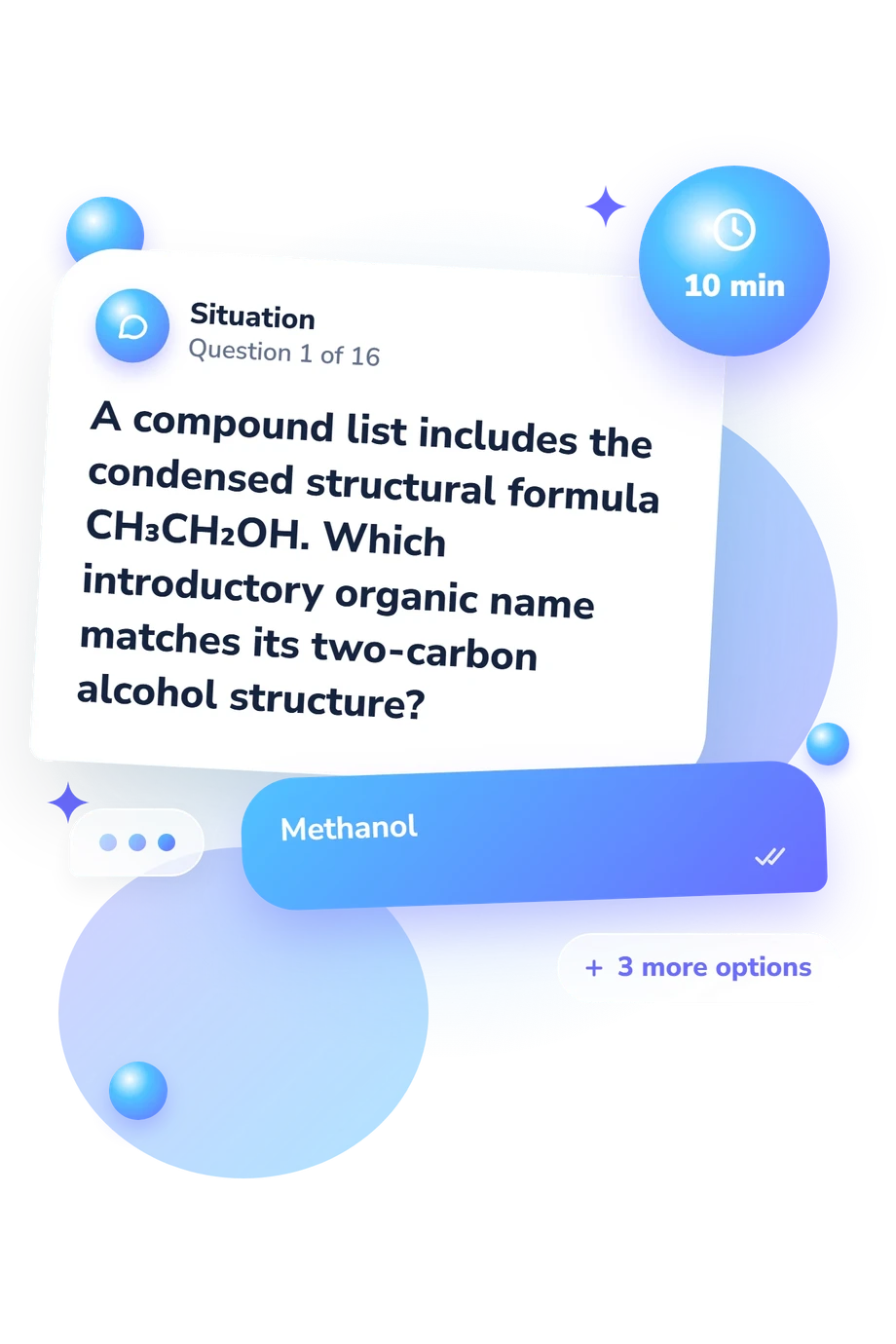
Example Questions From the Test
- CaNO₂ — one calcium with one nitrite
- Ca(NO₃)₂ — one calcium with two nitrates
- Ca(NO₂)₂ — one calcium with two nitrites
- Ca₂NO₃ — two calciums with one nitrate
- NO₅ — one nitrogen atom and five oxygen atoms
- N₂O₅ — two nitrogen atoms and five oxygen atoms
- N₅O₂ — five nitrogen atoms and two oxygen atoms
- N₂O₄ — two nitrogen atoms and four oxygen atoms
- Magnesium hydroxide
- Magnesium hydrogen oxide
- Magnesium oxide
- Magnesium(II) hydride
Nomenclature Quiz - Description and methodology of the test
Students, instructors, and independent learners who want to check their command of chemical naming can use this nomenclature quiz as a focused self-check. It is suitable for revision before coursework, laboratory work, or a chemistry lesson. As a nomenclature practice quiz, it shows which naming conventions and formula-writing decisions feel secure and which deserve another pass.
What This Assessment Explores
The questions examine connected parts of chemical nomenclature, asking the learner to move between a formula and its correct name rather than rely on labels alone. This chemical naming practice samples ionic, molecular, acid, hydrate, and introductory organic conventions.
The main topic groups are:
- Ionic compounds require charge balancing, polyatomic-ion recognition, and Roman numerals for variable-charge metals.
- Molecular compounds use numerical prefixes and formula-to-name conversions, including contractions such as tetroxide.
- Acids and oxyacids depend on anion patterns and aqueous-state notation.
- Hydrates and introductory organic compounds involve waters of crystallization and familiar carbon-chain names.
The result appears as Chemical Nomenclature Knowledge, 0-16: Foundations to build (0-6) signals review needs; Developing command (7-12) reflects many usable rules with gaps; Strong command (13-16) indicates accurate application across most sampled topics. It is an educational snapshot of these conventions.
Methodology and Scientific Basis
Each item uses a short prompt with four answer choices. Some ask for a name from a formula; others select a balanced formula. Distractors alter one feature, such as an ion, charge, prefix, suffix, or state, so careful reading matters. The format checks applied recognition across compound types.
The scoring is presented as one overall total rather than separate subscores. Its bands describe performance on the conventions sampled here, not every aspect of chemical nomenclature. The questionnaire does not state item weights, norms, reliability estimates, or a standardized validation procedure, so the total is a learning indicator rather than a credential.
The educational focus is conceptually consistent with Bodé, Caron and Flynn (2016), while the naming rules align with OpenStax Chemistry 2e and IUPAC recommendations for inorganic and organic nomenclature. This questionnaire is not presented as an adaptation of that study or instructional platform. The value of this naming compounds online quiz depends on honest answers and attention to charge balance, although revision, notation familiarity, and guessing can affect performance. Use the score to guide targeted study rather than claim certification.
- Bodé, Nicholas E., Jeanette Caron, and Alison B. Flynn. “Evaluating students’ learning gains and experiences from using.” Chemistry Education Research and Practice 17, no. 4 (2016): 1156-1173. 10.1039/C6RP00132G
- Flowers, Paul, Klaus Theopold, Richard Langley, and William R. Robinson. Chemistry 2e. OpenStax, 2019. Section 2.7: “Chemical Nomenclature.”
- Connelly, Neil G., Ture Damhus, Richard M. Hartshorn, and Alan T. Hutton, eds. Nomenclature of Inorganic Chemistry: IUPAC Recommendations 2005. Royal Society of Chemistry, 2005.
- Favre, Henri A., and Warren H. Powell, eds. Nomenclature of Organic Chemistry: IUPAC Recommendations and Preferred Names 2013. Royal Society of Chemistry, 2013. 10.1039/9781849733069
Updated: