
Should I Get a Cat Quiz
How the Scales are Structured
Who Usually Takes This Test?
See How You Compare
Below is a preview of how scores are typically distributed across each scale.
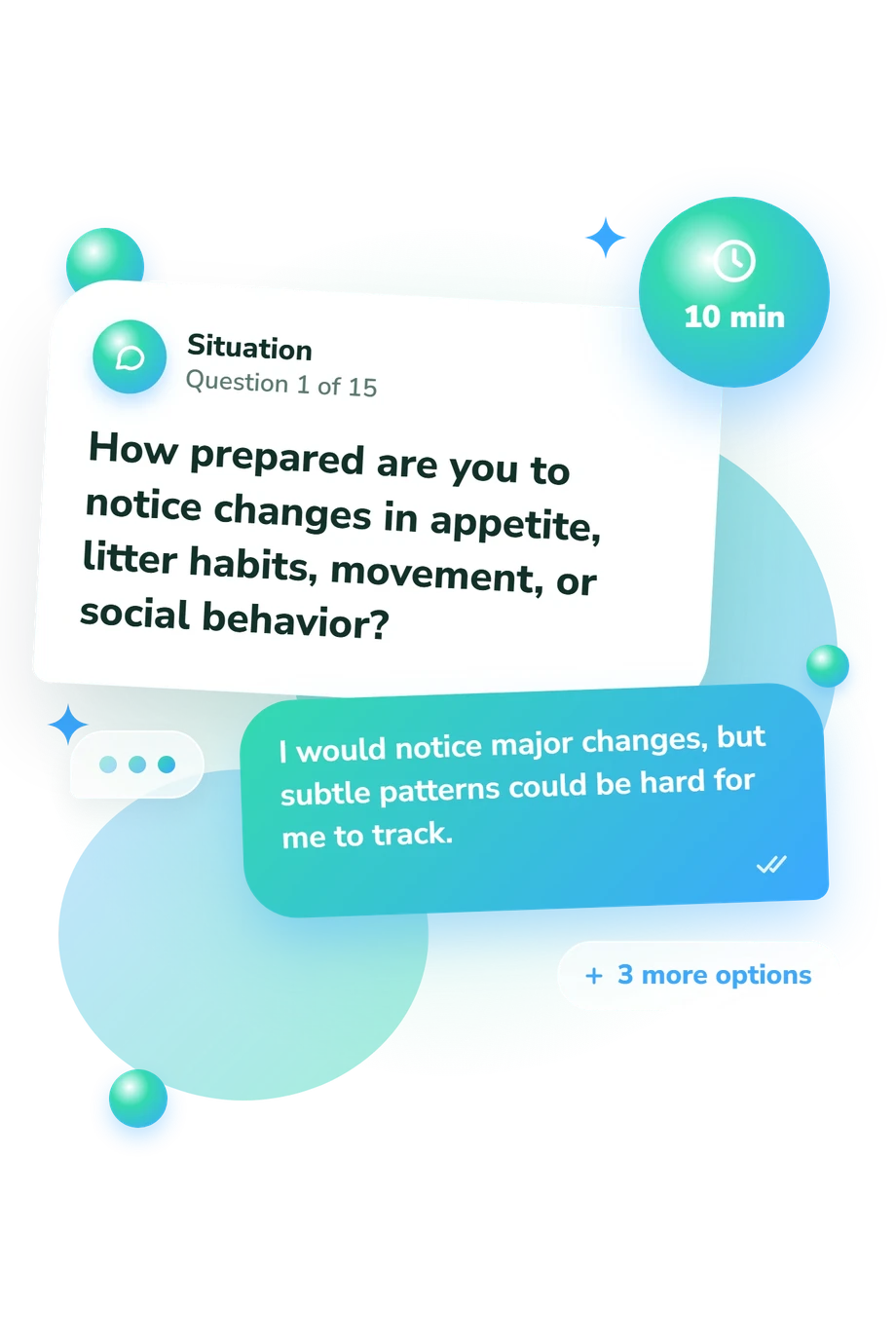
Example Questions From the Test
- I would notice major changes, but subtle patterns could be hard for me to track.
- I could observe the cat daily and keep simple notes when something changed.
- My current schedule would make regular observation difficult.
- I would usually notice changes through daily routines, though I might need reminders during busy periods.
- Try different post materials and locations, protect the sofa, and reinforce use of suitable surfaces.
- Move the existing post and use a furniture cover before deciding whether more changes are needed.
- Keep the cat away from that room because I have little flexibility to change the setup.
- I would need a pet that could reliably avoid scratching household items from the start.
- Everyone affected agrees, and responsibilities, boundaries, and allergy considerations have been discussed.
- People are generally supportive, but responsibilities or house rules still need clarification.
- There is mixed enthusiasm or an unresolved concern that could affect the cat’s home life.
- Agreement, allergies, or household safety has not yet been discussed.
Should I Get a Cat Quiz - Description and methodology of the test
People considering adoption can use this assessment to examine whether their expectations, routines, household arrangements, and resources fit the realities of living with a cat. The Should I Get a Cat Quiz gives a prospective adopter a practical picture before choosing an individual animal. It also gives an am i ready for a cat quiz a concrete structure, turning uncertainty into areas to review.
What This Assessment Explores
It examines flexibility, care reliability, and practical readiness rather than assuming every cat will match your hopes. Scenarios cover observation, scratching, play, hiding, affection, household agreement, housing, costs, veterinary contingencies, and backup care.
These themes are organized into three result dimensions:
- Cat-Fit Expectations (0-15) reflects fit with personality, adjustment, behavior, and long-term needs: Expectations need review (0-5), Some flexibility (6-10), or Realistic and adaptable (11-15).
- Daily Care Capacity (0-15) reflects reliability for feeding, litter, enrichment, observation, and absences: Pause and plan (0-5), Partial capacity (6-10), or Consistent capacity (11-15).
- Home and Financial Preparation (0-15) reflects housing, agreement, setup, budget, and contingencies: Foundations unresolved (0-5), Preparation in progress (6-10), or Strong foundation (11-15).
The assessment handles the should i get a cat or kitten quiz decision through compatibility, not appearance or age alone.
Methodology and Scientific Basis
Each item presents a concrete ownership situation with four response options describing different levels of preparation, flexibility, or support. This is a scenario-based self-report format.
Responses are combined into three displayed dimensions. The questionnaire publishes neither a point-by-point key nor population norms, so its bands organize reflection rather than establish universal cutoffs. A should i adopt a cat quiz reading is most useful when it leads to a specific plan.
Patronek et al. (1996) offers the closest conceptual link to relinquishment-related household and expectation factors. The questionnaire is conceptually consistent with the modified Feline-Ality assessment discussed by Weiss et al. (2015), owner-satisfaction findings from Onodera et al. (2014), and return-related factors examined by Hawes et al. (2020). It is not an adaptation of those studies; they support themes, not individual prediction.
The profile addresses the is a cat right for me quiz question with a current readiness picture. Self-report reflects present circumstances and self-awareness, while an individual cat may behave differently during adjustment, so the score cannot guarantee a particular match.
- Gary J. Patronek, Lawrence T. Glickman, Alan M. Beck, George P. McCabe, and Carol Ecker. Risk factors for relinquishment of cats to an animal shelter. Journal of the American Veterinary Medical Association. 1996;209(3):582-588. 10.2460/javma.1996.209.03.582
- Emily Weiss, Shannon Gramann, Natasha Drain, Emily Dolan, and Margaret Slater. Modification of the Feline-Ality™ Assessment and the Ability to Predict Adopted Cats’ Behaviors in Their New Homes. Animals. 2015;5(1):71-88. 10.3390/ani5010071
- Nodoka Onodera, Keiko Uchida, and Yoshie Kakuma. Association between Characteristics of Cats and Satisfaction of Owners who Adopted Cats from an Animal Hospital in Japan. Journal of Veterinary Medical Science. 2014;76(5):729-733. 10.1292/jvms.12-0569
- Sloane M. Hawes, Josephine M. Kerrigan, Tess Hupe, and Kevin N. Morris. Factors Informing the Return of Adopted Dogs and Cats to an Animal Shelter. Animals. 2020;10(9):1573. 10.3390/ani10091573
Updated: