
5th Grade Science Quiz
How the Scales are Structured
Who Usually Takes This Test?
See How You Compare
Below is a preview of how scores are typically distributed across each scale.
Example Questions From the Test
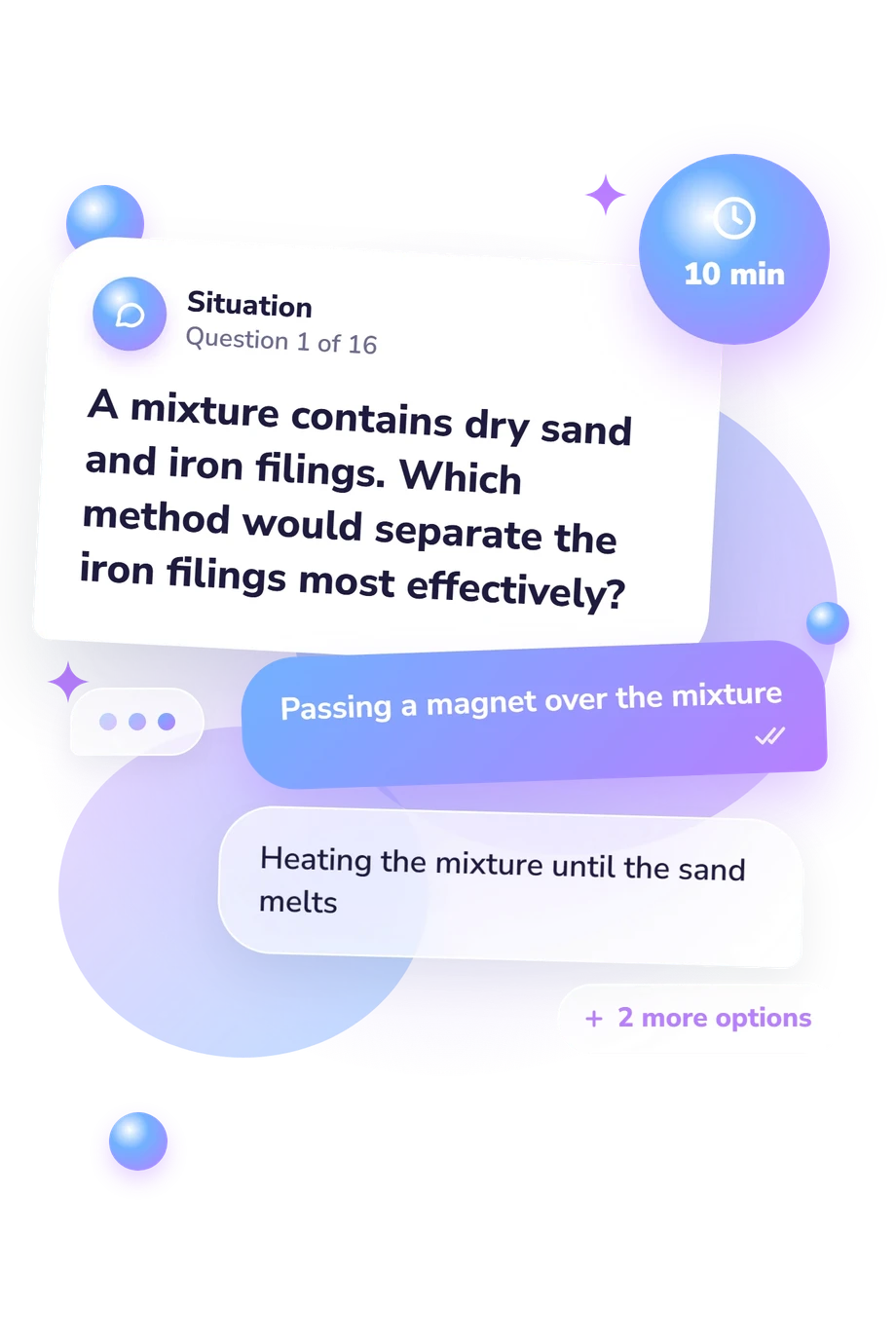
- Passing a magnet over the mixture
- Heating the mixture until the sand melts
- Adding water so the iron dissolves
- Pouring the mixture through a paper filter
- Carbon dioxide from the air
- Minerals absorbed from soil
- Sunlight absorbed by leaves
- Water stored in the roots
- Deposition, because rock is being formed
- Erosion, because sediment is being moved
- Weathering, because soil is breaking into smaller pieces
- Evaporation, because rainwater is disappearing
5th Grade Science Quiz - Description and methodology of the test
Designed for learners who want to check their grasp of elementary science, this 5th grade science quiz measures fifth-grade science knowledge through recall, application, and explanation. It suits learners reviewing core ideas, parents supporting practice, and educators discussing progress. As a science quiz for 5th graders, it goes beyond memorized definitions.
What This Assessment Explores
Questions sample conceptual knowledge through recall and application: learners identify processes, link causes and effects, apply vocabulary, and select explanations for observations. As a science quiz for grade 5, its choices apply those ideas to situations such as predicting shadow changes or identifying ecosystem processes.
One educational scale, 5th Grade Science Knowledge (0-16), reports the result. Its bands are Emerging Foundation (0-6), Developing Knowledge (7-12), and Strong Knowledge (13-16). They describe sampled-concept performance, not grade placement or school performance.
Questions group into five content areas:
- Matter and materials cover mixtures, dissolving, mass, and conduction.
- Life science examines decomposers, inherited traits, food webs, and population changes.
- Physical science covers sound, shadows, forces, circuits, and energy.
- Earth and space science addresses erosion, condensation, planetary motion, and lunar phases.
- Scientific reasoning shows how learners apply knowledge when choosing a method or explanation from observations.
Methodology and Scientific Basis
Each item uses four-option multiple choice. The learner selects the response that best explains a stated situation, such as an open circuit, a changing shadow, or sediment movement. This is an achievement-style knowledge check using applied recall and reasoning rather than open-ended performance.
The displayed result is a total performance score. The bands describe performance on the sampled concepts and do not indicate grade placement or school performance. Because each item targets a specific concept, the overall result can suggest which topics deserve further review.
Sener and Tas (2017) report a fifth-grade biology achievement-test study that provides contextual support for classroom-style items, but it does not validate or establish this questionnaire's scoring. National Research Council standards and assessment guidance support emphasis on disciplinary ideas, phenomena, application, and evidence-based reasoning. This questionnaire is conceptually consistent with these works, not a reproduction of their instruments.
Self-administered responses can reflect guessing, attention, reading confidence, and recent study. A fifth grade science quiz is therefore most useful as a focused snapshot that guides review or discussion.
- Sener, Nilay, and Erol Tas. (2017). Developing Achievement Test: A Research for Assessment of 5th Grade Biology Subject. Journal of Education and Learning, 6(2), 254-271. 10.5539/jel.v6n2p254.
- National Research Council. (2013). Next Generation Science Standards: For States, By States. Washington, DC: The National Academies Press. 10.17226/18290.
- National Research Council. (2014). Developing Assessments for the Next Generation Science Standards. Washington, DC: The National Academies Press. 10.17226/18409.
Updated: