
5.4 Comprehension Quiz
How the Scales are Structured
Who Usually Takes This Test?
See How You Compare
Below is a preview of how scores are typically distributed across each scale.
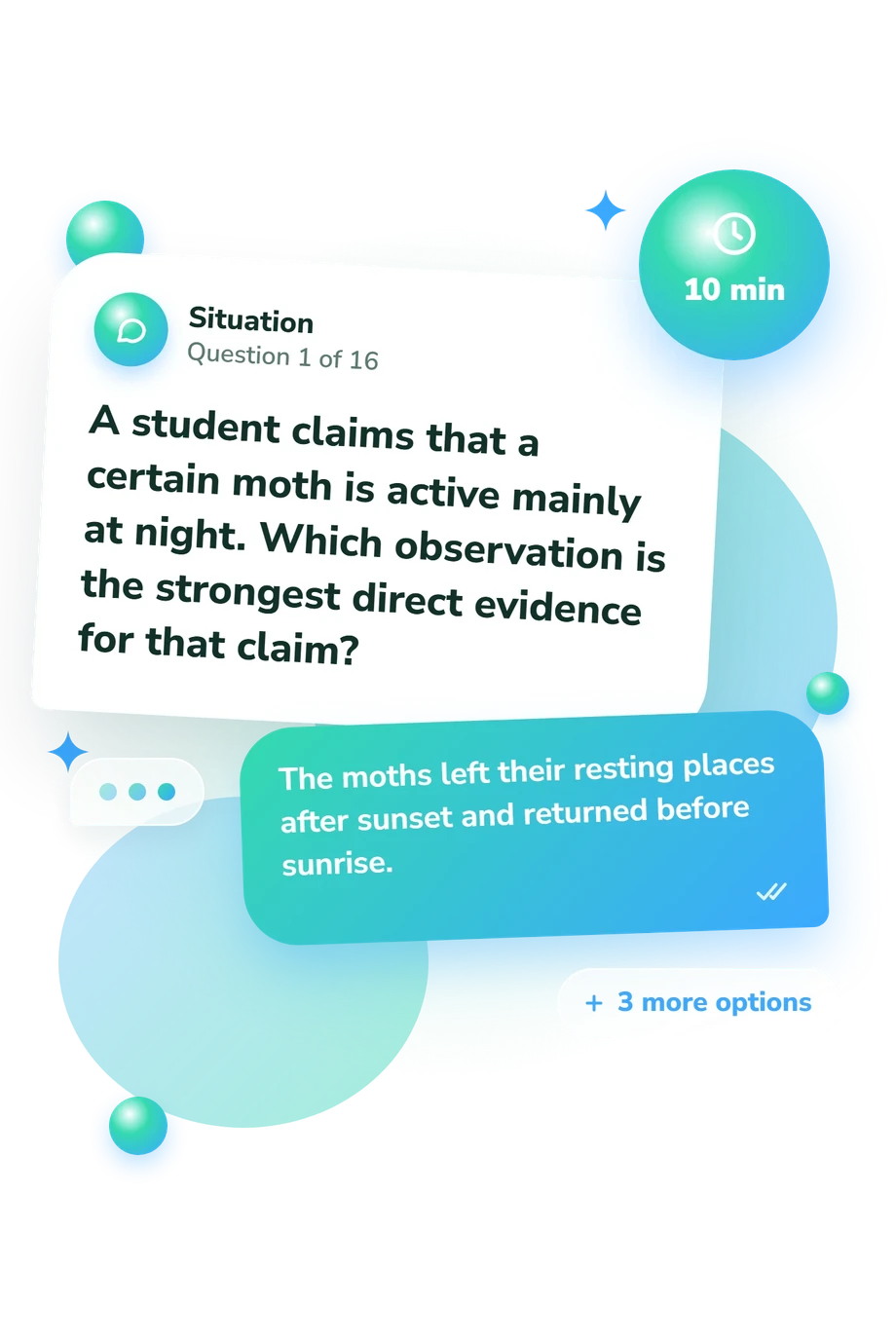
Example Questions From the Test
- The student survey proved that every student wanted longer hours.
- The library gained 18 percent more books during that month.
- The later closing time was associated with increased weekday visits.
- Longer hours were the only possible cause of increased visits.
- The new playground is the most exciting place in town.
- Everyone prefers the blue playground design.
- The town council approved the playground plan on March 12.
- The council made a wonderful decision about the playground.
- The fog made the harbor warmer than a blanket would.
- Someone dropped bedding into the harbor.
- The fog formed a thick layer covering the harbor.
- Sailors used fabric to hide the harbor at dawn.
5.4 Comprehension Quiz - Description and methodology of the test
Readers, students, and educators can use the 5.4 Comprehension Quiz to examine how they connect evidence, language, and ideas across short passages and practical tasks. It suits anyone seeking a comprehension skills test that shows where understanding is secure and where closer attention may help. The result describes performance on this item set, not overall intelligence or mastery of a particular curriculum.
What This Assessment Explores
These items examine how readers turn short texts into understanding. Sources, notices, instructions, routes, and narratives require more than recall: respondents must connect details, judge evidence, interpret language, and infer meaning. The 5.4 comprehension test suits anyone reviewing practical reading skills; its result describes performance on these comprehension items, not overall intelligence or mastery of a particular curriculum.
The main themes are:
- Main ideas show whether the central message is identified.
- Evidence shows whether conclusions use the strongest stated detail.
- Context shows whether words, references, and figurative phrases fit surrounding information.
- Structure and inference show whether sequence, causes, solutions, and implications are recognized.
One scale is reported: 5.4 Comprehension Knowledge (0-16). Foundations to Build (0-6) calls for revisiting core strategies; Developing Comprehension (7-12) reflects partial consistency; Strong Comprehension (13-16) reflects consistent use of ideas, details, and evidence across text types.
Methodology and Evidence Base
Each item presents a short passage, notice, instruction, data display, or paired source with four answer choices. The respondent selects the option best supported by the wording and evidence. The catalogue reports one overall result from the item set, providing a descriptive summary of performance on these self-contained comprehension items through the displayed bands.
The assessment is conceptually consistent with Cain and Oakhill (2006), who emphasize measuring distinct comprehension processes rather than treating reading as one undifferentiated ability. The questionnaire is also conceptually consistent with the RAND Reading Study Group’s view of meaning-making as an interaction among reader, text, and activity, and with the National Assessment Governing Board framework’s focus on locating information, developing interpretations, and applying ideas. It is not a direct administration of those published frameworks.
As a reading comprehension quiz, its bands interpret performance on this item set and can help identify which processes may benefit from practice. Attention, vocabulary, topic familiarity, and care with each choice can affect performance, making this a snapshot of responses rather than a complete profile of reading ability.
- Cain, Kate, and Jane Oakhill. (2006). Assessment matters: Issues in the measurement of reading comprehension. British Journal of Educational Psychology, 76(4), 697-708. 10.1348/000709905X69807
- National Assessment Governing Board. (2008). Reading Framework for the 2009 National Assessment of Educational Progress. U.S. Department of Education, Washington, DC.
- RAND Reading Study Group. (2002). Reading for Understanding: Toward an R&D Program in Reading Comprehension. RAND Corporation, Santa Monica, CA.
Updated: