
Little Space Quiz
How the Scales are Structured
Who Usually Takes This Test?
See How You Compare
Below is a preview of how scores are typically distributed across each scale.
Example Questions From the Test
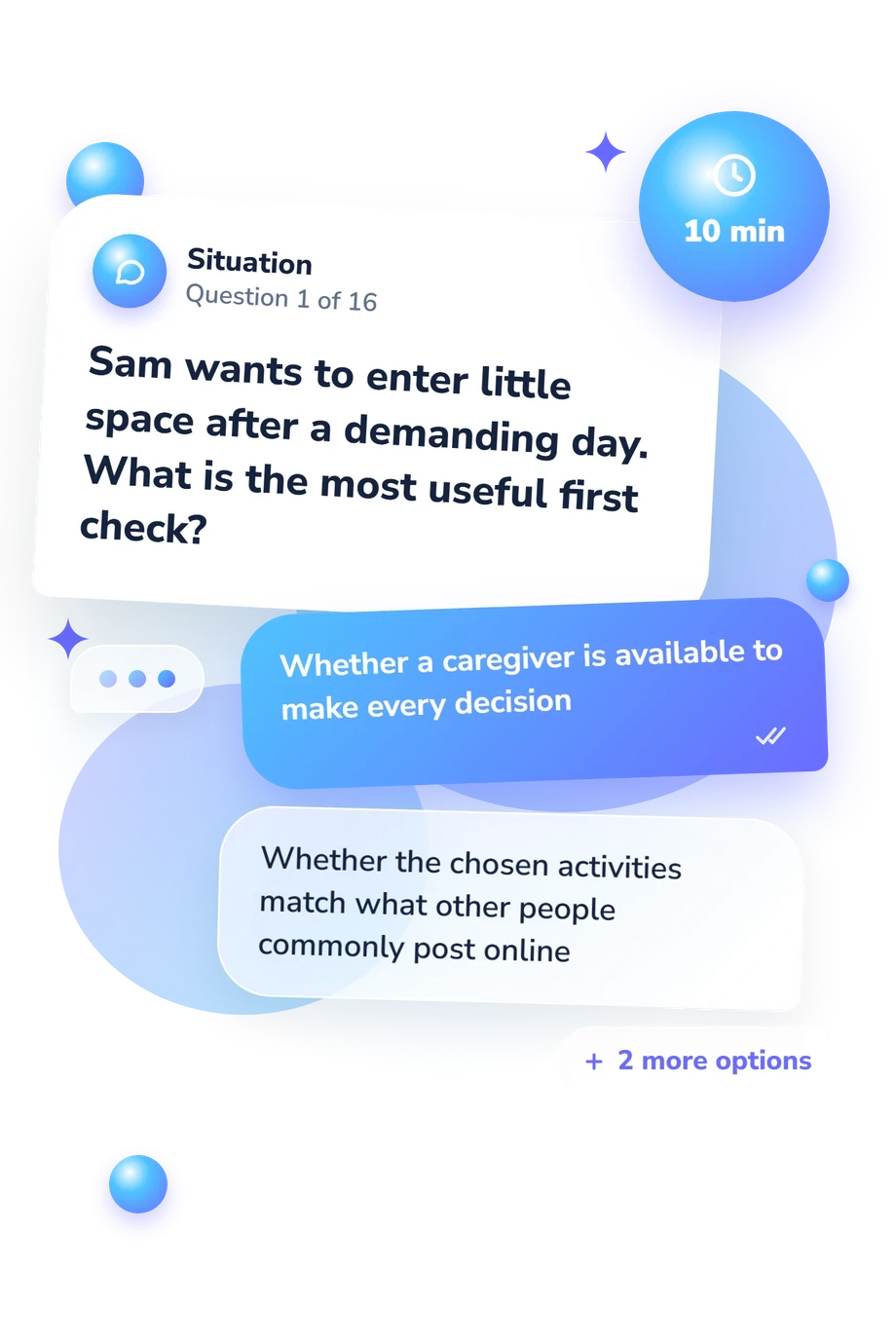
- Whether a caregiver is available to make every decision
- Whether the chosen activities match what other people commonly post online
- Whether the setting is physically secure and important responsibilities, such as driving or childcare, are already handled
- Whether Sam can remain in the headspace for a planned minimum time
- Ask them to explain the cause before offering any support
- Stay calm, reduce pressure, ask simple questions about what they need, and respect their choices
- Immediately tell them which psychological condition is responsible
- Assume a parental role and make decisions without checking
- It does not by itself establish a mental health diagnosis, trauma history, or specific cause
- It establishes that the person cannot manage adult responsibilities
- It proves the person is intentionally role-playing
- It confirms that professional treatment is required
Little Space Quiz - Description and methodology of the test
For adults who want a clearer, safer understanding of younger-feeling states, the little space quiz offers an educational way to examine common concepts and practical decisions. Its result can highlight concepts to revisit before a respectful conversation or supportive role. The little age quiz also addresses age-related concepts within little space, while emphasizing what a person understands about consent, boundaries, and care.
What This Assessment Explores
Little space can describe a younger-feeling state that varies by person and context. The questions distinguish it from age play, assumptions about trauma or diagnosis, and any belief that feeling younger removes adult responsibility. Readers may be exploring personal experiences or learning to support someone. This little quiz emphasizes practical understanding rather than a label.
The result brings together these item themes:
- Little Space Knowledge runs from 0-16: “Foundations to build” is 0-6, “Developing understanding” is 7-12, and “Strong understanding” is 13-16; these are educational summaries, not measures of identity, wellbeing, or diagnosis.
- Consent and autonomy are item themes; questions test understanding that boundaries can be discussed, changed, or withdrawn.
- Safety and grounding address hazards, digital boundaries, orientation, and urgent support.
- Support and terminology address communication, cues, nonsexual possibilities, and age regression versus age play.
Methodology and Scientific Basis
Each item presents a short situation or statement with four response options. Choices ask for the safest, most respectful, or most accurate conclusion, drawing on autonomy, communication, privacy, grounding, and adult responsibility. The result combines answers into one knowledge score rather than a multi-trait profile.
The questionnaire is conceptually consistent with Bauer (2023), which examines little space, vulnerability, discipline, and adultist assumptions, and with Tiidenberg and Paasonen (2019), who discuss littles through affect, aesthetics, and sexual age-play. Bauer (2021) supplies a consent framework for negotiation, ongoing choice, and boundaries in BDSM contexts. These references do not establish the questionnaire’s validity, norms, or standardization; it is not an adaptation or standardized version of them.
The age-related focus makes it a little space age quiz that can clarify terminology and practical principles, while its score remains an educational summary of selected answers. The bands are unvalidated educational summaries, not clinical cutoffs. Self-report can shift with prior reading, wording interpretation, current emotions, or uncertainty about another person’s situation. It does not establish a diagnosis or universal meaning for little space; distress, impaired functioning, or immediate danger calls for human support rather than score-based conclusions.
- Bauer, Robin. “Perverting Innocence in Age Play? Using Little Space to Explore Vulnerability, Innocence, and Discipline in Adultist Society.” In The Power of BDSM: Play, Communities, and Consent in the 21st Century, edited by Brandy L. Simula, Robin Bauer, and Liam Wignall, 94-114. Oxford University Press, 2023. 10.1093/oso/9780197658598.003.0006
- Tiidenberg, Katrin, and Susanna Paasonen. “Littles: Affects and Aesthetics in Sexual Age-Play.” Sexuality & Culture 23, no. 2 (2019): 375-393. 10.1007/s12119-018-09580-5
- Bauer, Robin. “Queering Consent: Negotiating Critical Consent in Les-bi-trans-queer BDSM Contexts.” Sexualities 24, nos. 5-6 (2021): 767-783. 10.1177/1363460720973902
Updated: