
Is My Boyfriend Going to Propose Quiz
How the Scales are Structured
Who Usually Takes This Test?
See How You Compare
Below is a preview of how scores are typically distributed across each scale.
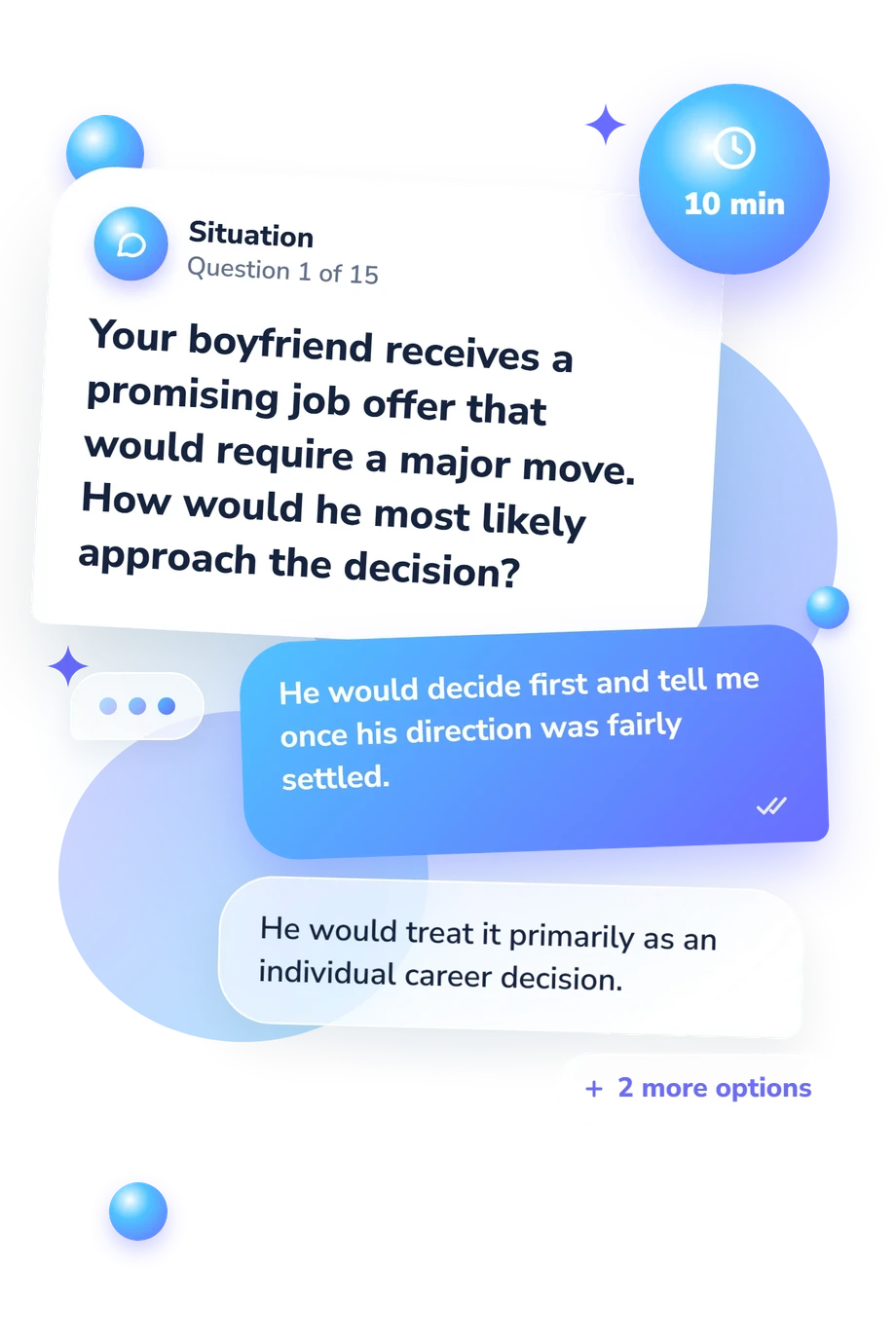
Example Questions From the Test
- His contact with them has increased, but for reasons that appear unrelated to engagement.
- A trusted person has indicated that he recently sought specific proposal or ring guidance.
- I have noticed no marriage-related contact or questions.
- He has asked people close to me about my values, traditions, or broad preferences.
- He would decide first and tell me once his direction was fairly settled.
- He would treat it primarily as an individual career decision.
- He would ask for my thoughts and consider how the move could affect us.
- We would jointly weigh locations, timelines, and effects on our shared plans.
- We have seen only brief snapshots, so daily compatibility is still largely unknown.
- We understand some routines but have not addressed many practical trade-offs.
- We have worked through recurring matters such as chores, privacy, schedules, or expenses.
- We have tested or established routines and made concrete plans for managing a home together.
Is My Boyfriend Going to Propose Quiz - Description and methodology of the test
People considering whether a relationship is moving toward marriage can use the Is My Boyfriend Going to Propose Quiz to organize observable information without treating uncertainty as proof. It is intended for partners who want a clearer picture of shared expectations, proposal-related signals, and practical preparation. Readers wondering when they might get engaged can use a when will i get engaged quiz to explore relationship context rather than predict an exact date.
What This Assessment Explores
Three themes connect the questions. They cover marriage discussions, proposal-related observations, and practical coordination for a shared future. Rather than serving as an is he going to propose quiz, it focuses on observable relationship evidence, not his private intentions.
The result uses three scales:
- Marriage Expectations: 0-15. This measures how clearly you have discussed marriage, timing, and preferred form. Bands are Mostly Unspoken (0-5), Emerging Alignment (6-10), and Clearly Aligned (11-15).
- Proposal Momentum: 0-15. This measures reported proposal-specific activity while allowing ordinary explanations for some clues. Bands are Few Concrete Signals (0-5), Possible Momentum (6-10), and Strong Visible Momentum (11-15).
- Shared Practical Readiness: 0-15. This measures concrete coordination around daily life, money, commitments, and future plans. Bands are Separate Foundations (0-5), Foundations in Progress (6-10), and Strong Shared Foundation (11-15).
Together, the scales distinguish conversation, visible signals, and shared preparation.
Methodology and Scientific Basis
Each item presents a relationship situation with options from limited evidence to explicit discussion or coordinated action. You select what matches what you have observed; the format discourages private investigation or guesses about hidden intentions. Answers form three 0-15 scales, not a universal probability or timetable.
Its conceptual comparison point is Marital Scales (Park and Rosén, 2013), addressing intentions, attitudes, and marital relationships. The questions are conceptually consistent with that work and with themes in PREPARE and commitment research by Fowers and Olson and by Stanley and Markman. This online questionnaire has its own three-scale format rather than reproducing those instruments, so their findings do not transfer directly to these scores.
Framing this assessment as a when will he propose quiz can make clues seem conclusive. The result organizes reported evidence rather than decoding intentions. Whether you wonder when your boyfriend might propose or use a when will my boyfriend propose quiz for context, interpret the result as a snapshot of communication and preparation, not a timing prediction. Current circumstances, attention, memory, and self-report honesty can shape the outcome, so direct, pressure-free conversation remains more reliable.
- Park, Stacey S., and Lee A. Rosén. "The Marital Scales: Measurement of Intent, Attitudes, and Aspects Regarding Marital Relationships." Journal of Divorce & Remarriage 54, no. 4 (2013): 295-312. 10.1080/10502556.2013.780491
- Fowers, Blaine J., and David H. Olson. "Predicting Marital Success with PREPARE: A Predictive Validity Study." Journal of Marital and Family Therapy 12, no. 4 (1986): 403-413. 10.1111/j.1752-0606.1986.tb00673.x
- Stanley, Scott M., and Howard J. Markman. "Assessing Commitment in Personal Relationships." Journal of Marriage and the Family 54, no. 3 (1992): 595-608. 10.2307/353245
Updated: