
What Is Wrong with My Stomach Quiz
How the Scales are Structured
Who Usually Takes This Test?
See How You Compare
Below is a preview of how scores are typically distributed across each scale.
Example Questions From the Test
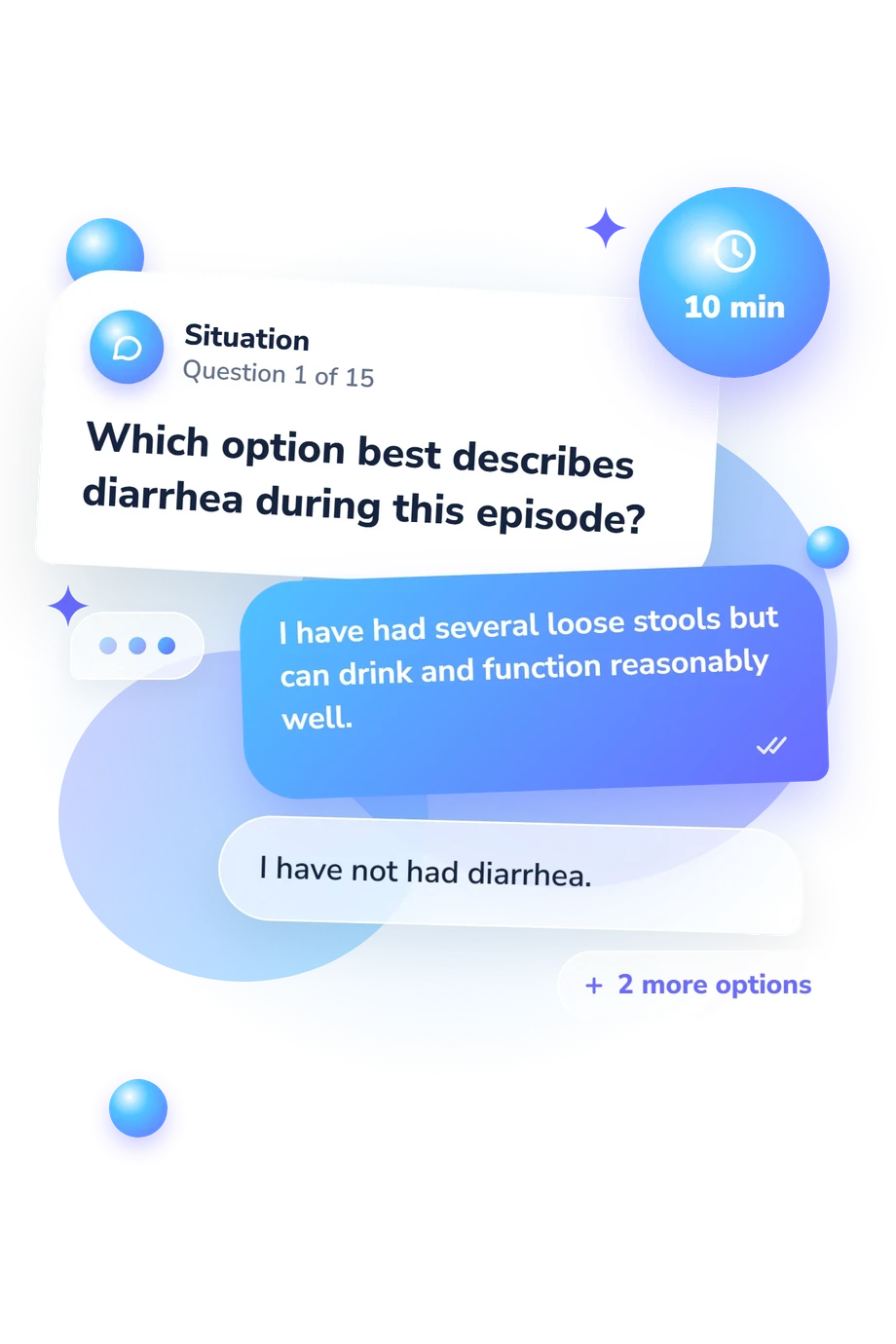
- I have had several loose stools but can drink and function reasonably well.
- I have not had diarrhea.
- I have had one or two loose stools without notable weakness.
- Diarrhea is very frequent or relentless and is accompanied by inability to hydrate, faintness, confusion, or marked weakness.
- I can pass stool and gas normally.
- There is a mild change, but I can still pass both.
- Constipation or reduced gas is causing persistent discomfort.
- I cannot pass stool or gas and also have increasing swelling, significant pain, or vomiting.
- I noticed a small, isolated bright-red streak, with no other warning signs.
- I have not seen blood or black, tar-like stool.
- I have vomited blood or coffee-ground-like material, or passed black, tar-like stool or substantial blood.
- I have seen bright-red blood more than once or more than a small streak.
What Is Wrong with My Stomach Quiz - Description and methodology of the test
People wanting a structured first look at digestive symptoms may use this What Is Wrong with My Stomach Quiz to organize concerns before discussing them with a clinician. This stomach issues quiz can sort an active or recurring episode involving pain, bowel changes, vomiting, hydration, or eating. The result highlights persistence, hydration changes, daily impact, and warning signs to help guide what to monitor and when to seek medical guidance.
What This Assessment Explores
The questionnaire organizes experiences around hydration, symptom course, daily impact, and warning signs. Items cover bowel changes, bleeding, pain, swelling, vomiting, fluids, urination, dizziness, recurrence, eating, weight, and daily interference. As a stomach problems quiz, it groups symptoms according to situations that may need attention.
The result contains three summaries:
- Hydration and Digestive Function (0-15) reflects whether vomiting, diarrhea, reduced fluids, urination changes, or blocked bowel function may require support. Bands are No indicators (0), Some indicators (1-2), and Action threshold (3-15).
- Symptom Course and Daily Impact (0-15) summarizes persistence, recurrence, eating changes, and disruption to daily life. Bands are No indicators (0), Some indicators (1-2), and Action threshold (3-15).
- Urgent Warning Signs (0-15) checks symptoms that may warrant timely assessment. Bands are No indicators endorsed (0), Some indicator(s) (1-2), and Action threshold (3-15).
Methodology and Evidence Base
Each item offers four self-report choices covering absent, manageable, persistent, disabling, or urgent experiences. Results present scores, but the questionnaire does not specify how answers contribute to displayed totals; its bands are unvalidated summaries rather than diagnostic or severity cutoffs. A concerning response may matter alone.
The warning-sign emphasis is conceptually consistent with Tans et al. (2024), which examined features linked with serious illness in acute abdominal-pain presentations; this questionnaire is not an adaptation of that review. Its organization is consistent with the GSRS described by Svedlund, Sjödin, and Dotevall, but this is not the GSRS.
Using this what's wrong with my stomach quiz helps organize observations before a clinical conversation. It keeps attention on patterns and changes rather than labels. It is not a what digestive disorder do i have quiz; it cannot identify a digestive disorder but structures information for discussion. Self-report varies with recall and context. Red flags-major bleeding, fainting, breathing difficulty, confusion, inability to keep fluids down, or inability to pass stool or gas with pain or vomiting-warrant prompt medical attention regardless of score.
- Tans A, Struyf T, Geboers R, Smeets T, Asselbergh Y, Declerck E, Bloemen L, van den Bruel A. Signs and symptoms of serious illness in adults with acute abdominal pain presenting to ambulatory care: a systematic review. BJGP Open. 2024;8(3):BJGPO.2023.0245. 10.3399/BJGPO.2023.0245
- Svedlund J, Sjödin I, Dotevall G. GSRS-A clinical rating scale for gastrointestinal symptoms in patients with irritable bowel syndrome and peptic ulcer disease. Digestive Diseases and Sciences. 1988;33(2):129-134. 10.1007/BF01535722
Updated: