
Is My Wife Attracted to Me Quiz
How the Scales are Structured
Who Usually Takes This Test?
See How You Compare
Below is a preview of how scores are typically distributed across each scale.
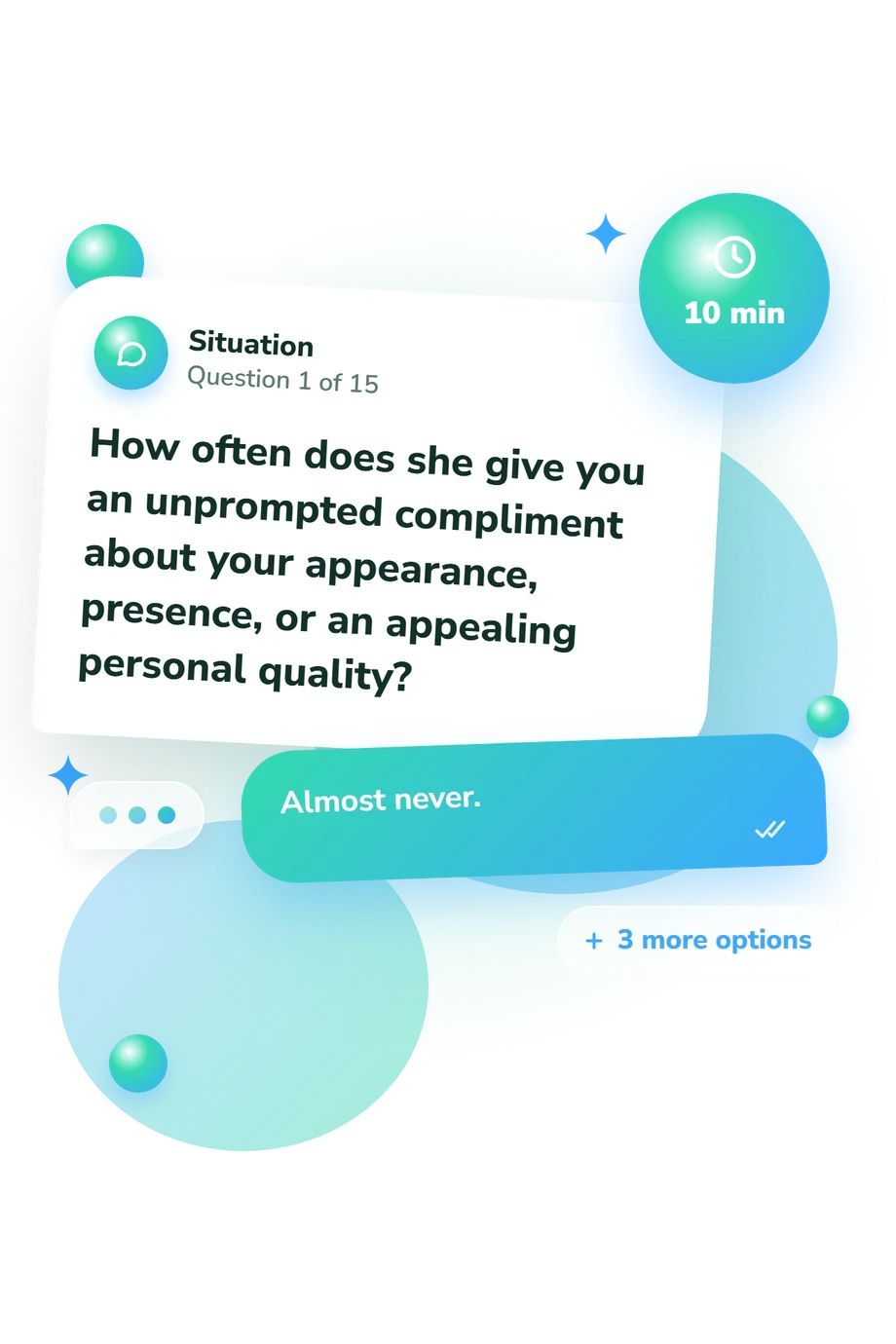
Example Questions From the Test
- Almost never.
- Occasionally, often in response to a specific event or change.
- Fairly regularly, with some compliments that feel personal.
- Frequently, and she often names specific things she finds appealing.
- She usually declines or redirects the interaction.
- She accepts briefly but rarely adds to the moment.
- She often reciprocates and appears comfortable staying close.
- She warmly reciprocates and frequently extends or later reinitiates the affection.
- Almost never; initiation generally comes from me.
- Occasionally, usually after I have already created the moment.
- Sometimes, including moments she begins herself.
- Regularly; she often creates or initiates affectionate moments.
Is My Wife Attracted to Me Quiz - Description and methodology of the test
People wondering whether their wife still feels love or attraction can use this assessment to review observable relationship patterns. The Is My Wife Attracted to Me Quiz is intended for people reflecting on affection, admiration, and romantic initiative within a marriage. Results identify observations for discussion and must be interpreted with context, consent, and her perspective in mind.
What This Assessment Explores
These questions focus on relationship situations that can be observed. They cover warmth, appreciation, affectionate responses, romantic playfulness, and recent initiation of mutually welcome closeness. This assessment organizes observations related to affection, admiration, and romantic interest without claiming to measure love itself.
The three displayed dimensions are:
- Everyday Fondness and Attention (0-15) reflects emotional attention and enjoyment of connection: Limited signals (0-5), Mixed signals (6-10), or Frequent signals (11-15).
- Expressed Attraction and Admiration (0-15) reflects communicated appreciation or attraction: Seldom expressed (0-5), Occasionally expressed (6-10), or Clearly expressed (11-15).
- Romantic and Physical Initiative (0-15) reflects recent consensual romantic or physical interest expressed through initiation, reciprocation, or extending closeness: Limited initiative (0-5), Situational initiative (6-10), or Frequent initiative (11-15).
Together, the scales describe observable signals, not internal feelings, and give partners situations to explore.
Methodology and Scientific Basis
Each item presents a concrete relationship situation with four ordered choices, moving from rare or unclear signals toward more frequent, specific, or reciprocal responses. Topics include compliments, affection, initiation, flirtation, private closeness, stress, shared time, and attention.
Initiative may also vary with stress, health, medication, pain, privacy, relationship tension, and differing desire styles.
Results are summarized by dimension, not as a single yes-or-no answer. The assessment gives ranges and descriptive bands, but does not state how many points each response contributes, so no scoring formula should be inferred. The bands are reflective descriptions, not clinical norms.
Conceptually, the questionnaire is consistent with Birnbaum et al. (2016), which links partner responsiveness with intimacy and sexual desire. van Lankveld et al. (2021) connect closeness, responsiveness, attachment-linked needs, and desire, while Gordon et al. (2012) relate gratitude and appreciation to relationship maintenance. These sources provide context; this questionnaire is not presented as an adaptation or standardized reproduction of them.
People asking whether observations suggest affection or attraction should remember that self-report is shaped by memory, stress, expectations, and candor; respectful conversation adds context.
- Birnbaum, G. E., Reis, H. T., Mizrahi, M., Kanat-Maymon, Y., Sass, O., & Granovski-Milner, C. (2016). Intimately connected: The importance of partner responsiveness for experiencing sexual desire. Journal of Personality and Social Psychology, 111(4), 530-546. 10.1037/pspi0000069
- van Lankveld, J. J. D. M., Dewitte, M., Verboon, P., & van Hooren, S. A. H. (2021). Associations of intimacy, partner responsiveness, and attachment-related emotional needs with sexual desire. Frontiers in Psychology, 12, 665967. 10.3389/fpsyg.2021.665967
- Gordon, A. M., Impett, E. A., Kogan, A., Oveis, C., & Keltner, D. (2012). To have and to hold: Gratitude promotes relationship maintenance in intimate bonds. Journal of Personality and Social Psychology, 103(2), 257-274. 10.1037/a0028723
Updated: