
Human Resources Quiz
How the Scales are Structured
Who Usually Takes This Test?
See How You Compare
Below is a preview of how scores are typically distributed across each scale.
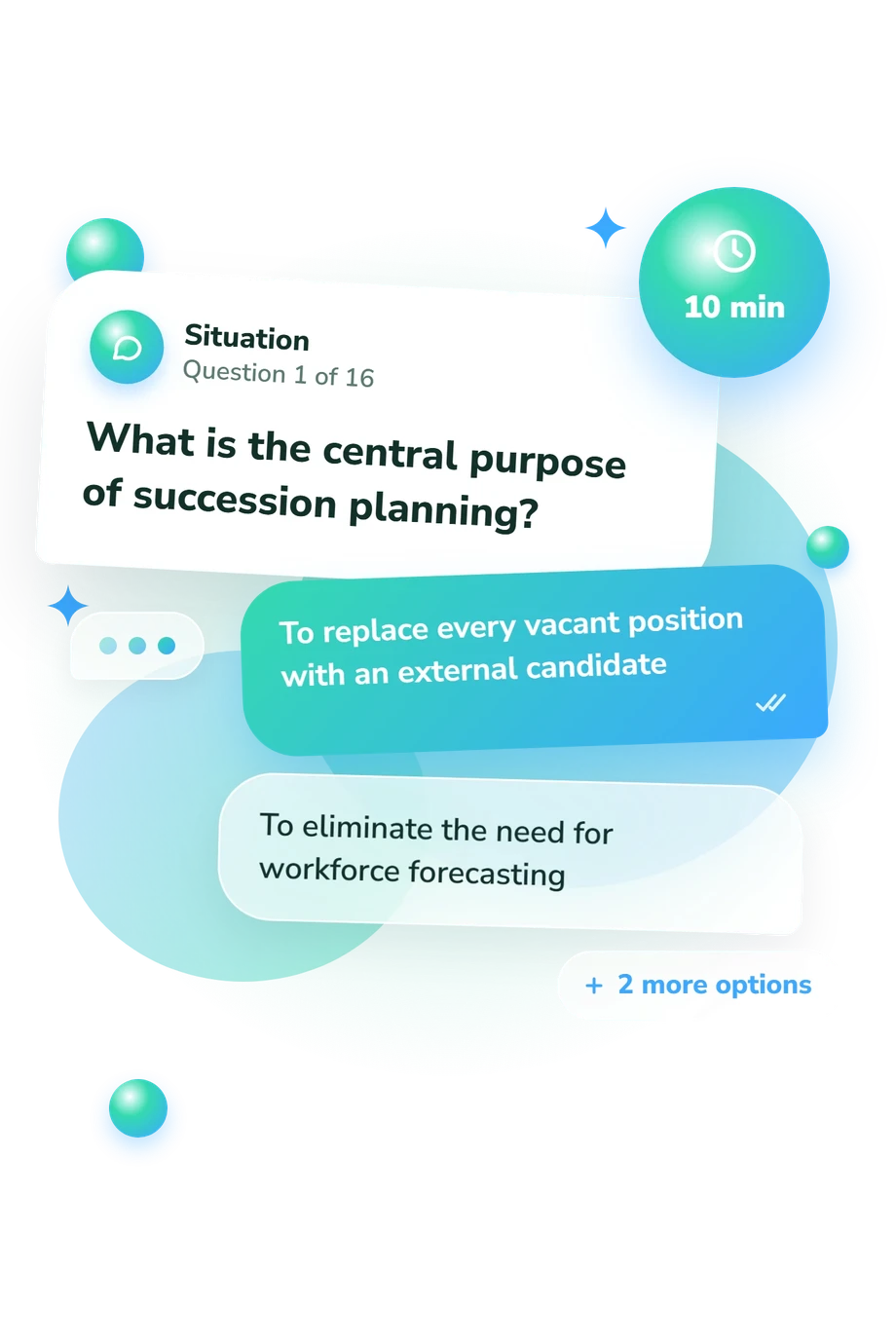
Example Questions From the Test
- To replace every vacant position with an external candidate
- To eliminate the need for workforce forecasting
- To guarantee promotion dates for selected employees
- To prepare potential talent for roles that may become important or vacant
- Why a former employee accepted another position
- How a supervisor should calculate an employee’s bonus
- Whether a candidate meets a role’s minimum qualifications
- Why a current employee stays and what could improve retention
- Use the same job-related questions and anchored rating criteria
- Let each interviewer focus on whichever topics seem important
- Replace interviews with unstructured reference conversations
- Interview candidates in a different order
Human Resources Quiz - Description and methodology of the test
People entering HR, preparing for broader people-operations responsibilities, or reviewing their professional foundations can use the human resources quiz to see how confidently they handle common workplace decisions. It focuses on practical judgment rather than personal style or workplace wellbeing. As an HR quiz, it offers a compact snapshot of knowledge across staffing, development, measurement, and employee relations.
What This Assessment Explores
The items in this human resources test target practical HR literacy: recognizing sound processes, choosing defensible next steps, and interpreting basic workforce evidence. It suits learners, early-career practitioners, managers who work with HR, and anyone reviewing foundational people-management concepts.
Across the questionnaire, the main thematic groups are:
- Workforce planning and talent development connect forecasting, succession, retention, and employee growth.
- Hiring, onboarding, and learning clarify role requirements, integrate newcomers, and address skill gaps.
- Performance, employee relations, and HR metrics guide feedback, engagement, psychological safety, and evidence-based decisions.
Together, these themes show whether a respondent can connect an HR concept with an appropriate action or interpretation. The Human Resources Knowledge scale runs from 0-16: Foundation to Build (0-6) signals core ideas to strengthen; Developing Knowledge (7-12) reflects solid essentials with room for consistency; Strong Knowledge (13-16) indicates broad command of foundational concepts.
Methodology and Scientific Basis
Each item presents a workplace scenario, definition, or numerical example with four answer choices. Selecting the best option emphasizes recognition and applied judgment rather than a written explanation. The result summarizes performance across the questionnaire; no separate weighting or penalty rule is stated.
Conceptually, its coverage is consistent with the SHRM Assurance of Learning Assessment (2011), which assesses HR knowledge for people entering the field. This questionnaire is not presented as an adaptation or digital reproduction of that assessment. Its competency emphasis also aligns with Ulrich, Brockbank, Yeung, and Lake (1995) and Ulrich, Brockbank, Johnson, and Younger (2007), whose work describes changing HR capabilities and expectations.
Those sources support the relevance of staffing, development, measurement, and workforce decisions, but they do not establish standardization, reliability coefficients, or validity evidence for this online questionnaire. The HR knowledge test is therefore a structured self-check, not a professional credential, and local laws or organizational policies may require different decisions.
The result is best read as a snapshot of current HR knowledge, since performance can vary with current familiarity, attention, and interpretation of wording across staffing, development, measurement, and workforce decisions.
- American Institutes for Research and Society for Human Resource Management. (2011, March 14). American Institutes for Research and the Society for Human Resource Management Create a New Test to Assess the Knowledge of College Graduates Seeking Careers in Human Resources. American Institutes for Research.
- Ulrich, Dave, Wayne Brockbank, Arthur K. Yeung, and Dale G. Lake. (1995). Human resource competencies: An empirical assessment. Human Resource Management, 34(4), 473-495. 10.1002/hrm.3930340402
- Ulrich, Dave, Wayne Brockbank, Dani Johnson, and Jon Younger. (2007). Human resource competencies: Responding to increased expectations. Employment Relations Today, 34(3), 1-12. 10.1002/ert.20159
Updated: