
Geology Quiz
How the Scales are Structured
Who Usually Takes This Test?
See How You Compare
Below is a preview of how scores are typically distributed across each scale.
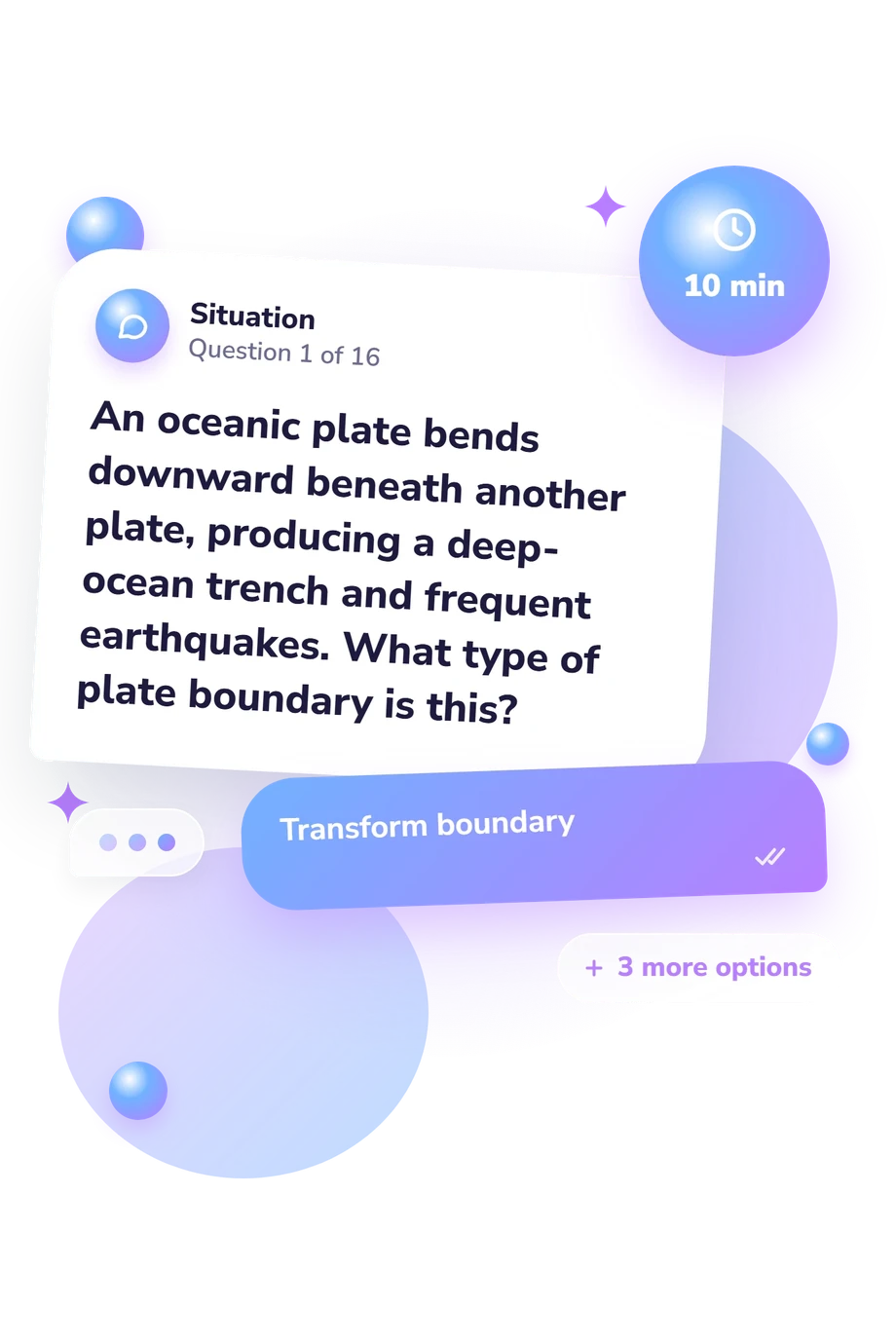
Example Questions From the Test
- Compaction
- Cementation
- Melting
- Crystallization
- Streak
- Cleavage
- Hardness
- Specific gravity
- Deposition by groundwater
- Mechanical weathering by frost wedging
- Chemical weathering by dissolution
- Metamorphism by pressure
Geology Quiz - Description and methodology of the test
Students, teachers, and curious readers can use this assessment to check how confidently they interpret common evidence from Earth science. The geology quiz is intended for anyone who wants to connect foundational concepts with observations before a course, exam, or field activity. It emphasizes reasoning from evidence rather than isolated memorization. This online quiz about geology provides a quick snapshot of current understanding and suggests topics for focused review.
What This Assessment Explores
The assessment covers rocks, minerals, plate tectonics, groundwater, surface processes, seismic evidence, and geologic time. Items test concepts through geology questions and answers in quiz format.
One Geology Knowledge score runs from 0-16. Building Foundations (0-6) marks core ideas to reinforce; Developing Knowledge (7-12) reflects understanding with room to strengthen; Strong Knowledge (13-16) reflects broad command of foundational geology and interpretation of varied evidence.
The main thematic groups are:
- Mineral properties and rock textures show how evidence supports identification.
- Plate boundaries, faults, and earthquakes connect settings with observable effects.
- Groundwater, weathering, and the rock cycle explain changes in Earth materials.
- Relative dating and fossils place geological events in time.
Working through these questions about geology and their answer options helps learners identify which kinds of evidence they interpret confidently. The result describes the concepts represented here, not all of geology.
Methodology and Scientific Basis
Each item presents a geological scenario or definition with four answer options. The respondent chooses the best-supported interpretation, such as identifying a plate boundary, inferring relative age, or linking a mineral property to a process. This format combines concept recognition with basic application.
Answers produce one displayed total rather than separate trait scores. The knowledge bands shown above identify review topics, including mineral identification, plate motion, and relative dating, and can help track learning over time.
Its conceptual reference point is the Geoscience Concept Inventory (Libarkin and Anderson, 2005), a published approach to introductory geoscience assessment. This questionnaire is conceptually consistent with that work, not an adaptation of the inventory. The inventory provides conceptual context, not the scoring method or validation of this online questionnaire.
Reliability, norms, and validation have not been established for this exact online form. Guessing, wording, prior coursework, familiarity with the format, and current attention can affect results. This geology knowledge test can guide study without capturing every topic or depth of reasoning in the field.
- Libarkin, Julie C., and Steven W. Anderson. "Assessment of Learning in Entry-Level Geoscience Courses: Results from the Geoscience Concept Inventory." Journal of Geoscience Education 53, no. 4 (2005): 394-401. 10.5408/1089-9995-53.4.394
- Libarkin, Julie C., and Steven W. Anderson. "The Geoscience Concept Inventory: Application of Rasch Analysis to Concept Inventory Development in Higher Education." In Applications of Rasch Measurement in Science Education, edited by Xiufeng Liu and William J. Boone, 45-73. Fort Dodge, Iowa: JAM Publishers, 2006.
- Libarkin, Julie C., Emily M. G. Ward, Steven W. Anderson, Gerd Kortemeyer, and S. P. Raeburn. "Revisiting the Geoscience Concept Inventory: A Call to the Community." GSA Today 21, no. 8 (2011): 26-28. 10.1130/G110GW.1
Updated: