
Middle Ages Quiz
How the Scales are Structured
Who Usually Takes This Test?
See How You Compare
Below is a preview of how scores are typically distributed across each scale.
Example Questions From the Test
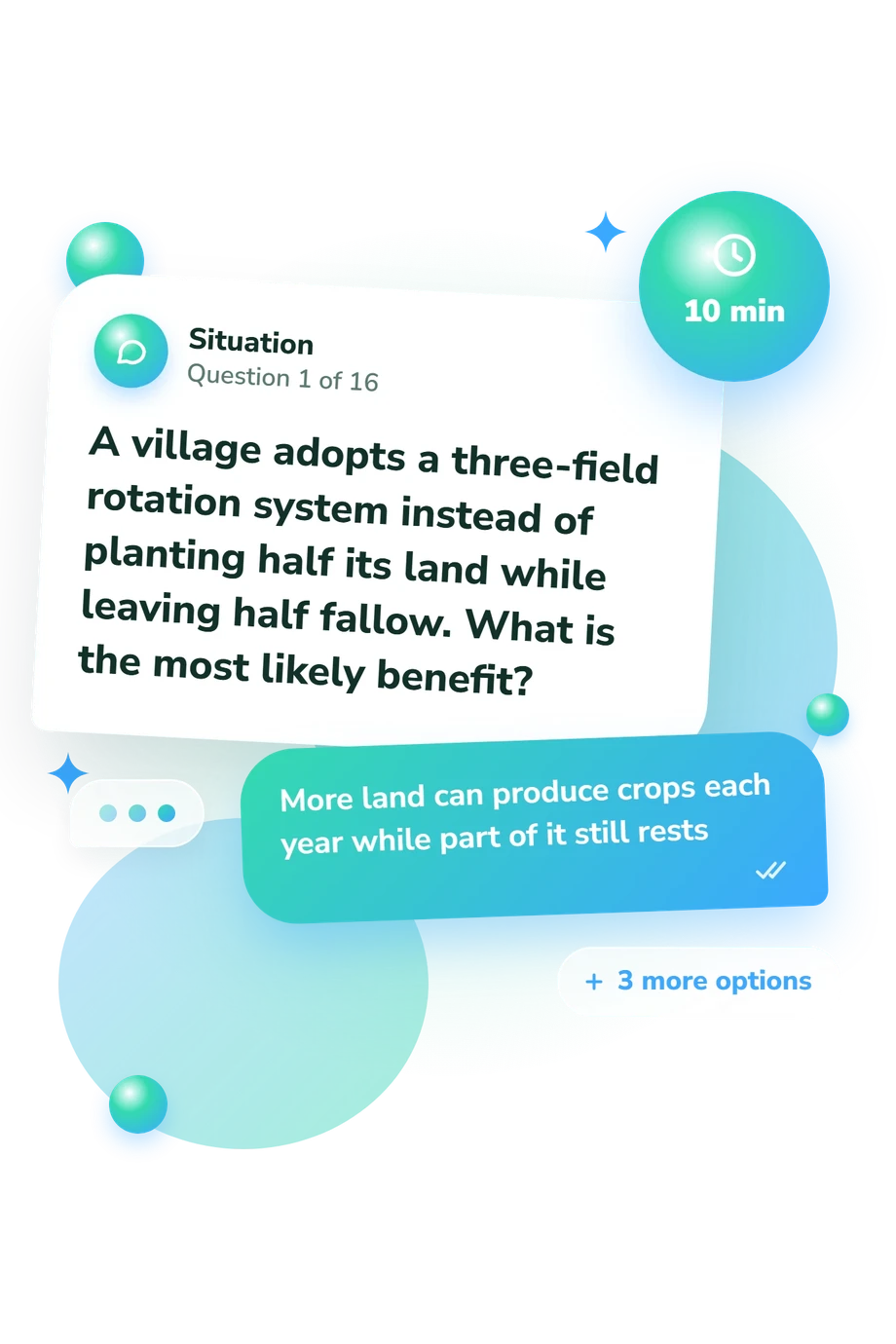
- More land can produce crops each year while part of it still rests
- The village no longer needs draft animals
- All farming becomes independent of seasonal weather
- The harvest can be preserved without storage buildings
- About 200 BCE to 300 CE
- About 1500 CE to 1800 CE
- About 500 CE to 1500 CE
- About 1800 CE to 1914 CE
- Magna Carta
- The Domesday Book
- The Edict of Milan
- The Golden Bull
Middle Ages Quiz - Description and methodology of the test
For readers who want a focused way to check their understanding of medieval history, the Middle Ages Quiz turns broad familiarity with the period into a structured learning snapshot. It suits students, lifelong learners, and anyone preparing to read more about medieval Europe. As a medieval quiz, it connects names, institutions, technologies, conflicts, and cultural developments rather than testing isolated dates alone.
What This Assessment Explores
The questions survey medieval Europe through chronology, authority, social roles, economic life, technology, architecture, disease, and cross-regional contact.
Several scenarios require application, not only recall. Framed as a quiz about medieval Europe, it asks whether interpreting crop rotation or identifying a trading association demonstrates that concepts connect to concrete situations.
The main areas represented are:
- Chronology and change show whether events and transitions are placed accurately.
- Institutions, society, and economy reveal understanding of power, dependency, work, and trade.
- Culture and exchange connect architecture, learning, technology, religion, and contact.
The single result scale is Middle Ages Knowledge (0-16). Foundations to Build covers 0-6, Developing Knowledge covers 7-12, and Strong Knowledge covers 13-16. This band summarizes performance on these questions rather than complete historical expertise.
Methodology and Scientific Basis
Each item presents a historical question or scenario with four answer choices and plausible distractors. The respondent selects the best-supported option, and overall performance is summarized on the questionnaire’s knowledge scale. The displayed bands describe the level assigned to the score. Results can vary with prior reading, wording comprehension, guessing, current study context, and selected topics; the scenarios cover farming, trade, church authority, warfare, plague, and contact among western, Byzantine, and Islamic societies.
The content is conceptually consistent with standard medieval-history coverage, not an adaptation of a single history text, while the cognitive demand is compatible with the revised Bloom framework, which distinguishes remembering from applying and interpreting knowledge. That combination explains the mix of direct identification and short contextual problems.
Its item-writing approach is also consistent with principles discussed by Haladyna, Downing, and Rodriguez, including one best answer and plausible alternatives. Together, the item design makes this a medieval history quiz that tests how learners recognize and apply historical knowledge.
The result is most useful for identifying areas to review, such as chronology, institutions, social structures, and cultural exchange.
- Bennett, Judith M., and Sandy Bardsley. Medieval Europe: A Short History. 12th ed. Oxford University Press, 2021.
- Anderson, Lorin W., and David R. Krathwohl, eds. A Taxonomy for Learning, Teaching, and Assessing: A Revision of Bloom's Taxonomy of Educational Objectives. Complete ed. Longman, 2001.
- Haladyna, Thomas M., Steven M. Downing, and Michael C. Rodriguez. "A Review of Multiple-Choice Item-Writing Guidelines for Classroom Assessment." Applied Measurement in Education 15, no. 3 (2002): 309-333. 10.1207/S15324818AME1503_5
Updated: