
Division Quiz
How the Scales are Structured
Who Usually Takes This Test?
See How You Compare
Below is a preview of how scores are typically distributed across each scale.
Example Questions From the Test
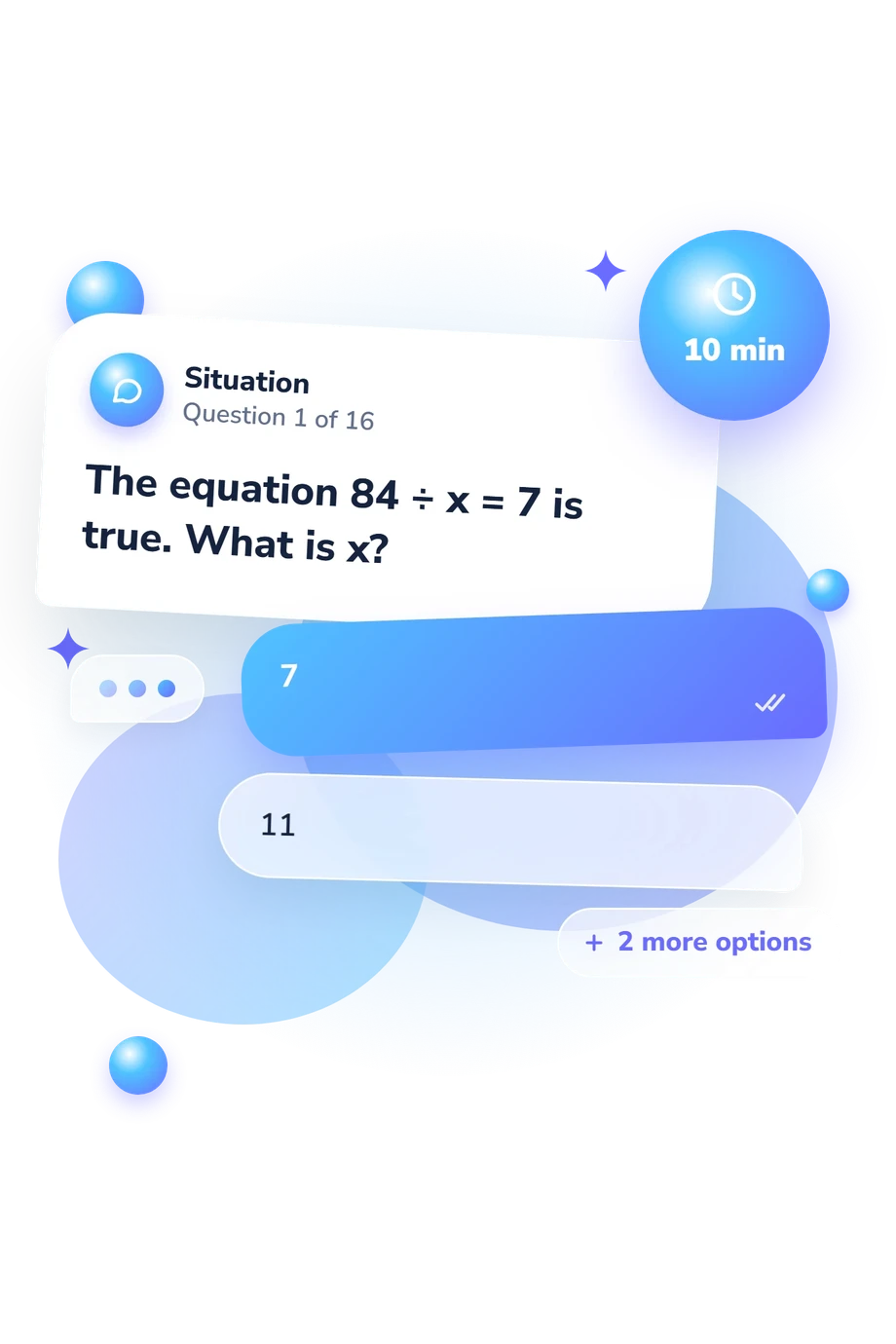
- 7
- 11
- 12
- 14
- 10
- 11
- 12
- 13
- It is undefined
- 0
- 19
- 1
Division Quiz - Description and methodology of the test
For learners reviewing core arithmetic, this division quiz helps them decide which division topics to practise next. It suits students, parents, and educators who want to see how a learner handles division in school and everyday contexts. The division online quiz gives learners a structured way to begin that review, while the result points toward topics that deserve more practice.
What This Assessment Measures
The questions examine division as more than memorized fact recall. They ask learners to find unknown divisors, calculate quotients, share quantities equally, and interpret answers in context. The dividing quiz includes applications involving money, measurement, travel, and classroom grouping. The items show how a learner handles division in straightforward and contextual problems.
The assessment samples these groups:
- Equations and fact fluency show whether division relationships support unknown-value problems.
- Equal sharing and grouping show how quantities can be partitioned into fair, repeatable sets.
- Remainders and quotient checks show whether an answer fits the quantity.
- Fractions, decimals, estimates, and rates show how division appears in varied representations.
The result is reported as Division Knowledge (0-16): Foundations to build (0-6), Developing (7-12), or Strong (13-16). This is an educational snapshot of division performance, not a measure of overall mathematical ability.
Methodology and Educational Basis
Every item uses a multiple-choice format with four answer options. The questions move between numerical equations and short applied situations, so the respondent must select the operation result rather than explain a written solution. One point is awarded for each correct response, and the total is interpreted through the displayed performance bands.
This division assessment is conceptually consistent with Common Core mathematics standards (2010), particularly expectations involving division, rational-number reasoning, estimation, and rates. It also fits the National Research Council’s proficiency framework, which treats mathematical competence as a combination of conceptual understanding, procedural fluency, strategic competence, adaptive reasoning, and productive disposition. NCTM’s framework similarly connects procedures with representations, problem solving, reasoning, and communication.
These standards and frameworks identify relevant content and proficiency ideas; they do not provide norming or validation evidence for this questionnaire. Results can be affected by prior practice, attention, reading of word problems, and familiarity with multiple-choice formats. Because the test samples selected division tasks, its bands indicate performance on those task types and can guide practice with similar problems.
- National Governors Association Center for Best Practices and Council of Chief State School Officers. Common Core State Standards for Mathematics. Washington, DC: National Governors Association Center for Best Practices and Council of Chief State School Officers, 2010.
- National Research Council. Adding It Up: Helping Children Learn Mathematics. Edited by Jeremy Kilpatrick, Jane Swafford, and Bradford Findell. Washington, DC: National Academy Press, 2001. 10.17226/9822
- National Council of Teachers of Mathematics. Principles and Standards for School Mathematics. Reston, VA: National Council of Teachers of Mathematics, 2000.
Updated: