
Glee Character Quiz
How the Scales are Structured
Who Usually Takes This Test?
See How You Compare
Below is a preview of how scores are typically distributed across each scale.
Example Questions From the Test
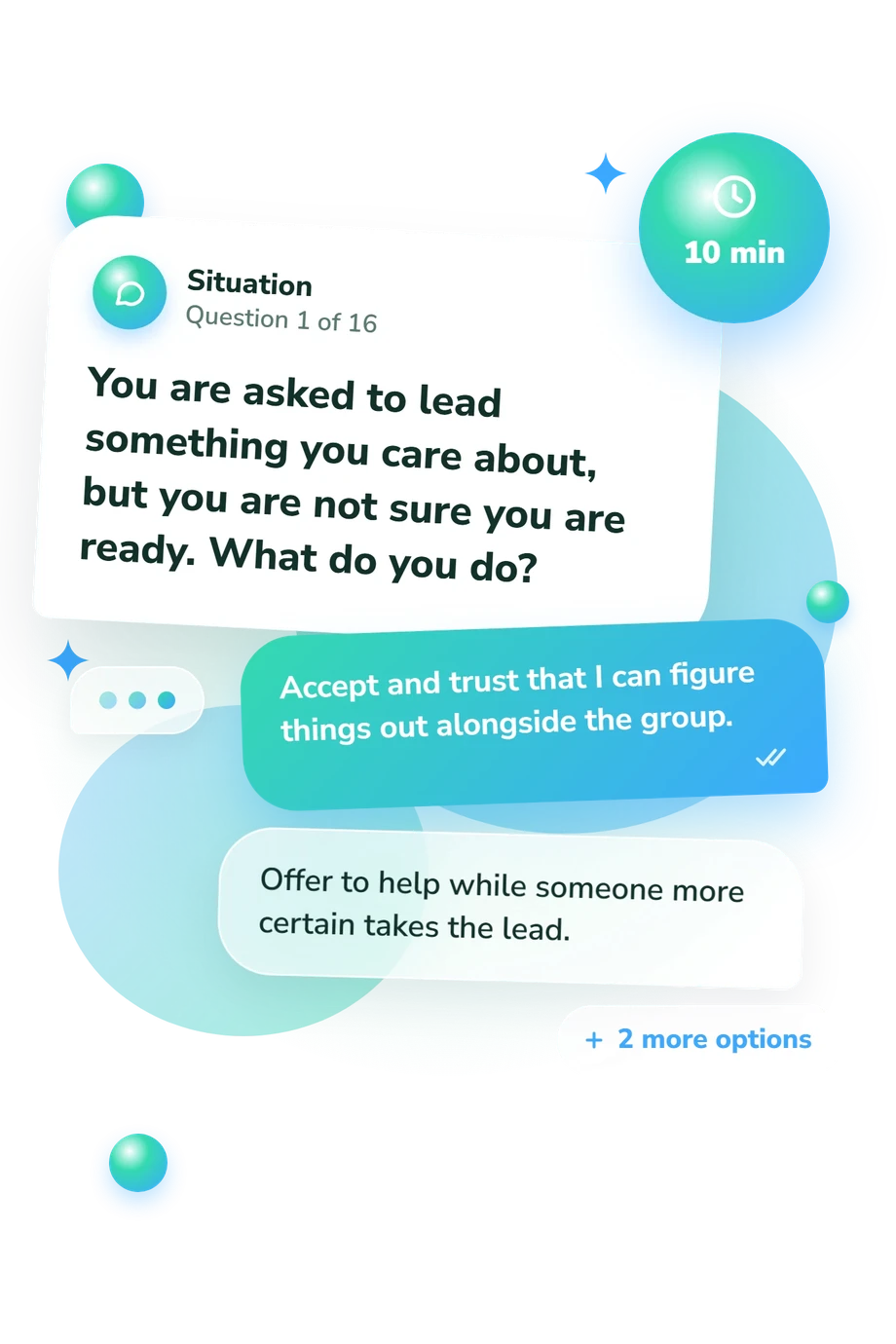
- Accept and trust that I can figure things out alongside the group.
- Offer to help while someone more certain takes the lead.
- Accept only after creating a detailed plan for every stage.
- Decline because uncertainty usually means the role belongs to someone else.
- Keep going and give the group a steady presence to rally around.
- Watch the strongest performer and follow their adjustments.
- Concentrate on delivering my own part accurately.
- Pull back so I do not add another mistake.
- Choosing the standard option so the event stays central.
- Adding one personal detail without changing the overall look.
- Building a polished look that is unmistakably mine.
- Adapting the expected style with a few carefully chosen twists.
Glee Character Quiz - Description and methodology of the test
Fans who want to connect a familiar Glee role with their own social style can use the glee character quiz as a playful self-reflection tool. A Glee quiz about what character you are focuses on responses to leadership, conflict, ambition, vulnerability, and group loyalty. It suits viewers who enjoy comparing their habits with the show's recurring personalities and seeing which character affinity feels strongest.
What This Assessment Explores
Questions cover leadership, conflict, ambition, vulnerability, presentation, loyalty, and competition. Each choice links an everyday situation to a character pattern, so the result reflects the response style that feels most familiar.
As a quiz about which Glee character you are, it gives a snapshot of identification rather than a fixed label. The displayed scales are:
- Finn Hudson (0-12) measures belonging and team-centred leadership: Different Team Role (0-4), Earnest Common Ground (5-8), and Finn Resonance (9-12).
- Kurt Hummel (0-12) measures self-expression and persistence under pressure: Different Expression (0-4), Individuality in Common (5-8), and Kurt Resonance (9-12).
- Rachel Berry (0-12) measures preparation, ambition, and stepping forward: Different Spotlight (0-4), Shared Ambition (5-8), and Rachel Resonance (9-12).
- Santana Lopez (0-12) measures social perception, competition, and guarded loyalty: Different Defense Style (0-4), Sharp-Edged Similarity (5-8), and Santana Resonance (9-12).
Methodology and Scientific Basis
The questionnaire presents everyday scenarios with four response options. You choose the reaction that feels most natural rather than rating a trait from low to high; themes span relationships, group roles, performance, identity, and emotional protection.
Scoring produces one affinity score for each character. The highest score is the strongest match, while scores within one point appear as a blended result. This is a relative comparison within this questionnaire, not a universal personality ranking.
As a Glee quiz about who you are, its framework comes from characters created by Ryan Murphy, Brad Falchuk, and Ian Brennan. Lorenz and Frisby (2022) provide the closest supporting study because they examine audience identification with a Glee character, while Cohen (2001) supplies broader theory about identification with media characters. This questionnaire is conceptually consistent with those works, not an adaptation or validation of either one.
Because this Freudly self-report tool has no population norms or clinical thresholds, results depend on honest choices, current context, and self-awareness; read them as a structured conversation starter rather than a complete identity verdict.
- Lorenz, Emily P., and Cynthia M. Frisby. "Disability on Drama TV: How Attitudes About Disability in the US Relate to Viewing Frequency and Identification with a Character with a Disability on 'Glee'." Media Education, 13(1), 81-91, 2022. 10.36253/me-12641
- Murphy, Ryan, Brad Falchuk, and Ian Brennan, creators. Glee. Fox, 2009-2015.
- Cohen, Jonathan. "Defining Identification: A Theoretical Look at the Identification of Audiences With Media Characters." Mass Communication & Society, 4(3), 245-264, 2001. 10.1207/S15327825MCS0403_01
Updated: