
Am I Attractive Quiz for Guys
How the Scales are Structured
Who Usually Takes This Test?
See How You Compare
Below is a preview of how scores are typically distributed across each scale.
Example Questions From the Test
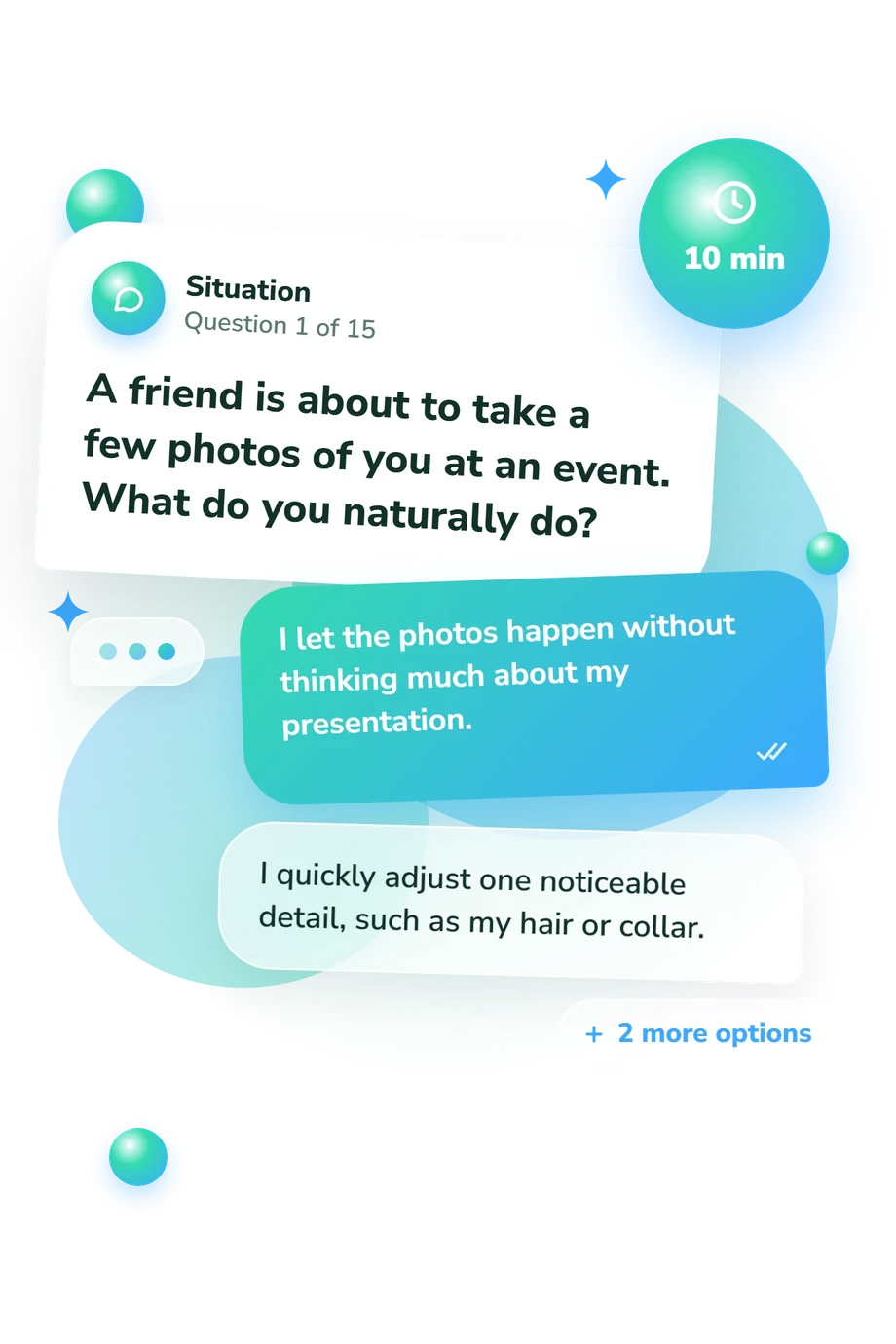
- I let the photos happen without thinking much about my presentation.
- I quickly adjust one noticeable detail, such as my hair or collar.
- I check my overall appearance and settle into a posture that feels natural.
- I make sure my outfit looks neat, then leave the pose to the photographer.
- Wear it mainly because I like the design or brand.
- Try different sizes, cuts, or alterations until the proportions suit me.
- Keep it for occasions when the fit will not matter much.
- Compare it with another option and choose whichever fits better.
- I question whether they really mean it.
- I make a joke that redirects attention away from me.
- I thank them, even if I feel a little awkward.
- I accept it warmly without needing to downplay or prove anything.
Am I Attractive Quiz for Guys - Description and methodology of the test
Men who want a clearer, more balanced way to think about romantic appeal can use this questionnaire to examine behaviors that shape first impressions and connection. A male attractiveness quiz is most useful when it considers presentation and interaction rather than facial features alone. The Am I Attractive Quiz for Guys turns those everyday choices into a profile for practical reflection.
What This Assessment Explores
Items cover fit, grooming, posture, eye contact, conversation, initiative, praise, comparison, awkwardness, and rejection. They examine presentation and interaction, not natural features, status, dominance, popularity, or personal worth.
Used as a romantic attraction test, the result profiles signals rather than delivering a universal appeal verdict. The three dimensions are:
- Personal Presentation (0-15) measures intentional clothing, grooming, and visual detail: Low-key approach (0-5) favors comfort; Selective polish (6-10) refines selectively; Intentional style (11-15) creates a considered impression.
- Self-Assured Presence (0-15) measures comfort with attention and uncertainty: Cautious presence (0-5) reflects self-monitoring; Situational ease (6-10) varies under pressure; Grounded confidence (11-15) stays open and balanced.
- Warmth and Connection (0-15) measures approachable, attentive, playful signals, not popularity or extroversion: Reserved signals (0-5) keep interest less visible; Responsive warmth (6-10) grows with momentum; Visible warmth (11-15) makes curiosity clear.
Methodology and Scientific Basis
Each item presents a social or dating situation with four response options. You choose the reaction closest to your usual approach; answers are grouped into the three dimensions and summarized as a profile. The displayed ranges organize score bands, but individual point assignments are not specified, so no finer scoring rule should be inferred.
The evidence is conceptual, not a claim that this questionnaire reproduces a published scale. Luo and Zhang (2009) provide the closest match because their speed-dating work treats attraction as more than physical beauty. Hamshaw and Gavin (2022) relate to the grooming and appearance concerns represented here.
Fiske, Cuddy, and Glick (2007) offer a framework for separating warmth from competence in social judgment. That distinction helps explain why approachability and attentive behavior can matter alongside presentation without turning either into a universal measure of desirability.
As a self-report grooming and attraction assessment, results can shift with mood, self-awareness, comparison habits, and imagined context. It has no published norms or established clinical cutoffs; the questionnaire is conceptually consistent with these works, not an adaptation or validation of them.
- Luo, Shanhong, and Guangjian Zhang. “What Leads to Romantic Attraction: Similarity, Reciprocity, Security, or Beauty? Evidence From a Speed-Dating Study.” Journal of Personality, 77(4), 2009, 933-964. 10.1111/j.1467-6494.2009.00570.x
- Hamshaw, Richard J. T., and Jeff Gavin. “Men’s Perspectives on Their Grooming Practices and Appearance Concerns: A Mixed Methods Study.” Journal of Men's Studies, 30(2), 2022, 251-270. 10.1177/10608265211052068
- Fiske, Susan T., Amy J. C. Cuddy, and Peter Glick. “Universal Dimensions of Social Cognition: Warmth and Competence.” Trends in Cognitive Sciences, 11(2), 2007, 77-83. 10.1016/j.tics.2006.11.005
Updated: