
What Is My Calling Quiz
How the Scales are Structured
Who Usually Takes This Test?
See How You Compare
Below is a preview of how scores are typically distributed across each scale.
Example Questions From the Test
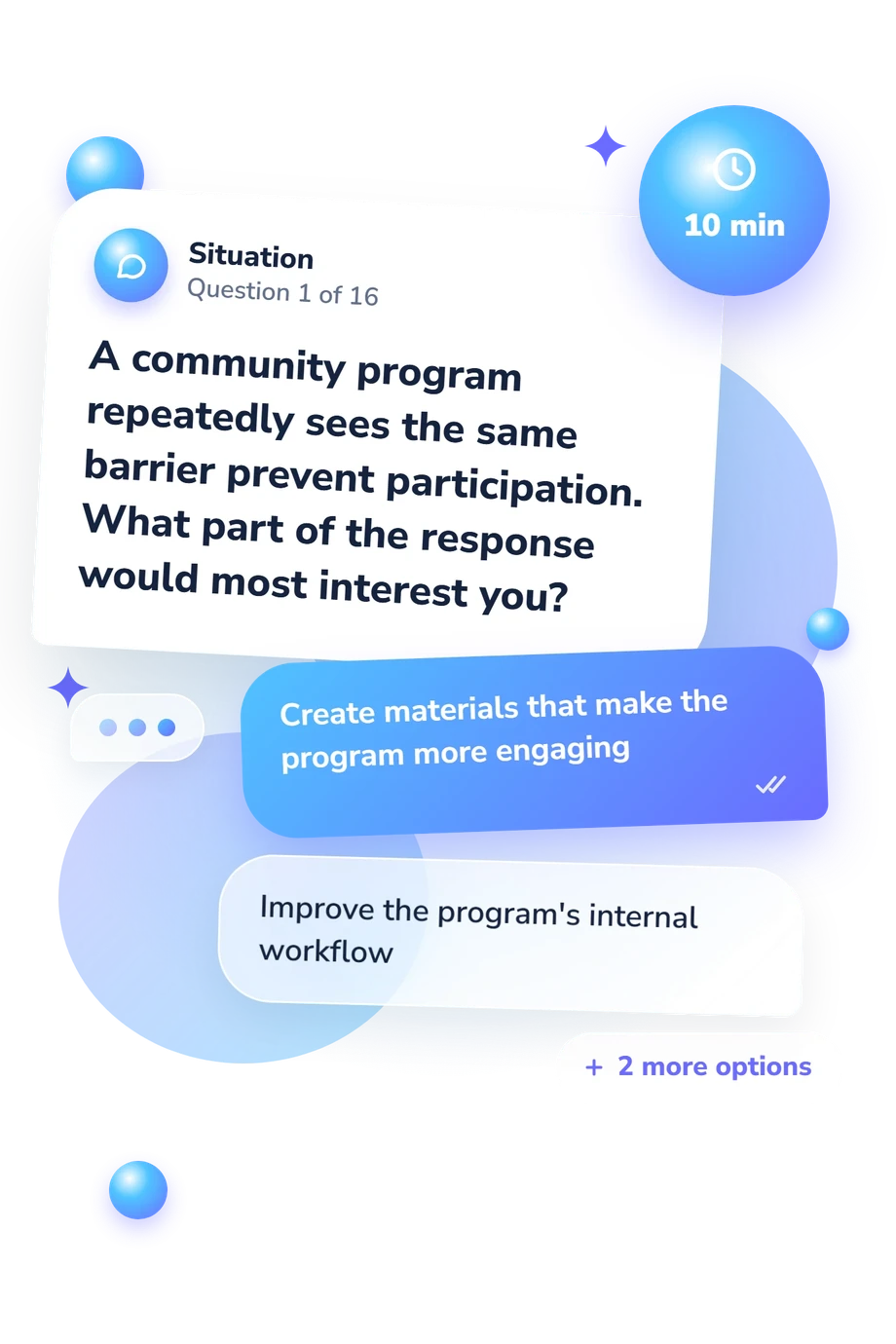
- Create materials that make the program more engaging
- Improve the program's internal workflow
- Help individual participants navigate the existing barrier
- Work with others to remove the barrier at its source
- Producing original experiences that inspire an audience
- Developing a high-quality product through technical craft
- Delivering a useful service directly to people who need it
- Changing systems so more people can access fair opportunities
- Point them toward reliable information or a specialist
- Describe what I have observed in similar situations
- Ask questions that help them clarify their priorities
- Keep supporting them as they explore, decide, and adjust
What Is My Calling Quiz - Description and methodology of the test
People considering a career change, meaningful projects, or a more coherent direction can use this assessment to examine what kinds of contribution feel energizing and worthwhile. The What Is My Calling Quiz turns a broad question about purpose into a comparative profile rather than a single job recommendation. People exploring their purpose can use this calling quiz to identify patterns worth exploring.
What This Assessment Explores
Rather than naming an occupation, the assessment examines how a person may create value in work, projects, relationships, and community life. It suits readers exploring purpose and fit; this purpose assessment describes motivational affinities rather than destiny. The result compares four dimensions:
- Building & Mastery (0-12) reflects skilled execution and durable systems: Background Thread (0-4), Active Thread (5-8), or Core Thread (9-12).
- Creative Expression (0-12) reflects imagination and distinctive communication: Background Thread (0-4), Active Thread (5-8), or Core Thread (9-12).
- Guidance & Growth (0-12) reflects teaching, listening, and helping potential develop: Background Thread (0-4), Active Thread (5-8), or Core Thread (9-12).
- Service & Advocacy (0-12) reflects collective wellbeing and responses to shared needs: Background Thread (0-4), Active Thread (5-8), or Core Thread (9-12).
The highest score shows strongest affinity; scores within one point suggest a blended result.
Methodology and Scientific Basis
Each scenario presents a concrete situation and four plausible responses. The options are preferences, not right or wrong; each choice represents a contribution style, and the profile compares affinities rather than assigning a job title.
The items do not assess religious belief; readers may interpret their broader sense of purpose personally, including through faith, and use the profile for personal vocation reflection. The conceptual frame is calling and vocation: work may feel purposeful, socially useful, and personally fitting. The questionnaire is conceptually consistent with the Calling and Vocation Questionnaire (Dik et al., 2012) and models from Dik and Duffy (2009) and Duffy et al. (2018), but it is not an adaptation or validation of those instruments.
The profile is comparative, not norm-referenced: a higher affinity means stronger resonance in this profile, not greater ability or virtue. Its displayed bands describe affinity within this questionnaire rather than clinical cutoffs. Readers can use the pattern to consider roles, projects, study, or service.
Because it is a self-report, the result remains sensitive to current circumstances, response bias, and self-awareness; read it as a context-sensitive snapshot rather than a final vocational verdict.
- Dik, B. J., Eldridge, B. M., Steger, M. F., & Duffy, R. D. (2012). Development and validation of the Calling and Vocation Questionnaire (CVQ) and Brief Calling Scale (BCS). Journal of Career Assessment, 20(3), 242-263. 10.1177/1069072711434410
- Dik, B. J., & Duffy, R. D. (2009). Calling and vocation at work: Definitions and prospects for research and practice. The Counseling Psychologist, 37(3), 424-450. 10.1177/0011000008316430
- Duffy, R. D., Dik, B. J., Douglass, R. P., England, J. W., & Velez, B. L. (2018). Work as a calling: A theoretical model. Journal of Counseling Psychology, 65(4), 423-439. 10.1037/cou0000276
Updated: