
Arabic Alphabet Quiz
How the Scales are Structured
Who Usually Takes This Test?
See How You Compare
Below is a preview of how scores are typically distributed across each scale.
Example Questions From the Test
- ث (thāʾ, three dots above)
- ش (shīn, three dots above a sīn-family shape)
- ت (tāʾ, two dots above)
- ن (nūn, one dot above)
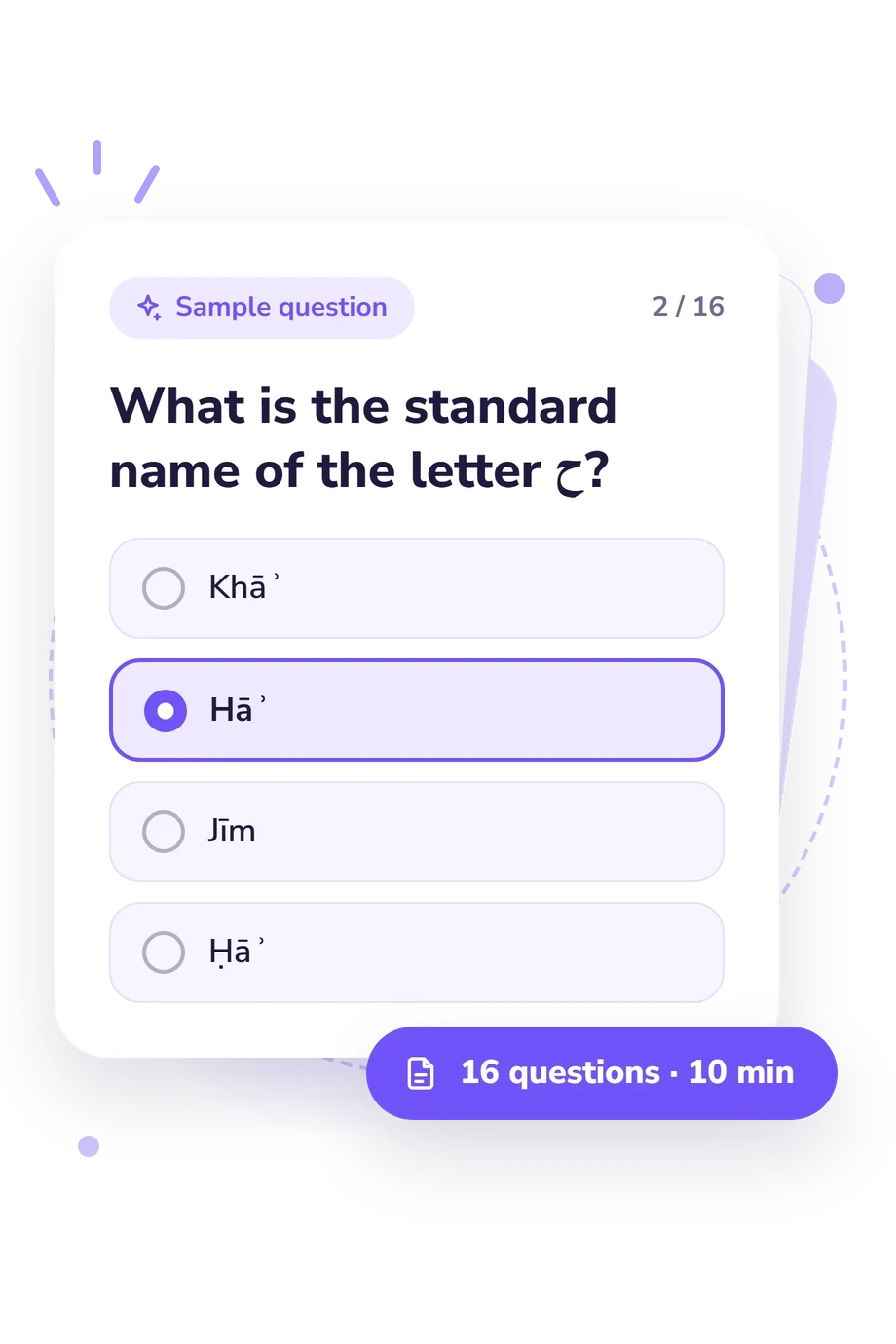
- Khāʾ
- Hāʾ
- Jīm
- Ḥāʾ
- س (sīn, no dots)
- ش (shīn, three dots above)
- ص (ṣād, the emphatic ṣ letter)
- ز (zāy, one dot above)
Arabic Alphabet Quiz - Description and methodology of the test
Designed for beginners, this assessment helps learners, teachers, or curious readers see how securely they recognize the building blocks of Arabic script. The arabic alphabet quiz connects visual identification with names, sounds, alphabetical order, and simple joining conventions, so the result can show whether review should focus on recall, confusing letter families, or early reading patterns. This Arabic alphabet test makes the next study step more concrete.
What This Assessment Explores
Rather than measuring fluency in Arabic, the questionnaire targets foundational script knowledge. It asks you to identify letters by shape and dots, recall names, follow alphabetical order, match symbols with sounds, and notice basic joining behavior. Familiar words connect symbols with initial sounds.
For learners comparing similar symbols, this Arabic letters quiz highlights letter families, dot placement, sequence, and forms that change beside another letter. The result reflects alphabet familiarity, not general language proficiency.
The questions examine these thematic areas:
- Visual and sound recognition concerns how you connect shapes, dots, names, and sounds.
- Alphabetic and joining awareness concerns how you handle order, connected forms, and forward non-connection.
- Arabic Alphabet Knowledge (0-16) reports: Foundation Builder (0-6) means review is useful; Developing Knowledge (7-12) shows growing command; Strong Alphabet Knowledge (13-16) shows solid beginner command of letters, order, sounds, and basic written patterns.
Methodology and Scientific Basis
Each item offers four answer choices and tests a focused recognition or application task. The set includes symbol identification, sequence completion, sound matching, word-initial recognition, dot comparisons, and joining rules. It samples connected beginner skills without requiring extended reading or writing.
This Arabic letter knowledge test reports one overall scale rather than separate subscores because the displayed result covers a single construct. The questionnaire reports one total scale with named bands but does not define a per-answer weighting rule, so scores should be interpreted through those bands without assuming one point per response.
Tibi et al. (2022) is the closest conceptual match: this questionnaire is conceptually consistent with its focus on Arabic letter knowledge and visual letter features, but it is not presented as an adaptation of that work. Tibi et al. (2021) adds a measurement perspective on the same construct. Ryding (2005) provides linguistic context for Modern Standard Arabic phonology, script, and joining conventions.
Results may vary with prior exposure, transliteration familiarity, attention, and current learning context. The cited studies do not establish norms for this questionnaire, so its band is best used as a practice snapshot, not a standardized estimate of Arabic ability.
- Tibi, S., Edwards, A. A., Kim, Y.-S. G., Schatschneider, C., & Boudelaa, S. (2022). The Contributions of Letter Features to Arabic Letter Knowledge for Arabic-Speaking Kindergartners. Scientific Studies of Reading, 26(5), 357-372. 10.1080/10888438.2021.2016769
- Tibi, S., Edwards, A. A., Schatschneider, C., Lombardino, L. J., Kirby, J. R., & Salha, S. H. (2021). IRT analyses of Arabic letter knowledge in Kindergarten. Reading and Writing, 34(3), 791-816. 10.1007/s11145-020-10086-6
- Ryding, K. C. (2005). Phonology and script. In A Reference Grammar of Modern Standard Arabic (pp. 10-43). Cambridge University Press. 10.1017/CBO9780511486975.003
Updated: