
5.1 Comprehension Quiz
How the Scales are Structured
Who Usually Takes This Test?
See How You Compare
Below is a preview of how scores are typically distributed across each scale.
Example Questions From the Test
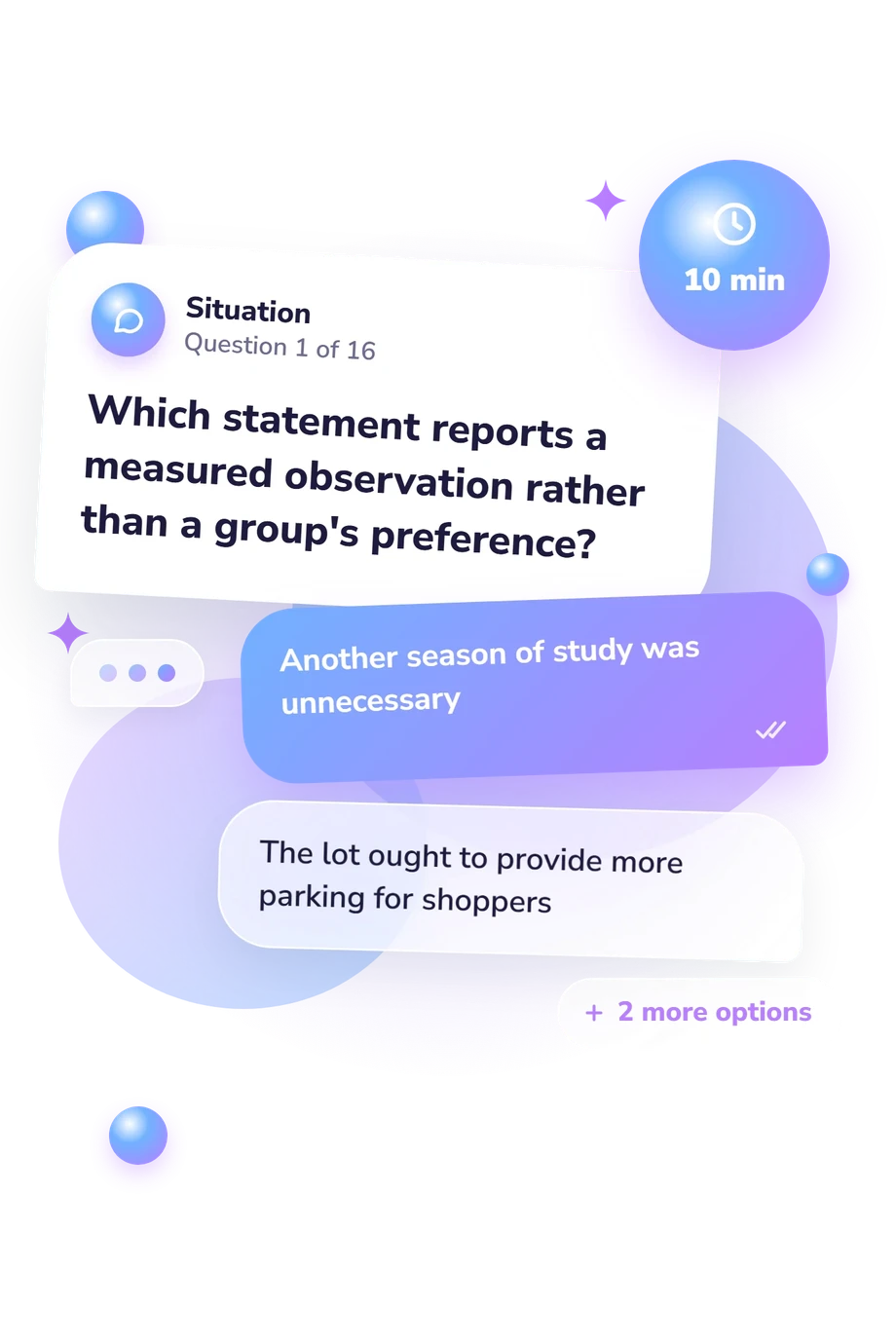
- Another season of study was unnecessary
- The lot ought to provide more parking for shoppers
- Expanding the garden would be the fairest outcome
- The spaces were mostly empty on weekends
- To learn whether shop owners would attend another meeting
- To collect more informative evidence about water after rainfall
- To replace the volunteers with professional planners
- To see whether weekend parking could be prohibited
- The amount of rainfall
- The number of temporary parking spaces
- The opinions of nearby tenants
- The season when the public meeting occurred
5.1 Comprehension Quiz - Description and methodology of the test
Readers who want to discuss why an answer fits a passage can use this assessment as a focused practice tool. The 5.1 Comprehension Quiz gives anyone working on careful reading a structured way to review choices and explain the evidence behind them. Its result can guide reading comprehension practice or a conversation about how to approach difficult passages.
What This Assessment Explores
The questionnaire examines comprehension as more than recall. Its items ask readers to distinguish observation from opinion, track reasons and variables, follow sequence and contrast, infer from evidence, identify a central idea, and recognize how a passage is organized. Other items test whether a conclusion changes when new information is introduced.
As a passage comprehension test, it suits readers who want a focused picture of connected reading skills. The result reflects performance on these tasks, not a fixed ability. Its scale, 5.1 Comprehension Knowledge (0-16), summarizes connections among details, conclusions, viewpoints, evidence, and structure.
The bands describe the total:
- Foundation to build (0-6) indicates that sequence, evidence, or contrasts may need attention.
- Developing comprehension (7-12) indicates understanding of the main situation and supporting details, with inference still developing.
- Strong comprehension (13-16) indicates connections among details, conclusions, viewpoints, and structure.
Methodology and Scientific Basis
The 16 items use selected-response questions with four answer choices. They cover local understanding and broader reasoning: retrieving details, comparing viewpoints, interpreting wording, inferring relationships, evaluating evidence, recognizing structure, and testing a conclusion against a later observation. This is a performance task rather than a self-report inventory.
The questionnaire reports one comprehension total; its answer-to-point mapping and any weighting are unspecified, with no stated item-level points, norms, or clinical cutoffs. The method is conceptually consistent with the Adolescent Comprehension Evaluation (ACE), but this online version is not presented as an adaptation or standardized administration of ACE.
The framework also aligns with Kintsch and van Dijk’s model of constructing and integrating meaning, and with the RAND Reading Study Group’s account of understanding and purposeful reading. The cited work does not establish psychometric reliability or validity for this online questionnaire.
For someone choosing an online comprehension quiz, the result is best read as a snapshot of passage-based reasoning. Attention, topic familiarity, working memory, and guessing can affect selected responses, so compare it with the reader’s explanations and performance across other texts.
- Severino, Lori, Mary Jean Tecce DeCarlo, Toni Sondergeld, Meltem Izzetoglu, and Alia Ammar. "A Validation Study of a Middle Grades Reading Comprehension Assessment." RMLE Online 41, no. 10 (2018): 1-16. 10.1080/19404476.2018.1528200.
- Kintsch, Walter, and Teun A. van Dijk. "Toward a Model of Text Comprehension and Production." Psychological Review 85, no. 5 (1978): 363-394. 10.1037/0033-295X.85.5.363.
- RAND Reading Study Group. Reading for Understanding: Toward an R&D Program in Reading Comprehension. Santa Monica, CA: RAND Corporation, 2002.
Updated: