
Book Boyfriend Quiz
How the Scales are Structured
Who Usually Takes This Test?
See How You Compare
Below is a preview of how scores are typically distributed across each scale.
Example Questions From the Test
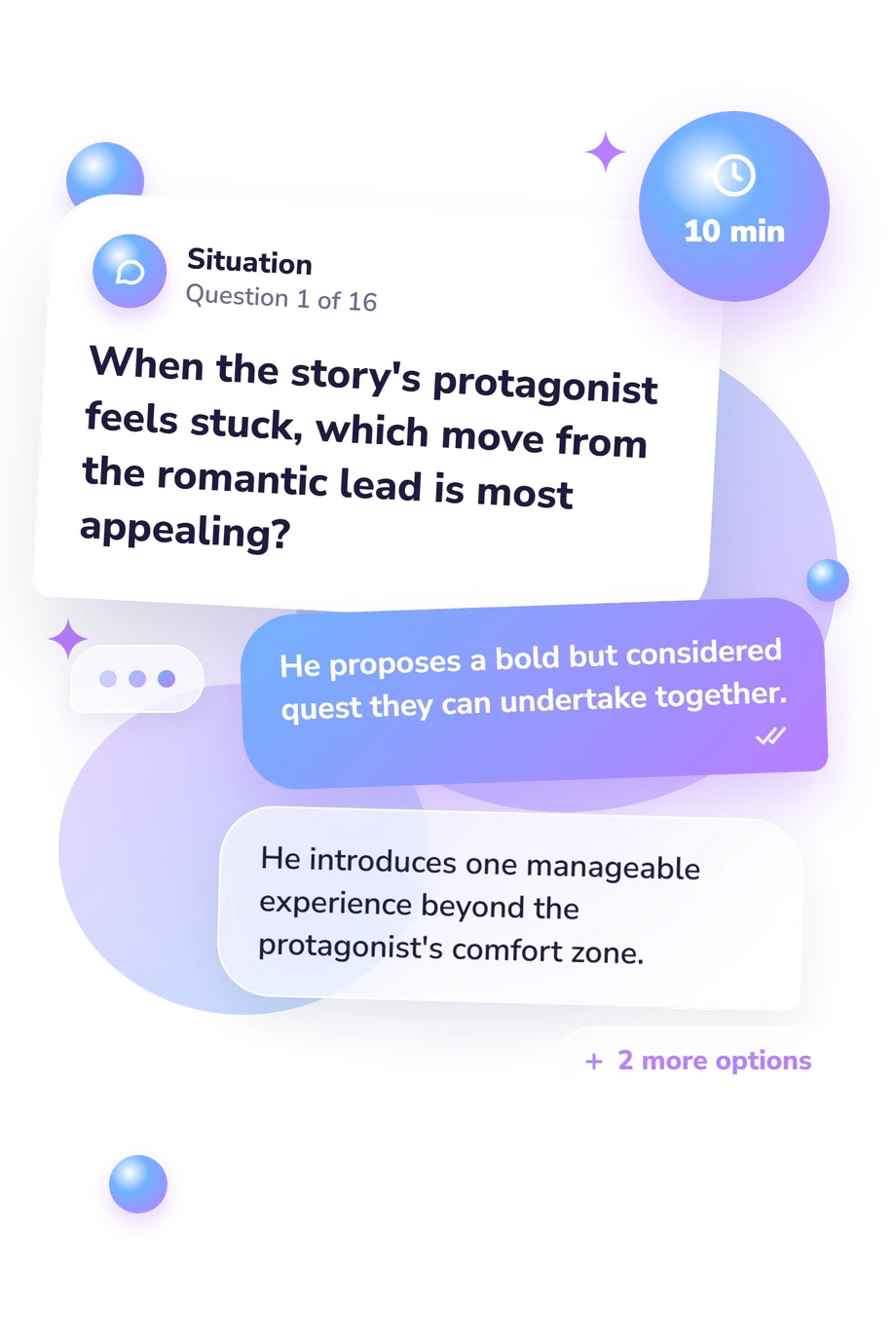
- He proposes a bold but considered quest they can undertake together.
- He introduces one manageable experience beyond the protagonist's comfort zone.
- He researches several possibilities and offers a clear plan.
- He protects the routines that currently provide stability.
- He turns the evening into an unexpected escape from everything.
- He restores the protagonist's confidence through playful teasing.
- He makes space for every feeling without rushing the conversation.
- He arrives as promised, handles what needs doing, and stays.
- “I planned our usual evening and saved your favorite place.”
- “There is somewhere new nearby; shall we choose a day to see it?”
- “I left clues around town. Find the last one and meet me there.”
- “Pack for the weekend. I found a route neither of us has taken.”
Book Boyfriend Quiz - Description and methodology of the test
Readers who enjoy romance fiction can use this profile to clarify which qualities make a fictional love interest compelling. The book boyfriend quiz organizes that curiosity around adventure, emotional understanding, dependability, and verbal chemistry. It presents your book boyfriend preferences as a profile across those four romantic styles, rather than selecting one identity.
What This Assessment Explores
Rather than identifying a real person, the assessment describes the fictional relationship dynamic that most attracts you. Its scenarios explore responses to vulnerability, disagreement, routine, and change. A higher score indicates stronger affinity, while several elevated scores suggest a blended ideal.
These four dimensions show what the profile can reveal:
- Daring Adventurer (0-12) measures attraction to spontaneity and discovery without requiring recklessness.
- Gentle Confidant (0-12) measures attraction to emotional attentiveness, patient trust, and deep understanding.
- Steadfast Partner (0-12) measures attraction to dependable devotion, shared routines, and love shown over time.
- Witty Challenger (0-12) measures attraction to verbal chemistry, intellectual friction, and respectful challenge.
Across four scales, the displayed bands are Occasional Appeal (0-4), Meaningful Affinity (5-8), and Signature Match (9-12). Each scale is interpreted through its displayed band, showing how your romantic style preferences appear across the four dimensions.
Methodology and Scientific Basis
Each item presents a story situation with four appealing responses, covering vulnerability, conflict, routine, future plans, and adventure. The response options represent contrasting romantic directions. This forced-choice self-report format asks which response feels most romantic rather than rating frequency or symptoms.
The questionnaire produces four separate scale results, each read through the displayed bands. Because the answer-to-score formula is not presented, those bands describe levels of affinity for each scale rather than population cutoffs or evidence of a disorder.
Liebers and Schramm (2017) offer the closest conceptual connection through their work on fictional character attributes, reading experiences, and parasocial romantic involvement. This questionnaire is conceptually consistent with that work, not an adaptation of its measure. Fletcher et al. (1999) support its focus on relationship ideals, while Eastwick and Finkel (2008) show why stated preferences may not perfectly predict attraction in live interactions.
The questionnaire produces a playful romantic-preference profile that brings together your fictional romance preferences around intimacy, conflict, routine, and change. Imagined scenarios and self-report can reflect current reading tastes, self-awareness, and response style, so the result is a snapshot of romantic preferences.
- Liebers, Nicole, and Holger Schramm. (2017). "Friends in books: The influence of character attributes and the reading experience on parasocial relationships and romances." Poetics, 65, 12-23. 10.1016/j.poetic.2017.10.001
- Fletcher, Garth J. O., Jeffry A. Simpson, Geoff Thomas, and Louise Giles. (1999). "Ideals in intimate relationships." Journal of Personality and Social Psychology, 76(1), 72-89. 10.1037/0022-3514.76.1.72
- Eastwick, Paul W., and Eli J. Finkel. (2008). "Sex differences in mate preferences revisited: Do people know what they initially desire in a romantic partner?" Journal of Personality and Social Psychology, 94(2), 245-264. 10.1037/0022-3514.94.2.245
Updated: