
Simple Compound and Complex Sentences Quiz
How the Scales are Structured
Who Usually Takes This Test?
See How You Compare
Below is a preview of how scores are typically distributed across each scale.
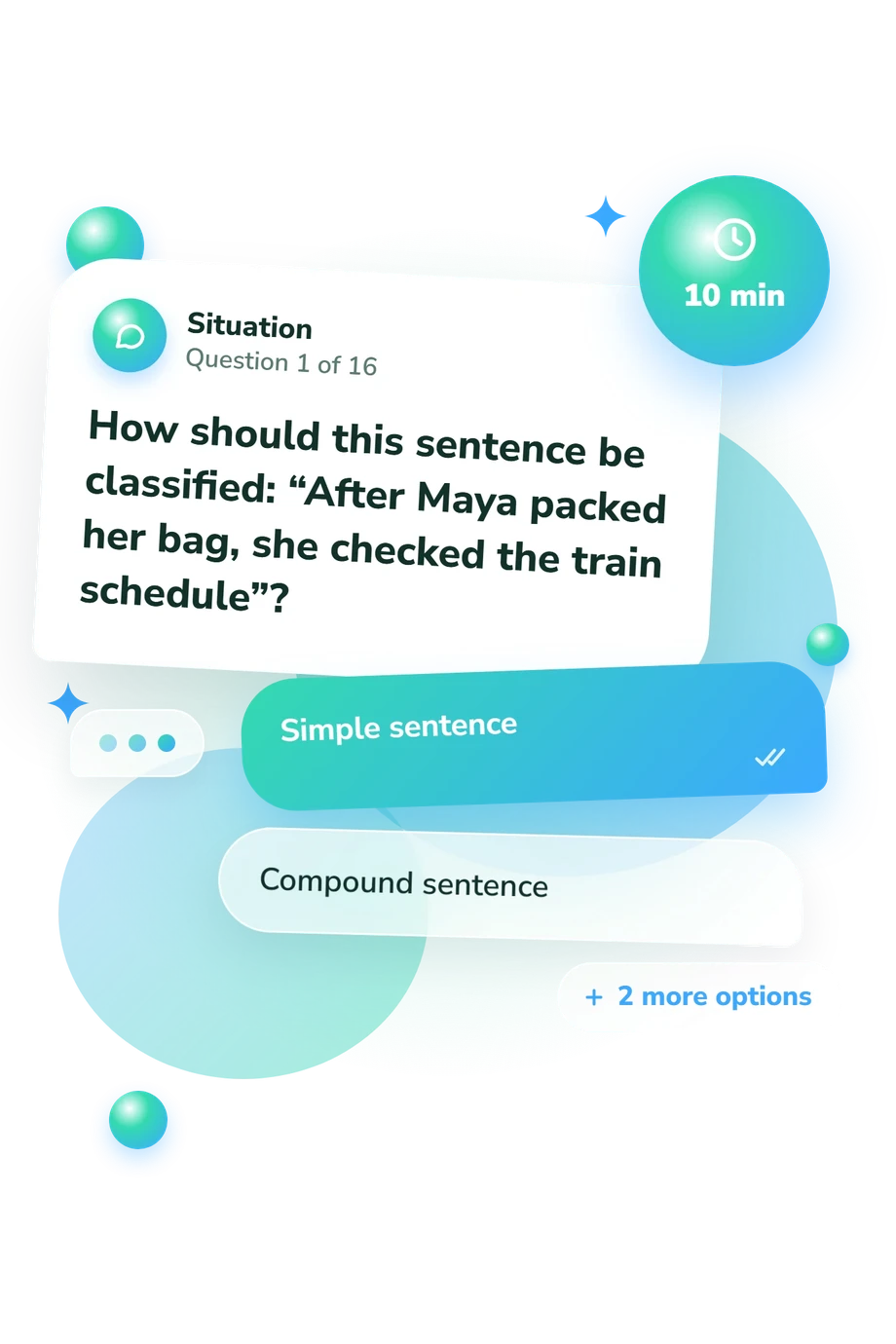
Example Questions From the Test
- Simple sentence
- Compound sentence
- Sentence fragment
- Complex sentence
- One
- Three
- Two
- None
- Nora set an alarm; she did not want to oversleep.
- Nora set an alarm because she did not want to oversleep.
- Nora set an alarm, and she did not want to oversleep.
- Nora did not want to oversleep, she set an alarm.
Simple Compound and Complex Sentences Quiz - Description and methodology of the test
Readers who want to strengthen grammar foundations can use this assessment to check how clauses are arranged and connected. The simple compound and complex sentences quiz suits learners, writers, and teachers seeking a clear picture of sentence-structure knowledge. It emphasizes practical identification, combination, and punctuation decisions, so the result can guide targeted review. It works as a quiz on types of sentences: simple, compound, and complex.
What This Assessment Explores
Sentence classification is the central skill: items distinguish one independent clause from two, or from an independent clause joined to a dependent clause. They also test whether a compound subject or predicate can remain part of a simple sentence.
The assessment works as a compound and complex sentences quiz by focusing on coordination, subordination, clause boundaries, conjunctions, sentence combining, and punctuation. Its result brings together these areas:
- Sentence classification shows whether you can recognize simple, compound, and complex patterns.
- Clause analysis shows whether you can identify independent and dependent clauses.
- Sentence construction shows how well you apply conjunctions, subordination, and punctuation.
Sentence Structure Knowledge is scored from 0-16: Foundation to build (0-6) calls for clause review, Developing knowledge (7-12) reflects partial control, and Strong knowledge (13-16) indicates consistent distinctions among the tested structures.
Methodology and Scientific Basis
Each item uses a multiple-choice format: a sentence may need classification, clause counting, definition matching, revision, or punctuation. The alternatives include plausible grammatical errors, so the task tests recognition and application rather than extended writing.
For learners wanting a sentence structure quiz, this assessment focuses on separating compound from complex construction in fresh examples. It is an educational knowledge check, not a personality or symptom measure, and it samples grammar decisions rather than overall writing skill.
Scoring summarizes performance at the item level. Correct selections are reflected in the overall result, but no weighting scheme or item-by-item point allocation is stated. The outcome is therefore a snapshot of performance on the tested decisions, not a percentile or norm.
The framework is conceptually consistent with Caplan (2026), Thornbury’s treatment of complex sentences, and Huddleston and Pullum’s clause analysis. The quiz is not presented as a standardized adaptation of those publications. Familiarity with grammatical terms, recent instruction, and momentary attention can affect performance, so use the result to select review topics and track learning over time.
- Caplan, Nigel A. “Simple, Compound, and Complex Sentences.” In Talking About Language: The Structures and Functions of English. University of Delaware, 2026.
- Thornbury, Scott. “Sentence Structure: The Complex Sentence.” In About Language: Tasks for Teachers of English, pp. 96-102. Cambridge University Press, 2017. 10.1017/9781009024525.017.
- Huddleston, Rodney, and Geoffrey K. Pullum. The Cambridge Grammar of the English Language. Cambridge University Press, 2002. 10.1017/9781316423530.
Updated: