
Branches of Government Quiz
How the Scales are Structured
Who Usually Takes This Test?
See How You Compare
Below is a preview of how scores are typically distributed across each scale.
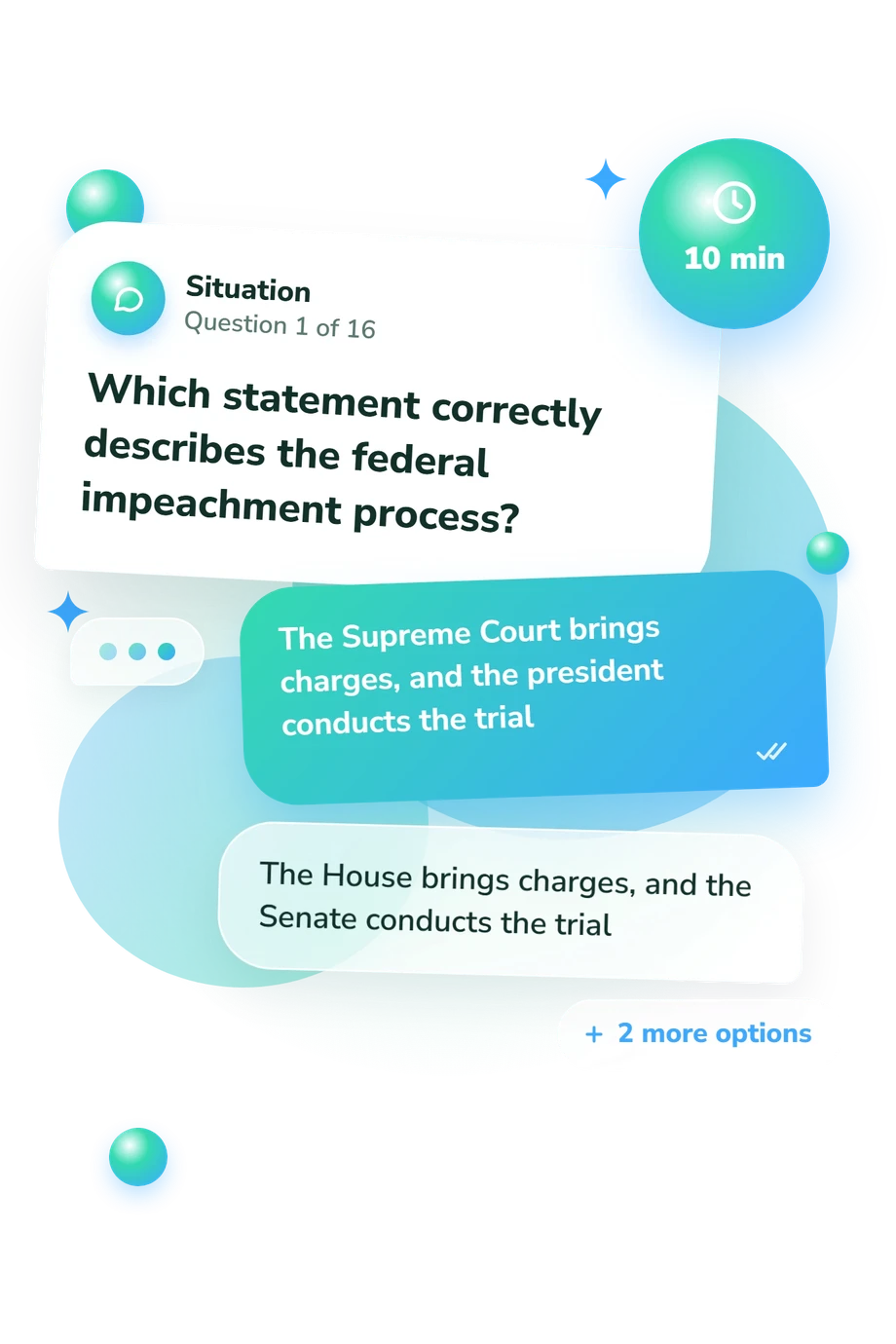
Example Questions From the Test
- Resolving cases under federal law
- Enforcing federal laws through agencies
- Writing and passing federal laws
- Commanding the armed forces
- The legislative branch
- The judicial branch
- The executive branch
- Both houses of Congress acting as a judicial body
- The Supreme Court and lower federal courts
- The president and Cabinet
- Congress, consisting of the House and Senate
- The governors and state legislatures
Branches of Government Quiz - Description and methodology of the test
People reviewing federal civics can use the branches of government quiz to test how well they distinguish constitutional responsibilities and limits among federal institutions. It suits learners preparing for discussion, review, or a focused civics knowledge check rather than someone seeking a personality profile. The result can indicate whether branch roles, checks, or less familiar procedures merit further review.
What This Assessment Explores
The questionnaire tests whether you can match federal branches with responsibilities and recognize how checks limit authority. Its scenarios cover Congress, the president, agencies, courts, appointments, funding, treaties, impeachment, vetoes, and judicial review. The emphasis is practical: identifying who acts, who may respond, and how separated powers prevent concentration.
For learners using this assessment to review civics, the result describes knowledge of constitutional branch roles rather than personality or preference. It reports one scale, Branches of Government Knowledge: 0-16, with bands that frame the outcome:
- Emerging Foundation (0-6) indicates that you recognize some federal-government features but may benefit from reviewing branch roles and checks and balances.
- Developing Knowledge (7-12) shows understanding of many central powers and relationships while leaving some procedures to clarify.
- Strong Knowledge (13-16) reflects a well-developed understanding of the three branches and how they limit one another.
Methodology and Evidence Base
The items present constitutional scenarios or direct knowledge questions with four answer choices. You select the option that best matches the power or procedure described. The result presents performance on the 0-16 scale; no scoring method beyond that displayed scale is specified. It therefore focuses on recognizing and applying federal civic knowledge, rather than measuring political identity.
The main conceptual reference point is the Annenberg Civics Knowledge Survey, which examines public understanding of constitutional structure and governmental powers. This questionnaire is conceptually consistent with that work, but is not a reproduction or standardized administration of the survey. The Constitution's provisions on legislative powers, executive responsibilities, courts, treaties, impeachment, vetoes, and overrides provide the framework.
Ihme and Tausendpfund show why political-knowledge performance should be read in context: wording, prior exposure, attention, and situational factors can affect answers. Unfamiliar terminology and uneven familiarity with civics may also shape performance. The displayed bands are descriptive categories for this questionnaire, so use the result to choose topics for further review.
- Annenberg Public Policy Center. 2019. 2019 Annenberg Civics Knowledge Constitution Day Survey. University of Pennsylvania.
- Ihme, Toni Alexander, and Markus Tausendpfund. 2018. "Gender Differences in Political Knowledge: Bringing Situation Back In." Journal of Experimental Political Science, 5(1), 39-55. DOI 10.1017/XPS.2017.21.
- United States Constitution. 1787. Articles I-III and Article I, Section 7. National Archives.
Updated: