
Options Trading Quiz
How the Scales are Structured
Who Usually Takes This Test?
See How You Compare
Below is a preview of how scores are typically distributed across each scale.
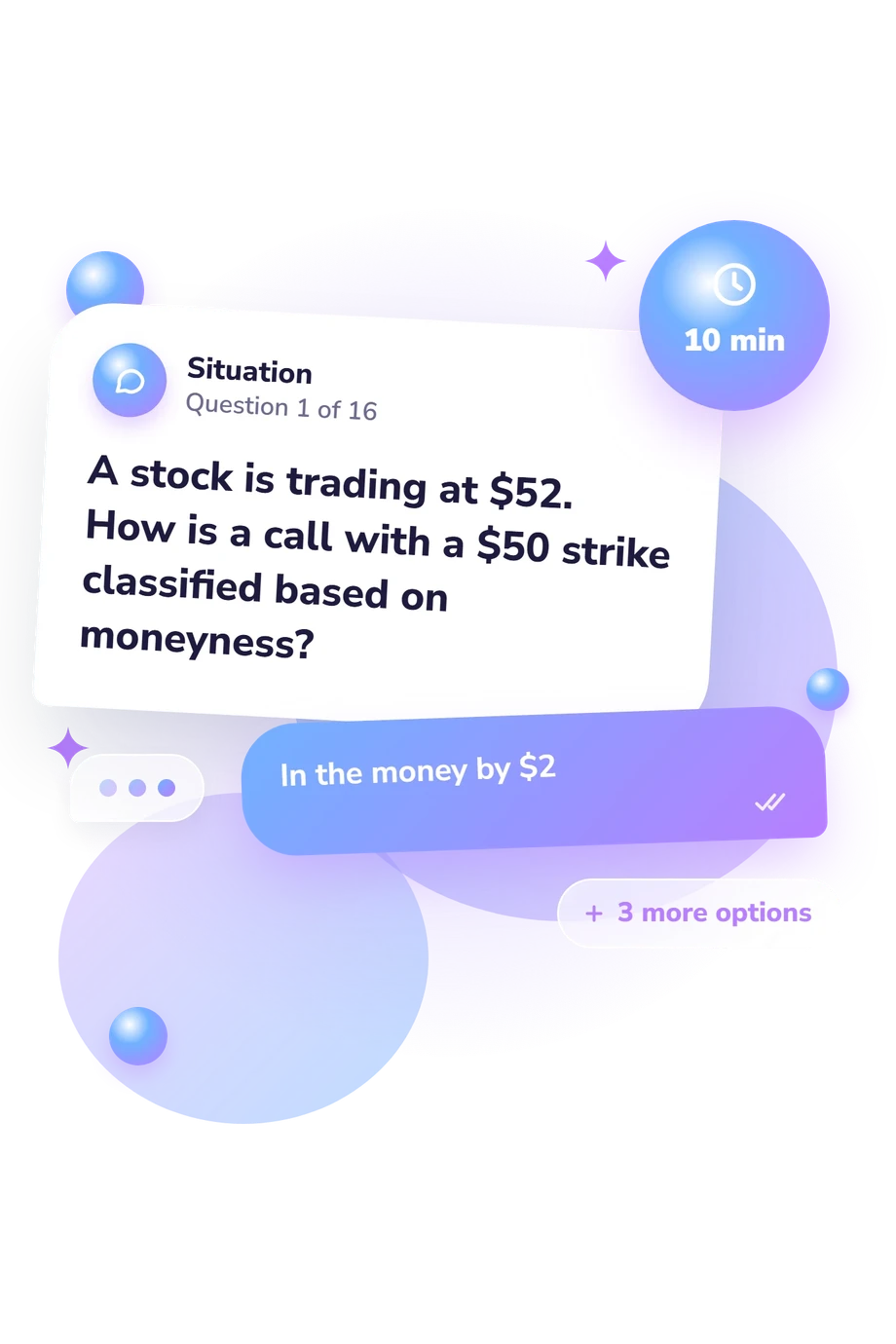
Example Questions From the Test
- In the money by $2
- Out of the money by $2
- At the money because the prices are close
- In the money by $50
- $4
- $2
- $0
- $64
- $47
- $50
- $53
- $56
Options Trading Quiz - Description and methodology of the test
People who want to check whether core concepts are settling into a usable framework can use this options knowledge test before studying further or discussing trades. This options trading quiz is intended for learners seeking a structured snapshot of their understanding without requiring a trading history. Its overall result can guide further study or trade-related learning by showing a broad level of readiness.
What This Assessment Explores
The questionnaire tests understanding rather than attitudes or trading history. In this options quiz, questions cover contract rights, moneyness, intrinsic value, order execution, volatility, time decay, assignment, and strategy payoffs. The total score reflects performance across these areas, not a separate result for each topic.
Topic groups include:
- Contract mechanics show whether you distinguish rights, obligations, assignment, exercise, and order handling.
- Pricing and strategy items show how you apply moneyness, intrinsic value, delta, theta, volatility, break-even points, and defined-risk payoffs.
- Options Trading Knowledge (0-16) reports correct answers as Foundation-building (0-6), Developing knowledge (7-12), or Strong knowledge (13-16). The first band suggests broader review of basic mechanics, the second more practice with calculations and strategy risk, and the third a solid command of core mechanics and common applications. This unvalidated educational score is not investing advice and does not predict trading results.
Methodology and Scientific Basis
To keep the format direct, the test presents its options quiz questions as brief market scenarios or concept prompts with several answer choices. The respondent selects the best answer; correct responses produce one overall educational score rather than separate topic scores. This questionnaire supports broad study planning but does not measure live execution, portfolio construction, or emotional discipline.
Hull and Basu (2016) provide a conceptual reference for calls, puts, payoffs, moneyness, and option sensitivities. The OCC’s standardized-options risk framework supports treatment of exercise, assignment, contract obligations, and loss exposure. Natenberg addresses volatility, strategy construction, and risk trade-offs, while Black-Scholes supplies a classic account of option pricing. The questionnaire is conceptually consistent with these sources; it is not presented as an adaptation, validation, or reproduction of any one.
Because the score is explicitly unvalidated, interpretation should stay close to the tested content. Results can reflect prior study, terminology familiarity, attention, and the way a person interprets hypothetical situations. Actual trading outcomes also depend on liquidity, spreads, fees, changing volatility, position sizing, and risk management, none of which this questionnaire measures.
- John C. Hull and Sankarshan Basu. Options, Futures, and Other Derivatives. 9th ed. Pearson Education, 2016. ISBN 9789332559417.
- The Options Clearing Corporation. Characteristics and Risks of Standardized Options. June 2024.
- Sheldon Natenberg. Option Volatility and Pricing: Advanced Trading Strategies and Techniques. 2nd ed. McGraw-Hill Education, 2014. ISBN 9780071818773.
- Fischer Black and Myron Scholes. The Pricing of Options and Corporate Liabilities. Journal of Political Economy, 81(3), 637-654, 1973. 10.1086/260062.
Updated: