
What Are You to Finn Wolfhard Quiz
How the Scales are Structured
Who Usually Takes This Test?
See How You Compare
Below is a preview of how scores are typically distributed across each scale.
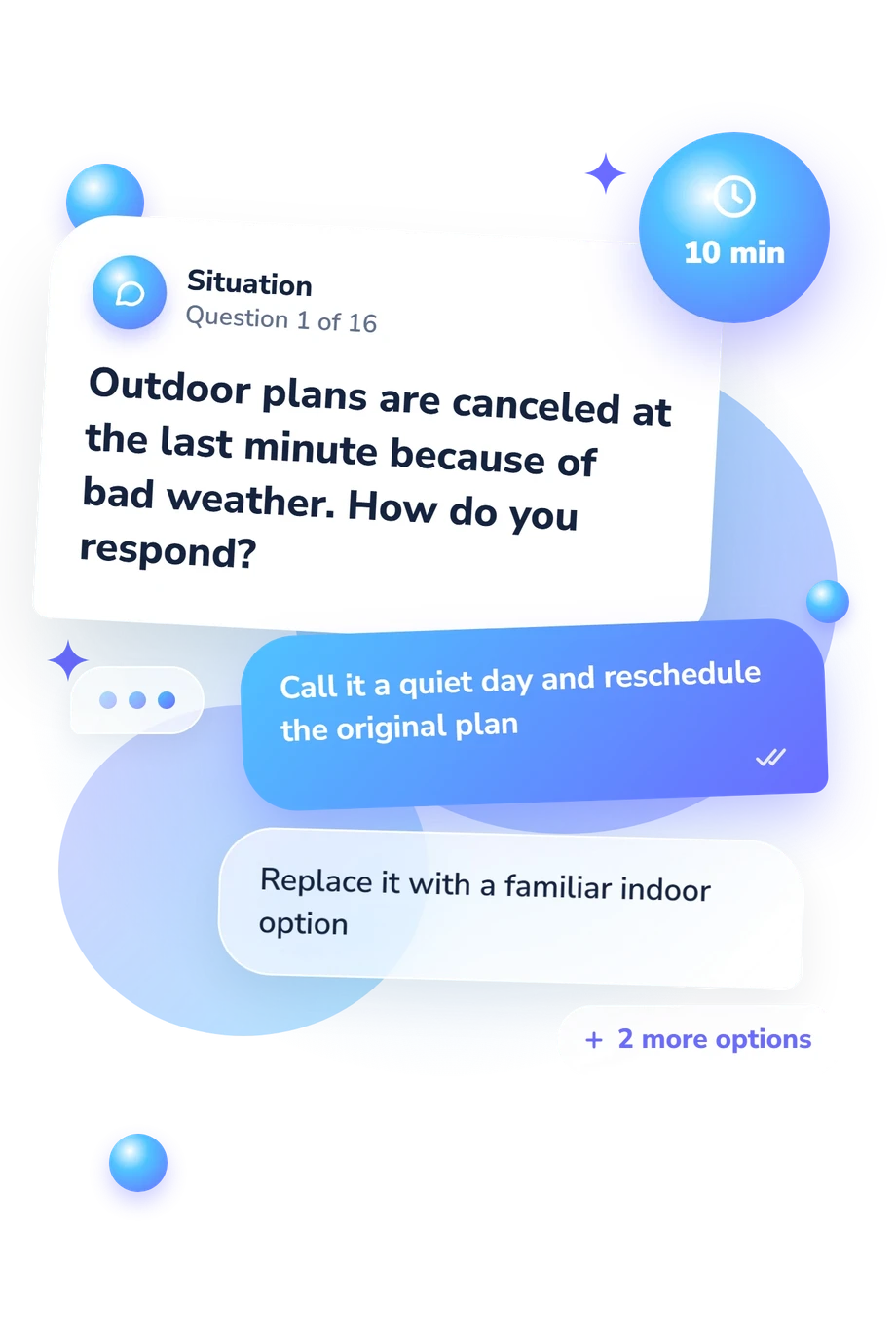
Example Questions From the Test
- Respect the boundary and avoid bringing the subject up again
- Offer an enjoyable distraction and keep things light
- Check in later so they know the invitation remains open
- Make unhurried space for them while letting them set the pace
- Let minor differences pass rather than make them central
- Ease the tension through a shared activity before revisiting it
- Take time to reflect, then discuss the disagreement calmly
- Speak candidly and work toward understanding what sits beneath it
- Keep the weekend restful and decide on one familiar activity
- Choose a destination and make a simple itinerary
- Set one anchor plan but leave plenty of room for discoveries
- Pick a direction, head out, and build the weekend as you go
What Are You to Finn Wolfhard Quiz - Description and methodology of the test
Designed for fans who enjoy imaginative personality formats, the What Are You to Finn Wolfhard Quiz invites you to consider what kind of connection you would naturally bring to an imagined friendship with Finn Wolfhard. This Finn Wolfhard quiz is most useful when read as a playful profile of preferences: it shows whether adventure, creativity, relaxed companionship, or emotional trust best matches your choices.
What This Assessment Explores
These imagined situations sort choices into four affinity dimensions, covering plans, companionship, disagreement, creative work, and openness. In this Who Am I to Finn Wolfhard Quiz, the result identifies the imagined connection style that best fits you. The result categories are:
- Adventure Buddy (0-12) measures planning: Planned Explorer (0-4) favors structure; Flexible Companion (5-8) accepts loose plans; Spontaneous Teammate (9-12) favors improvisation.
- Creative Collaborator (0-12) measures involvement: Appreciative Audience (0-4) supports work; Idea Exchange (5-8) contributes ideas; Co-Creator Energy (9-12) experiments together.
- Low-Key Hangout Friend (0-12) measures social rhythm: Occasion-Based Connection (0-4) prefers plans; Easygoing Company (5-8) balances routine and activity; Everyday Comfort (9-12) favors companionship.
- Trusted Confidant (0-12) measures openness: Respectful Distance (0-4) keeps boundaries; Steady Listener (5-8) offers support; Inner-Circle Trust (9-12) favors candid one-to-one openness.
Methodology and Scientific Basis
Each prompt offers four response options, with each choice expressing a different way of relating. Selections feed four independent affinity scores rather than one overall verdict. The highest score is the strongest match, while scores within one point indicate a blended profile. This makes the result comparative, not a measure of psychological health or relationship worth.
The questionnaire is conceptually consistent with the McGill Friendship Questionnaire-Friendship Functions (Mendelson & Aboud, 1999), which examines companionship, support, intimacy, and dependable connection. It also overlaps with the Network of Relationships Inventory and the Friendship Qualities Scale, especially their attention to relationship functions and qualities. Those published measures provide conceptual comparison, but they do not establish that this questionnaire was adapted from or validated against those instruments.
Viewed as a playful indication of who you might be to Finn Wolfhard in the imagined friendship, this Who Are You to Finn Wolfhard Quiz result supports imaginative self-reflection. The displayed bands are labels for their score ranges, and the choices compare imagined plans, companionship, creative work, and personal support. Self-report answers about an imagined situation can shift with mood, interpretation, and current preferences.
- Mendelson, Morton J., and Frances E. Aboud. “Measuring Friendship Quality in Late Adolescents and Young Adults: McGill Friendship Questionnaires.” Canadian Journal of Behavioural Science / Revue canadienne des sciences du comportement, 1999, 31(2), 130-132. 10.1037/h0087080
- Furman, Wyndol, and Duane Buhrmester. “The Network of Relationships Inventory: Behavioral Systems Version.” International Journal of Behavioral Development, 2009, 33(5), 470-478. 10.1177/0165025409342634
- Bukowski, William M., Betsy Hoza, and Michel Boivin. “Measuring Friendship Quality During Pre- and Early Adolescence: The Development and Psychometric Properties of the Friendship Qualities Scale.” Journal of Social and Personal Relationships, 1994, 11(3), 471-484. 10.1177/0265407594113011
Updated: