
K-Pop Personality Quiz
How the Scales are Structured
Who Usually Takes This Test?
See How You Compare
Below is a preview of how scores are typically distributed across each scale.
Example Questions From the Test
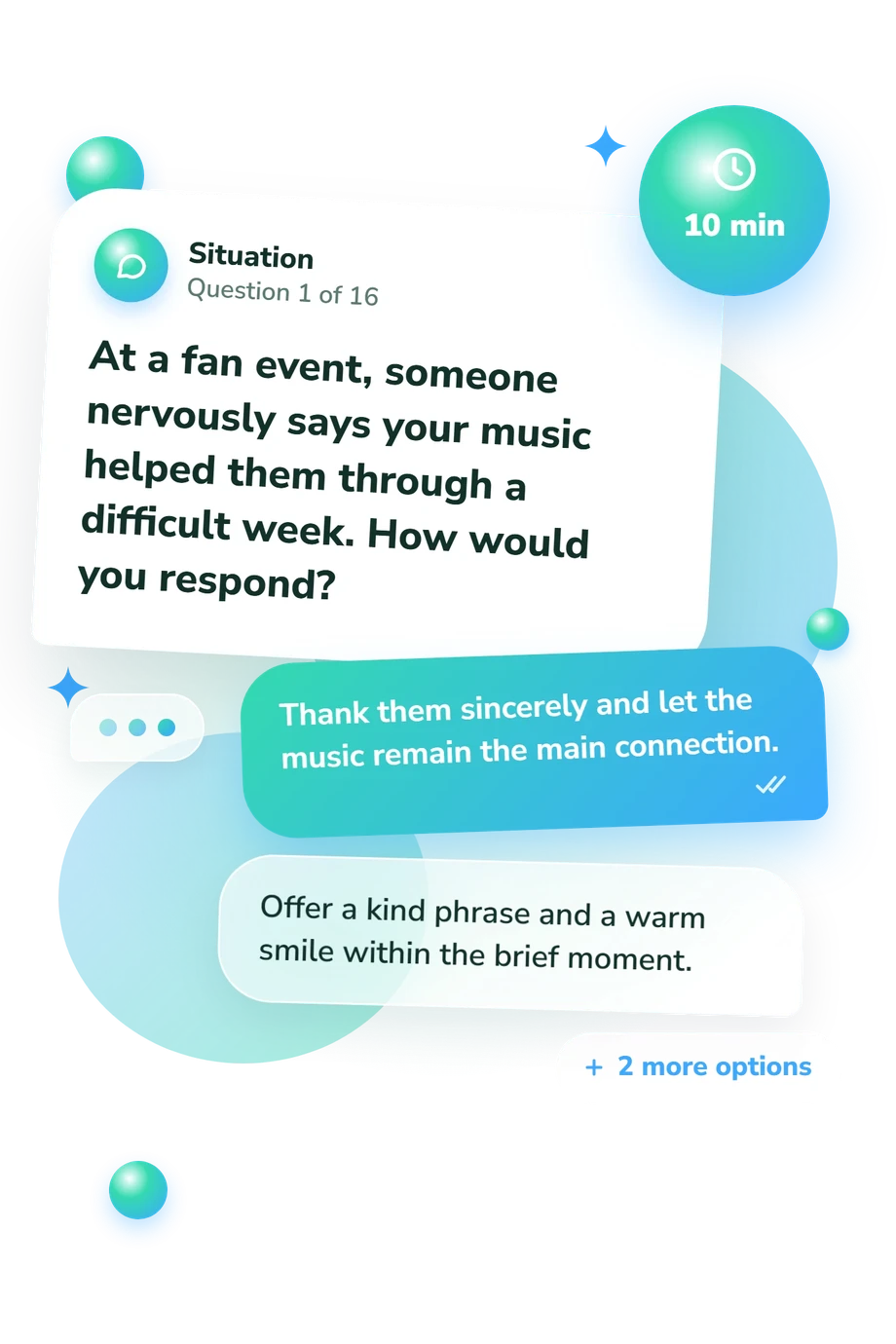
- Thank them sincerely and let the music remain the main connection.
- Offer a kind phrase and a warm smile within the brief moment.
- Acknowledge what they shared and give them a specific encouraging message.
- Listen closely, respond with care, and create a personal moment without making promises I cannot keep.
- Focus on completing my own part well once the decision is made.
- State which proposal I prefer and accept the group's choice.
- Point out the strengths of both ideas and suggest a workable compromise.
- Help each person feel heard, identify the shared goal, and shape a solution they can support together.
- Listen to the proposals and support whichever one creates the strongest immediate mood.
- Suggest a few styling references that match the selected song.
- Develop a theme that links the choreography, visuals, and emotional tone.
- Build a complete story world with symbols, character arcs, and ideas that can unfold across releases.
K-Pop Personality Quiz - Description and methodology of the test
Designed for fans who want to imagine their place in a group, the Kpop Personality Quiz turns preferences about concepts, visibility, practice, and connection into a readable profile. It suits anyone curious about performance style, whether you follow comebacks closely or simply enjoy K-pop’s creative world. If you wonder what K-pop idol you are, the result offers a role affinity rather than a fixed celebrity match.
What This Assessment Explores
Four dimensions describe possible contributions to a K-pop group: concept-building, visibility, technical refinement, and connection. Scenarios about comebacks, fans, choreography, and teamwork make these preferences concrete. The result dimensions are:
- Creative Storyteller (0-12) measures attraction to ideas and symbolism: Experience First (0-4), Concept Explorer (5-8), Creative Storyteller (9-12).
- Magnetic Center (0-12) measures comfort with visibility and bold expression: Behind-the-Scenes Energy (0-4), Growing Presence (5-8), Magnetic Center (9-12).
- Precision Performer (0-12) measures disciplined practice and polished execution: Instinct-Led Style (0-4), Focused Improver (5-8), Precision Performer (9-12).
- Warm Connector (0-12) measures chemistry, inclusion, and sincere exchange: Independent Rhythm (0-4), Responsive Teammate (5-8), Warm Connector (9-12).
If you wonder which K-pop idol you are, compare all four affinities: the highest is strongest, while scores within one point indicate a blend.
Methodology and Evidence Base
Each item presents a brief performance or group scenario with four response choices. The prompts cluster around concept creation, stage presence, technical control, and group connection, asking how you would contribute, react, practise, or connect. The displayed result compares four affinity totals: the highest is strongest, while scores within one point indicate a blend. Because the questionnaire does not state a point-by-point weighting rule, individual answers are best read as contributors to a profile rather than isolated conclusions.
Conceptually, the themes are consistent with Oh (2020) on identity expression in K-pop cover performance. They also resonate with Ma et al. (2022) on empathetic attachment in live-stream interaction and Elfving-Hwang (2018) on idol presentation and fan relationships. These sources provide context, not validation or authorship: this online K-pop personality test is not presented as an adaptation of those works.
The assessment is an online self-report reflection tool, so its bands are descriptive rather than population norms. Mood, recent experience, and self-awareness can influence choices; the profile is best used to notice tendencies, not define ability or identity.
- Chuyun Oh. “Identity Passing in Intercultural Performance of K-pop Cover Dance.” Journal of Intercultural Communication Research, 49(5), 472-483, 2020. 10.1080/17475759.2020.1803103
- Zhuang Ma, Linpei Song, Jue Zhou, Woonkian Chong, and Wantong Xiong. “How Do Comeback Korean Pop Performers Acquire Audience Empathetic Attachment and Sustained Loyalty? Parasocial Interactions Through Live Stream Shows.” Frontiers in Psychology, 13, Article 865698, 2022. 10.3389/fpsyg.2022.865698
- Joanna Katariina Elfving-Hwang. “K-Pop Idols, Artificial Beauty and Affective Fan Relationships in South Korea.” In Anthony Elliott (Ed.), Routledge Handbook of Celebrity Studies, pp. 190-201. Routledge, 2018. 10.4324/9781315776774-12
Updated: