
Punctuation Quiz
How the Scales are Structured
Who Usually Takes This Test?
See How You Compare
Below is a preview of how scores are typically distributed across each scale.
Example Questions From the Test
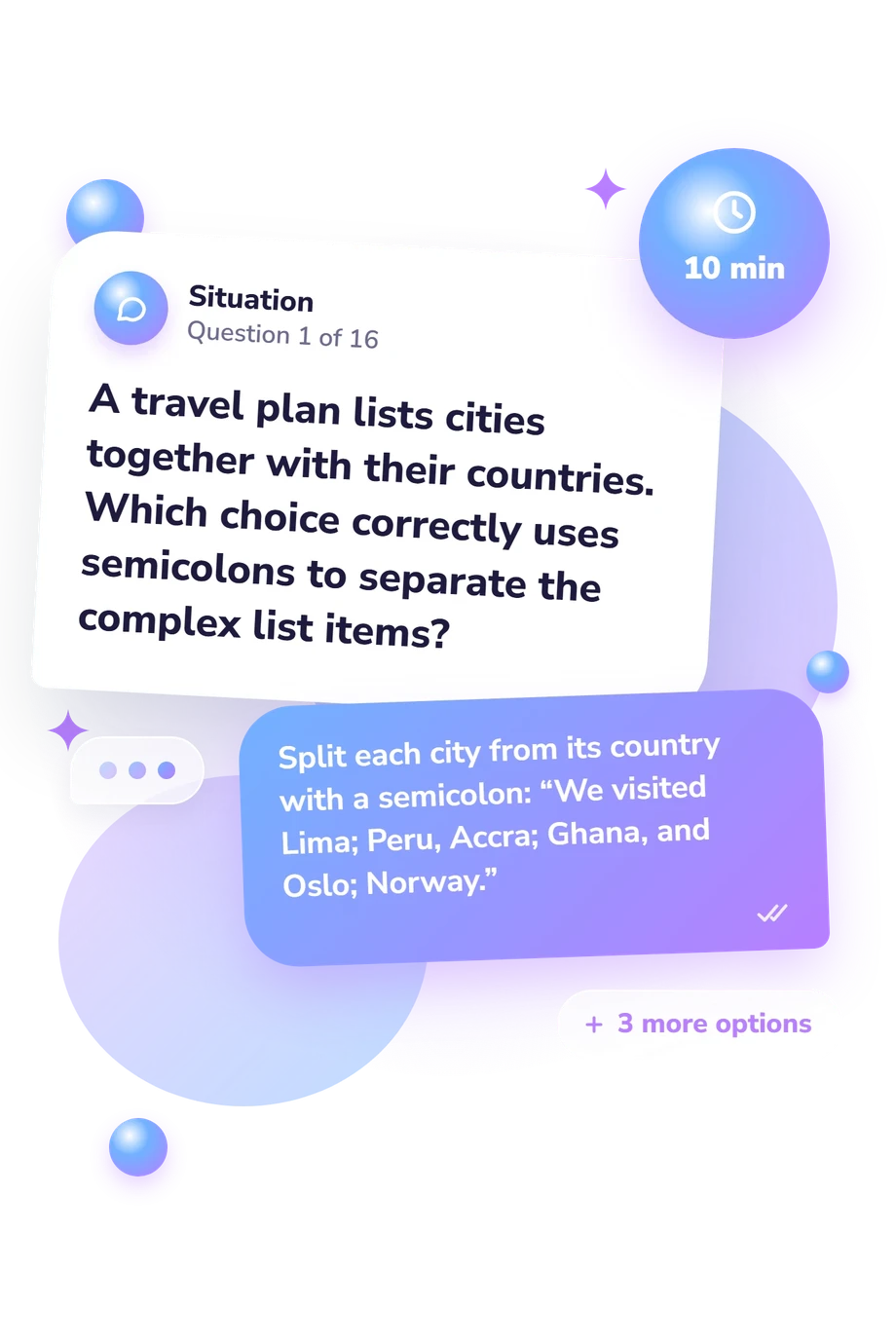
- Split each city from its country with a semicolon: “We visited Lima; Peru, Accra; Ghana, and Oslo; Norway.”
- Put a semicolon between the verb and the first destination: “We visited; Lima, Peru; Accra, Ghana; and Oslo, Norway.”
- Keep each city-country pair together and separate the pairs: “We visited Lima, Peru; Accra, Ghana; and Oslo, Norway.”
- Combine a comma and semicolon after each country: “We visited Lima, Peru,; Accra, Ghana,; and Oslo, Norway.”
- For the trip, remember: boots, water, and sunscreen.
- The trip requires three items: boots, water, and sunscreen.
- The essential items are: boots, water, and sunscreen.
- Please pack: boots, water, and sunscreen.
- Use a semicolon before the name: “Let’s eat; Maya.”
- Place a comma after the verb: “Let’s, eat Maya.”
- Write the request without internal punctuation: “Let’s eat Maya.”
- Set off the name with a direct-address comma: “Let’s eat, Maya.”
Punctuation Quiz - Description and methodology of the test
For readers who want a practical check of formal written English, this punctuation quiz focuses on choosing marks that clarify sentence structure rather than recalling isolated terminology. An English punctuation assessment can help students, teachers, editors, and everyday writers review their command of standard conventions. The outcome provides an overall indication of punctuation knowledge across the tested conventions, not overall writing ability.
What This Assessment Measures
The questions assess practical control of standard punctuation in sentences and editing situations. They distinguish marks that separate clauses, organize complex lists, show possession, introduce interruptions, format dialogue, and clarify whether information is essential or additional. This suits readers who want a punctuation knowledge test, not a measure of vocabulary, creativity, or composition skill.
The main question groups are:
- Semicolons test separation of complex list items and closely related independent clauses.
- Commas test introductory clauses, coordinating conjunctions, direct address, and extra information.
- Apostrophes test contractions and singular or plural possession.
- Other marks test lists, interruptions, modifiers, parentheses, and dialogue.
- Sentence-boundary and embedded-question items assess punctuation in those structures.
The single scale is Punctuation Knowledge (0-16): Foundations to review (0-6), Developing control (7-12), or Strong knowledge (13-16). It reflects performance on these conventions, not overall writing ability.
Methodology and Evidence Base
Each item presents a sentence or editing problem with four alternatives. Selecting the option that follows standard written English makes the method recognition-based rather than a test of spontaneous writing. In this punctuation practice test, distractors target comma placement, indirect questions, apostrophes, compound modifiers, and sentence boundaries.
The bands summarize performance on the questionnaire. Because no separate weighting system is stated, no per-answer formula is inferred; missed rule types are better treated as prompts for focused practice than as a complete measure of editing ability.
Two sources provide the closest conceptual context. Ardanouy et al. (2025) describe punctuation as serving syntactic and prosodic functions, while Howard (2012) examines how internal marks represent sentence structure. The questionnaire is conceptually consistent with these works, not an adaptation or validated version. No norms or validation status are established for this online questionnaire.
Responses can also reflect attention, familiarity with formal written English, and current context. A multiple-choice result may not match spontaneous editing performance, so interpret it as an overall indication of punctuation knowledge across the tested conventions.
- Ardanouy, Estelle, Alexandra Ryken, and S. Hélène Deacon. (2025). A Pilot Study Exploring Elementary School-Aged Children’s Knowledge of the Syntactic and Prosodic Functions of Punctuation. Reading Psychology, 46(8), 868-885. 10.1080/02702711.2025.2523045
- Howard, Pamela Sue. (2012). Development of a Measure Assessing Knowledge and Use of Internal Punctuation to Signal Syntactic Relationships. Doctoral dissertation, University of Denver.
Updated: