
Dosage Calculation Quiz
How the Scales are Structured
Who Usually Takes This Test?
See How You Compare
Below is a preview of how scores are typically distributed across each scale.
Example Questions From the Test
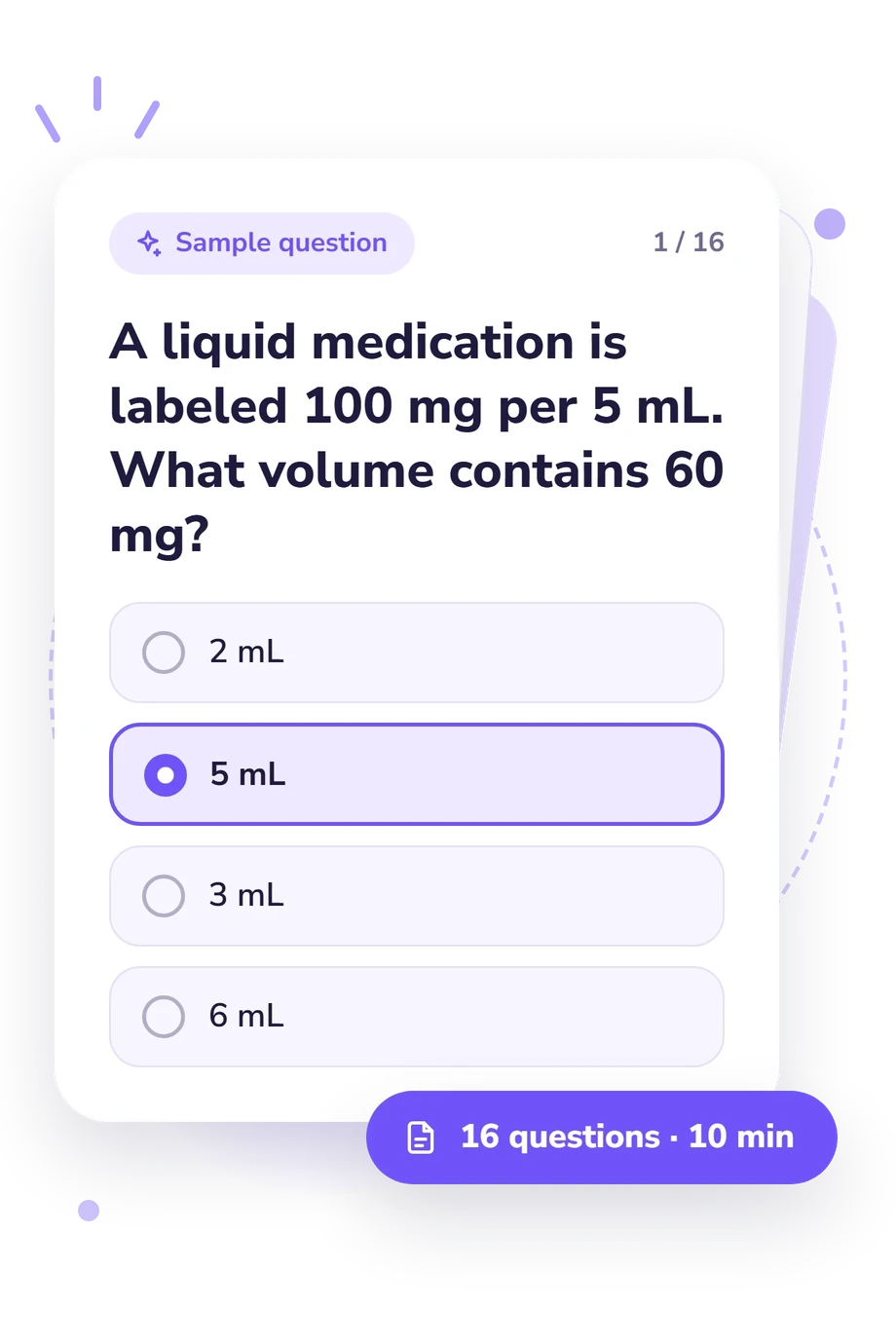
- 2 mL
- 5 mL
- 3 mL
- 6 mL
- 120 mL/hour
- 50 mL/hour
- 200 mL/hour
- 12 mL/hour
- 1 mL
- 2 mL
- 25 mL
- 5 mL
Dosage Calculation Quiz - Description and methodology of the test
Anyone reviewing medication arithmetic before coursework, clinical placement, or supervised practice can use this dosage calculation quiz to check how confidently they handle common numerical tasks. As a dosage calculation practice quiz, it gives learners a focused snapshot of numerical performance. The result points to areas that may deserve further practice, such as conversions, dose-volume relationships, and infusion-rate calculations.
What This Assessment Explores
These questions examine how well a learner turns medication orders into numerical answers. A med math quiz like this can reveal which basic operations deserve review before supervised practice, especially conversions, dose-volume relationships, and infusion-rate calculations.
The item themes show what the questions ask you to do:
- Unit conversion checks whether you can move between grams, milligrams, micrograms, kilograms, pounds, and related measures.
- Dose and concentration work shows whether you can express an order as tablets, liquid volume, or injectable volume.
- Weight-based and divided-dose problems test mg/kg reasoning and the calculation of scheduled portions.
- Infusion problems measure calculation of pump rates, drip rates, and volume delivered over time.
The displayed result summarizes performance on these educational problems and supports targeted review.
Methodology and Scientific Basis
Each item presents a medication calculation and four answer choices. Selecting one alternative tests applied arithmetic rather than a free-form explanation. The sample covers unit conversion, dose per volume, tablet quantities, weight-based dosing, and infusion rates, with one problem asking the learner to compare a dose with a recommended range.
The questionnaire displays an educational Dosage Calculation Knowledge result from 0-16, providing one overall indication of performance across the sampled calculation tasks. This questionnaire is a dosage and calculations quiz that supports study planning through numerical practice. Foundations to strengthen covers 0-6, Developing knowledge covers 7-12, and Strong knowledge covers 13-16.
McMullan, Jones and Lea (2010) address medication-safety concerns relevant to these items, while their 2011 interactive e-drug-calculation study offers related practice-oriented context; neither source is the online questionnaire or its scoring model.
This questionnaire is a drug calculation quiz that captures only the sampled tasks and may be affected by attention, arithmetic fluency, or current context. The educational score is not a validated clinical cutoff and must not guide real dosing; follow local protocols and independent-check requirements.
- Miriam McMullan, Ray Jones, and Susan Lea. Patient safety: Numerical skills and drug calculation abilities of nursing students and Registered Nurses. Journal of Advanced Nursing, 2010, 66(4), 891-899. 10.1111/j.1365-2648.2010.05258.x
- Miriam McMullan, Ray Jones, and Susan Lea. The effect of an interactive e-drug calculations package on nursing students’ drug calculation ability and self-efficacy. International Journal of Medical Informatics, 2011, 80(6), 421-430. 10.1016/j.ijmedinf.2010.10.021
- Pilar Fuster-Linares, Cristina Alfonso-Arias, Alberto Gallart Fernández-Puebla, Encarna Rodríguez-Higueras, Silvia García-Mayor, Isabel Font-Jimenez, and Mireia Llaurado-Serra. Assessing Nursing Students’ Self-Perceptions about Safe Medication Management: Design and Validation of a Tool, the NURSPeM. International Journal of Environmental Research and Public Health, 2022, 19(8), 4663. 10.3390/ijerph19084663
Updated: