
Online Financial Accounting Quiz
How the Scales are Structured
Who Usually Takes This Test?
See How You Compare
Below is a preview of how scores are typically distributed across each scale.
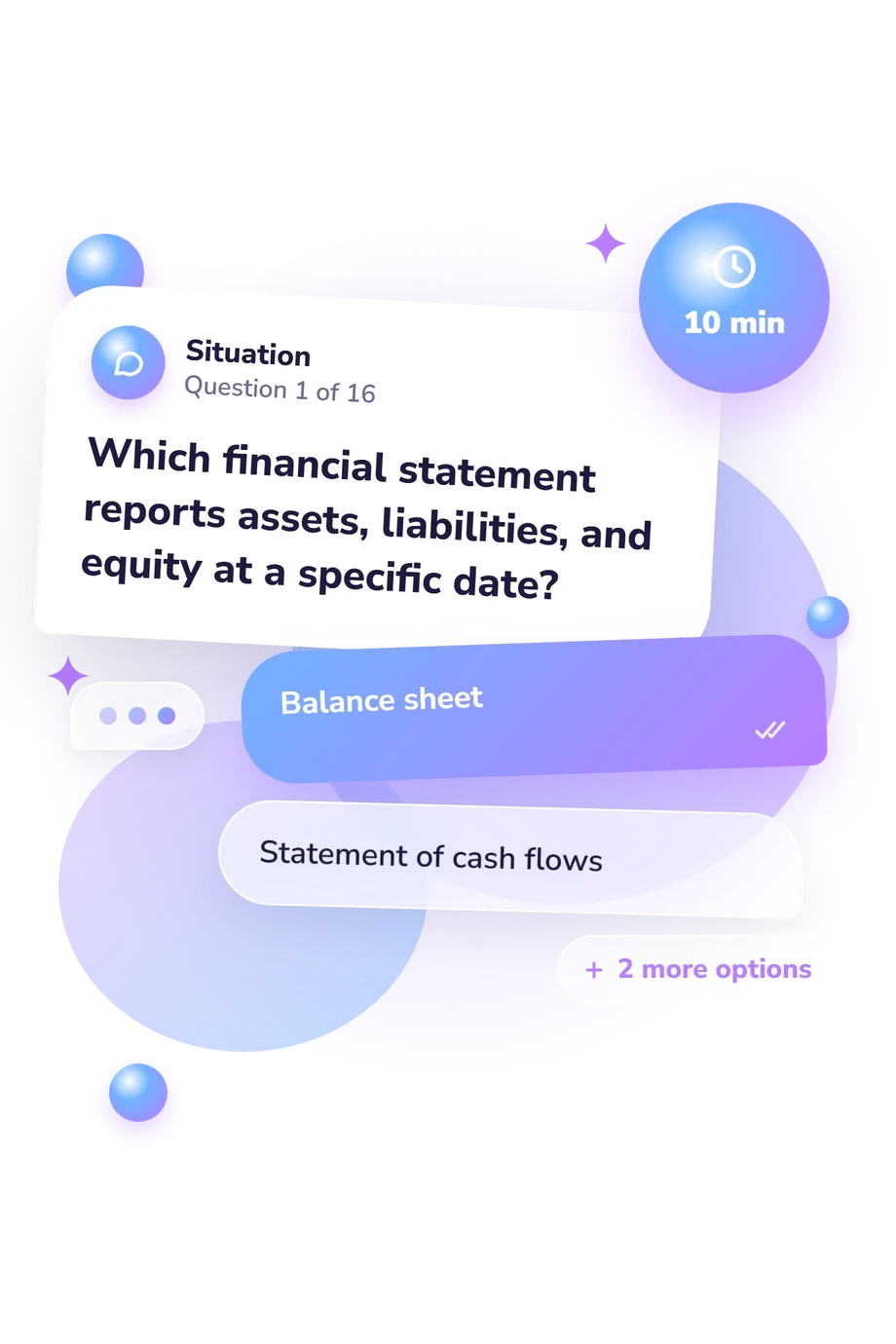
Example Questions From the Test
- Balance sheet
- Statement of cash flows
- Statement of retained earnings
- Income statement
- Subtract them from the company's book balance
- Add them to the bank statement balance
- Subtract them from the bank statement balance
- Add them to the company's book balance
- A transaction was omitted entirely from the accounting records
- A debit entry was recorded without its corresponding credit
- A $900 debit was posted as $90 while the credit remained $900
- A credit balance was accidentally listed in the debit column
Online Financial Accounting Quiz - Description and methodology of the test
People reviewing introductory accounting can use this assessment to check whether they apply reporting rules and transaction logic in realistic situations. This financial accounting quiz helps learners who are returning to core material, preparing for a course, or deciding where their practice is most needed. Its emphasis is practical: it tests whether familiar rules can guide an answer. The online financial accounting quiz can therefore point toward focused study priorities.
What This Assessment Measures
The questions link accounting rules to business events. As an accounting knowledge quiz, it asks you to identify statements, apply the accounting equation, trace account changes, and complete short calculations. It suits learners choosing topics for review or checking core skills.
The main areas represented are:
- Financial statements and the accounting equation show how assets, liabilities, equity, revenue, and expenses relate.
- Transaction analysis shows how purchases, collections, and payments affect accounts.
- Adjusting entries show how accruals, deferrals, depreciation, and unearned amounts fit the proper period.
- Basic analysis shows whether you can calculate gross profit and the current ratio.
The displayed scale, Financial Accounting Knowledge (0-16), counts correct answers. Foundation Building (0-6) signals review; Developing Knowledge (7-12) shows understanding with practice useful; Strong Knowledge (13-16) indicates command of these foundations. Use the result to target revision, not to cover every topic.
Methodology and Evidence Base
Each item presents a short problem, definition, or calculation with four answer choices. Choosing the best option measures performance on the tested content. The total equals the number of correct responses, making this an objective multiple-choice assessment rather than a self-rating scale.
The structure is conceptually consistent with the Test of Basic Bookkeeping Knowledge (WBB) described by Helm and Wimmer (2012), but this questionnaire is not presented as its reproduction or validated adaptation. Franklin, Graybeal, and Cooper (2019) provide the accounting framework for statements, entries, adjustments, inventory, depreciation, cash flows, and ratios. Helm (2015) supports viewing accounting competence as developing knowledge that can grow through instruction and practice.
For learners using this financial accounting test's result to plan study, it provides a descriptive snapshot of performance on these items. It is not norm-referenced, and it has no stated evidence for reliability, validity, or diagnostic classification. Guessing, prior coursework, calculation slips, and topic selection can affect performance. A low result identifies foundations to revisit; a high result shows success on this set without proving mastery of all financial accounting.
- Helm, Christoph, and Barbara Wimmer. 2012. How Can Learning Success in Accounting Be Measured? Developing a Measurement Instrument. wissenplus 5 (11-12): 24-29.
- Helm, Christoph. 2015. Determinants of Competence Development in Accounting in Upper Secondary Education. Empirical Research in Vocational Education and Training 7 (10): 1-36. 10.1186/s40461-015-0022-8.
- Franklin, Mitchell, Patty Graybeal, and Dixon Cooper. 2019. Principles of Accounting, Volume 1: Financial Accounting. Houston, TX: OpenStax.
Updated: