
Core Aesthetic Quiz
How the Scales are Structured
Who Usually Takes This Test?
See How You Compare
Below is a preview of how scores are typically distributed across each scale.
Example Questions From the Test
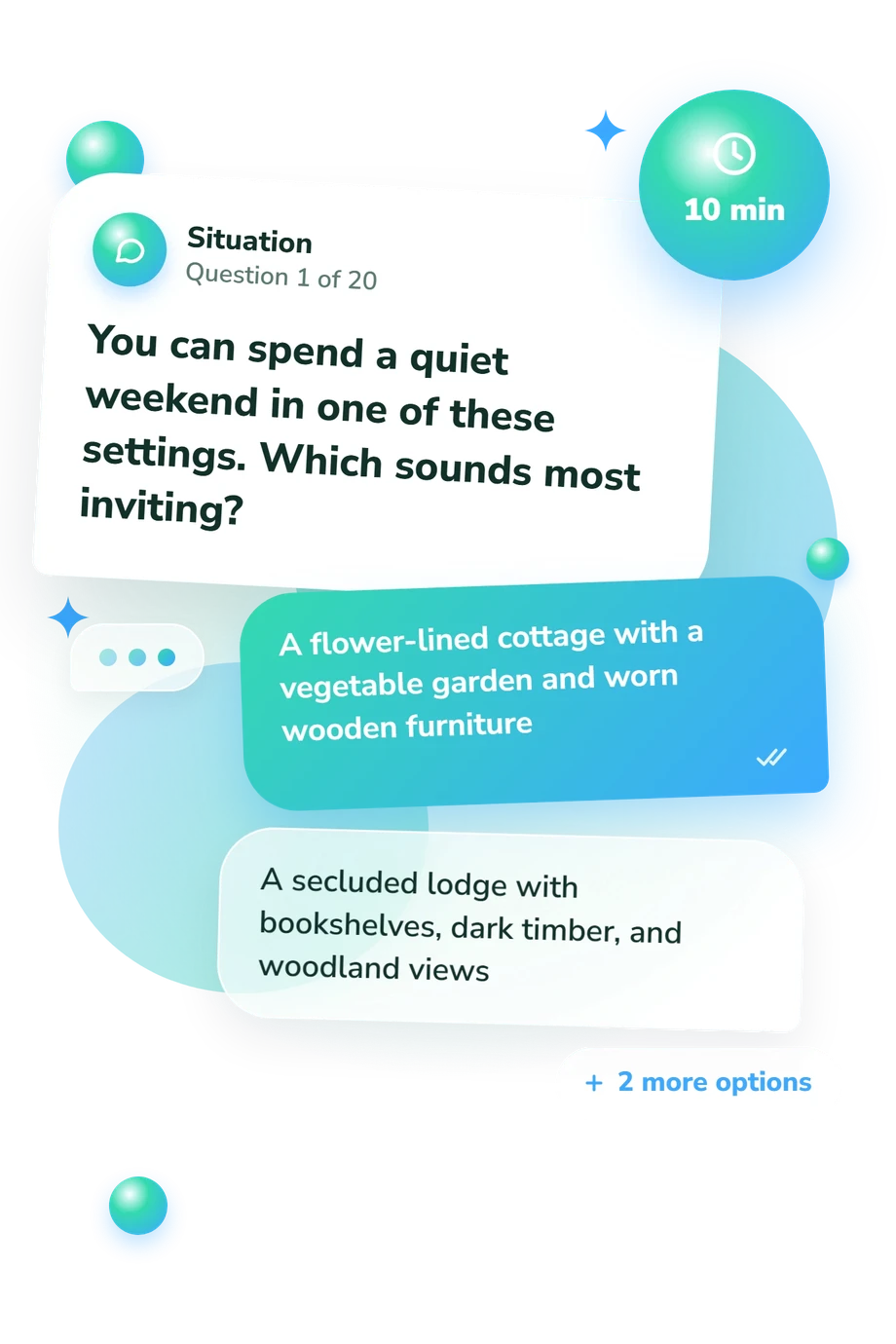
- A flower-lined cottage with a vegetable garden and worn wooden furniture
- A secluded lodge with bookshelves, dark timber, and woodland views
- A streamlined city loft with concrete floors and almost no decoration
- A colorful roadside motel filled with playful retro details
- A translucent music player or compact gadget in a bright candy color
- A colorful retro game console with bold geometric styling
- A wooden radio with brass controls and a gently aged finish
- A plain device whose controls can be hidden when it is not in use
- Black layers with lace, velvet, metal details, or dramatic boots
- A dark tailored outfit with an old-world coat and polished shoes
- A simple monochrome look with almost no accessories
- A bright nostalgic outfit with glossy fabric and colorful jewelry
Core Aesthetic Quiz - Description and methodology of the test
People curious about the visual language of their clothes, rooms, media, and routines can use this core quiz to see which aesthetic directions recur in their choices. It is intended for self-reflection, not for assigning a permanent identity. As a what core am i quiz, it turns everyday preferences into a readable profile of atmosphere, objects, and style.
What This Assessment Explores
These dimensions read taste through settings, objects, clothing, lighting, and arrangement. A result may show one affinity or a close blend, helping you describe taste without treating style as fixed. In this format, a what core are you quiz can name the directions that recur most strongly.
The five result dimensions are:
- Cottagecore (0-12) measures pastoral warmth and handmade nature; Subtle affinity (0-4), Growing affinity (5-8), Strong affinity (9-12).
- Dark Academia (0-12) measures scholarly nostalgia and historical taste; Subtle affinity (0-4), Growing affinity (5-8), Strong affinity (9-12).
- Goth (0-12) measures dark drama and romantic mystery; Subtle affinity (0-4), Growing affinity (5-8), Strong affinity (9-12).
- Minimalist (0-12) measures clarity, restraint, and function; Subtle affinity (0-4), Growing affinity (5-8), Strong affinity (9-12).
- Y2K (0-12) measures playful nostalgia and glossy, early-digital style; Subtle affinity (0-4), Growing affinity (5-8), Strong affinity (9-12).
Methodology and Evidence Base
Each item presents an everyday scenario and four contrasting choices covering environments, objects, creative projects, outfits, lighting, and social settings. Selecting the most appealing option makes this a forced-choice self-report rather than a free description of style. It functions as a what core aesthetic are you quiz by turning preferences into comparative scores.
Each direction receives a total from 0 to 12, without a stated weighting rule. The highest total is the strongest affinity; any direction within one point joins a blended result. The bands are descriptive, not population norms or clinical cutoffs.
Internet aesthetics (Giolo and Berghman, 2023) provides the closest conceptual frame for online style as meaning-making and self-presentation. Fredenburg (2025) links core labels with identity and algorithmic communities; Hanquinet, Roose, and Savage (2014) support viewing taste as socially patterned. Healey and Fraser (2017) add a reference on subcultural style and spirituality. These sources offer context, not evidence that this questionnaire adapts or validates their instruments.
Because self-report reflects mood, current interests, and self-awareness, read the result as a snapshot of aesthetic affinity rather than a fixed identity.
- Giolo, Guilherme, and Michaël Berghman. “The aesthetics of the self: The meaning-making of Internet aesthetics.” First Monday, volume 28, number 3, 2023. 10.5210/fm.v28i3.12723.
- Fredenburg, Jill Nicole. “At the ‘Core’: Identity and Internet Aesthetics in the Age of Algorithmic Community Building.” PhD dissertation, University of Memphis, 2025.
- Hanquinet, Laurie, Henk Roose, and Mike Savage. “The Eyes of the Beholder: Aesthetic Preferences and the Remaking of Cultural Capital.” Sociology, volume 48, number 1, 2014, pages 111-132. 10.1177/0038038513477935.
- Healey, Kevin, and Leigh Fraser. “A Common Darkness: Style and Spirituality in Goth Subculture.” Journal of Popular Music Studies, volume 29, 2017, article e12231. 10.1111/jpms.12231.
Updated: