
Weed Quiz
How the Scales are Structured
Who Usually Takes This Test?
See How You Compare
Below is a preview of how scores are typically distributed across each scale.
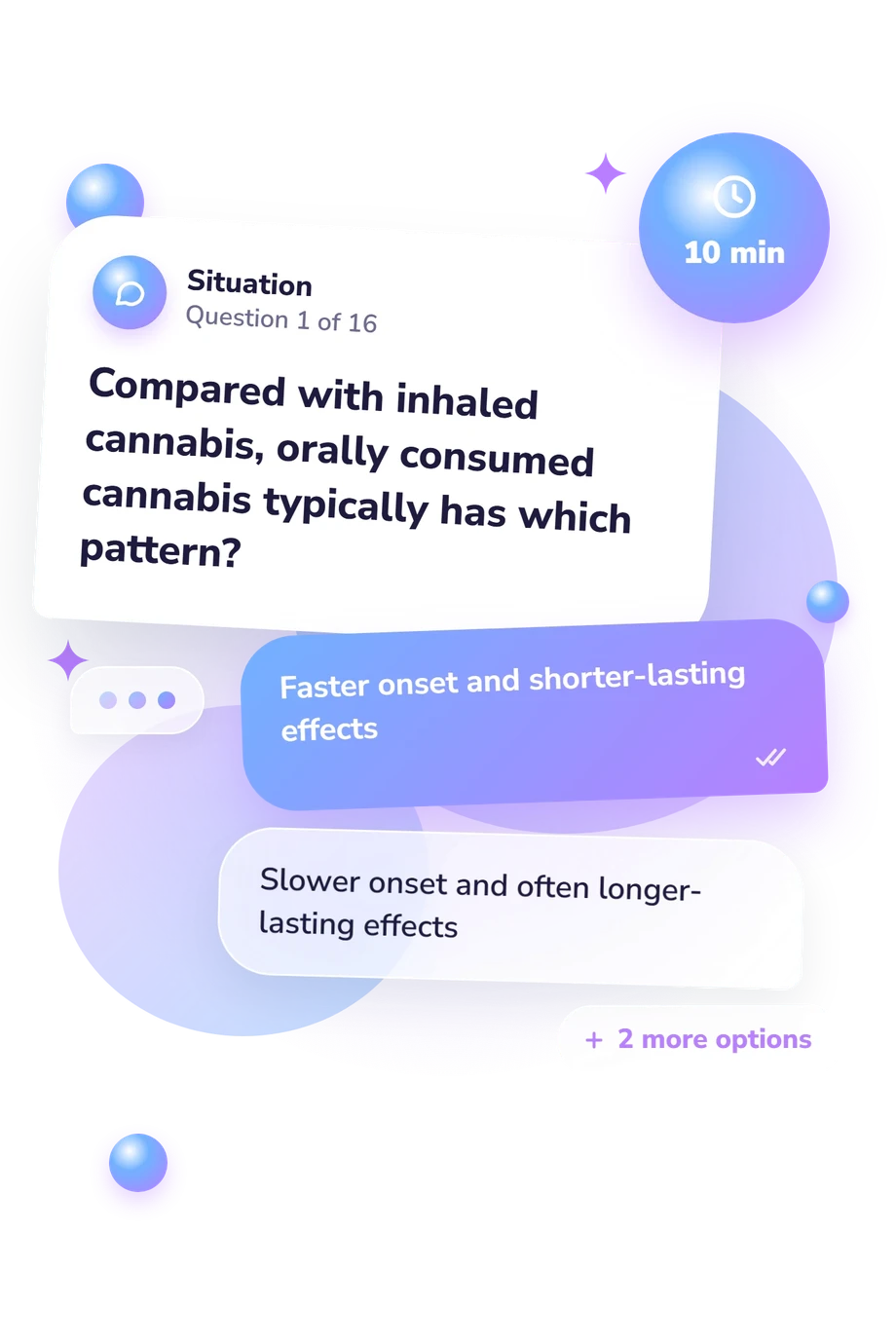
Example Questions From the Test
- Faster onset and shorter-lasting effects
- Slower onset and often longer-lasting effects
- Faster onset and longer-lasting effects
- Exactly the same onset and duration
- Permanent loss of hearing and tooth discoloration
- Instant unconsciousness and slowed wound healing
- Improved sleep and increased appetite in every case
- Irritability and sleep difficulties
- Hemp seed oil
- CBD
- CBG
- THC
Weed Quiz - Description and methodology of the test
People who want to check their understanding of cannabis safety and effects can use this weed quiz as a focused knowledge review, not a measure of identity or consumption history. It covers practical decisions involving impairment, products, dosing, interactions, storage, and emergencies. This cannabis quiz shows which core ideas are secure and which topics may deserve another look.
What This Assessment Explores
This marijuana quiz measures cannabis knowledge across effects, products, impairment, health precautions, and emergencies. Its scenarios test recognition of delayed edible effects, impairment, medication interactions, and storage risks.
The main areas represented by the questions are:
- Cannabis effects and pharmacology show understanding of THC, CBD, onset, duration, and delayed oral effects.
- Impairment-related items show recognition of effects on attention, coordination, judgment, and driving.
- Products and dosing assess interpretation of serving labels and recognition of ways to reduce accidental overconsumption.
- Health, interactions, and emergencies show understanding of respiratory concerns, dependence, medication questions, storage, and urgent symptoms.
The displayed scale is Weed Knowledge (0-16), with one point for each correct answer. Foundations to build (0-6) marks core ideas to review; Developing knowledge (7-12) shows many essentials with meaningful gaps; Strong knowledge (13-16) shows a well-rounded grasp of the covered topics.
Methodology and Evidence Base
This pothead quiz uses short factual prompts or scenarios with four answer choices. Scoring follows a direct answer-key method: every correct response earns one point, and the displayed bands describe levels of educational knowledge.
The questionnaire is conceptually consistent with the Cannabis Knowledge Assessment Tool (Bayat et al., 2023), a published cannabis-knowledge measure. The National Academies’ 2017 review supports content about impairment, respiratory effects, dependence, interactions, and related health considerations. Huestis (2007) provides pharmacokinetic context for inhaled versus oral routes, delayed effects, and why detection does not establish current impairment.
Prior experience is not required because the items test factual understanding of effects, products, impairment, precautions, and emergencies rather than identity or use frequency. Guessing, wording, personal knowledge, and changing product or legal information can affect performance. The score cannot establish current impairment, a diagnosis, or an individual’s likely response; immediate safety decisions should follow the situation and current symptoms, not this result alone.
- Bayat A, Mansell H, Taylor J, Szafron M, Mansell K. The development of a Cannabis Knowledge Assessment Tool (CKAT). PLoS One. 2023;18(9):e0291113. 10.1371/journal.pone.0291113
- National Academies of Sciences, Engineering, and Medicine. The Health Effects of Cannabis and Cannabinoids: The Current State of Evidence and Recommendations for Research. Washington, DC: The National Academies Press; 2017. 10.17226/24625
- Huestis MA. Human cannabinoid pharmacokinetics. Chemistry & Biodiversity. 2007;4(8):1770-1804. 10.1002/cbdv.200790152
Updated: