
Medical Assistant Quiz
How the Scales are Structured
Who Usually Takes This Test?
See How You Compare
Below is a preview of how scores are typically distributed across each scale.
Example Questions From the Test
- Label it later from memory after finishing all collections
- Label it in the patient's presence using the required identifiers
- Ask another employee to label it at the end of the shift
- Use the room number as the primary patient identifier
- A training chart containing no real or identifiable patient data
- An unused blank medical history form
- A public brochure listing clinic opening hours
- A patient's name linked to the patient's laboratory result
- Only patients with a confirmed bloodborne infection
- Only patients receiving invasive procedures
- All patients, regardless of known or suspected infection status
- Only patients treated in isolation rooms
Medical Assistant Quiz - Description and methodology of the test
People preparing for front-office and clinical support work can use this assessment to check whether everyday medical-assisting knowledge is secure across safety, communication, procedures, and urgent response. The medical assistant quiz is intended for learners who want a structured review before supervised practice or formal study. As a medical assistant practice quiz, it helps identify topics for focused revision without treating one score as a complete judgment of readiness.
What This Assessment Explores
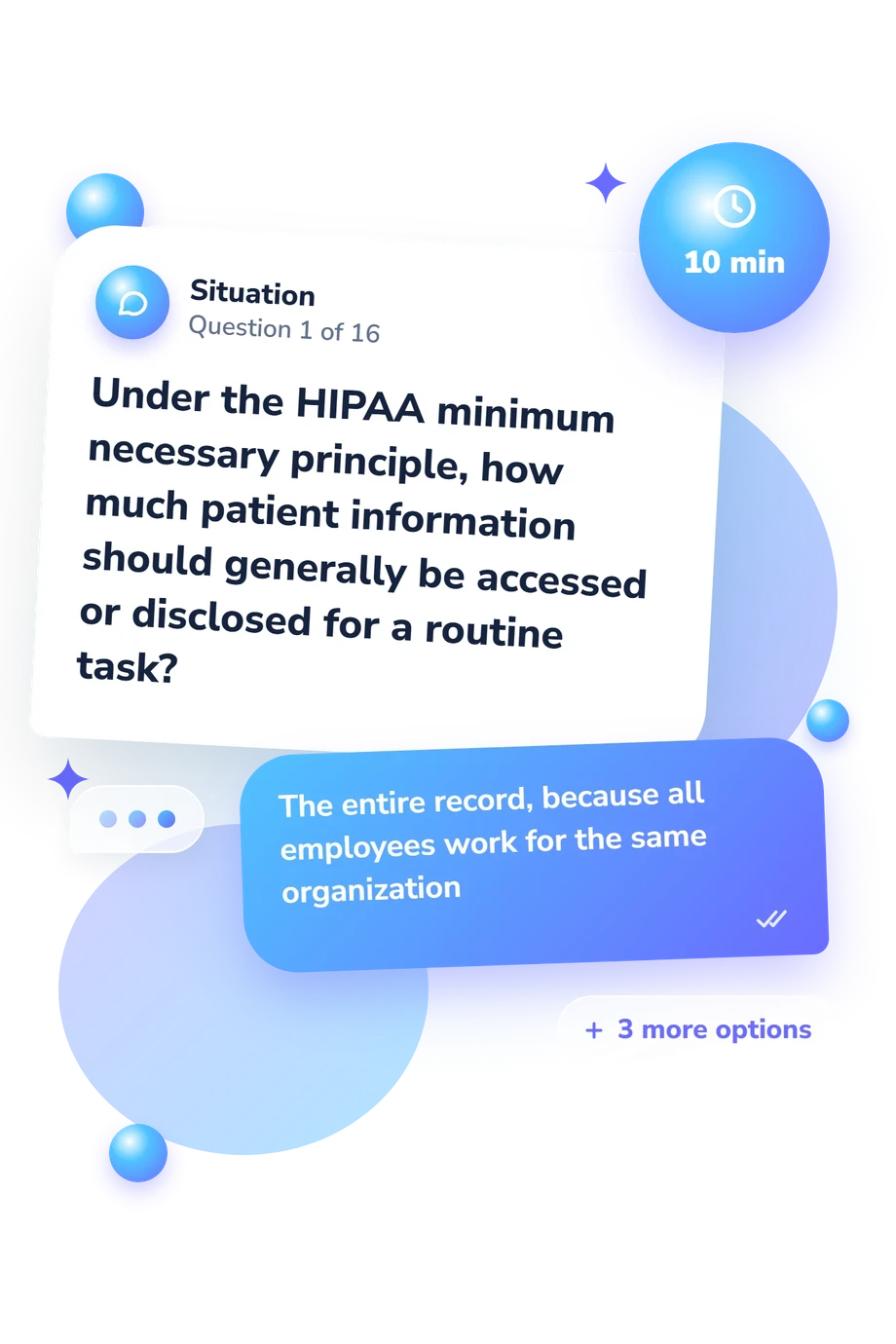
The questions sample knowledge for routine ambulatory care rather than opinions. They cover privacy and minimum-necessary disclosure, infection prevention, specimen handling, vital signs, ECG preparation, positioning, medication-order clarification, emergency escalation, and workplace exposures. In this ma quiz, each short scenario asks the learner to choose the best action from four options, so the result reflects recognition of appropriate priorities in common situations.
The questionnaire reports one educational scale, Medical Assistant Knowledge: 0-16. It describes command of the terminology, safety procedures, and routine clinical workflows sampled here while the displayed bands provide a study signal:
- Foundation to build (0-6) indicates that core terminology, safety procedures, and routine workflows need review.
- Developing knowledge (7-12) indicates that many essentials are present but targeted study and supervised practice may help.
- Strong foundation (13-16) indicates broad command of the concepts sampled in this assessment.
Methodology and Evidence Base
The response format is a four-choice, single-best-answer check. Scenarios ask for the safest or most appropriate action, while the result uses the stated educational bands. Item weights, a formal scoring algorithm, standardized norms, reliability estimates, and a certification decision rule are not published.
Content is conceptually consistent with the NHA CCMA Test Plan (2022), covering patient care, infection control, laboratory work, phlebotomy, ECG testing, communication, and ethics. It is not a standardized administration of that plan. Blesi and Ferrari and Bonewit-West provide procedural context, while Hull et al. (2013) show how structured skills assessment can reveal gaps that written knowledge may miss.
Learners using a practice quiz for medical assistant certification can treat the result as a revision map. It works alongside procedure review and supervised practice. A free quiz for medical assistants offers a way to revisit topics without a cost barrier. Performance remains sensitive to attention, prior study, wording, context, and honest self-report, so the unvalidated score cannot establish competence or authorize clinical judgment; workplace protocols, licensed supervision, and immediate escalation of urgent symptoms still govern practice.
- National Healthcareer Association. (2022). NHA Certified Clinical Medical Assistant (CCMA) Test Plan for the CCMA Exam. National Healthcareer Association.
- Hull, Tammie, Patricia Taylor, Emily Turo, Joan Kramer, Susan Crocetti, and Maura McGuire. (2013). Implementation of a Training and Structured Skills Assessment Program for Medical Assistants in a Primary Care Setting. Journal for Healthcare Quality, 35(4), 50-60. 10.1111/jhq.12022
- Blesi, Michelle, and Virginia Ferrari. (2022). Medical Assisting: Administrative & Clinical Competencies (9th ed.). Cengage Learning. ISBN 9780357502815.
- Bonewit-West, Kathy. (2022). Clinical Procedures for Medical Assistants (11th ed.). Saunders. ISBN 9780323758581.
Updated: