
Lobes of the Brain Quiz
How the Scales are Structured
Who Usually Takes This Test?
See How You Compare
Below is a preview of how scores are typically distributed across each scale.
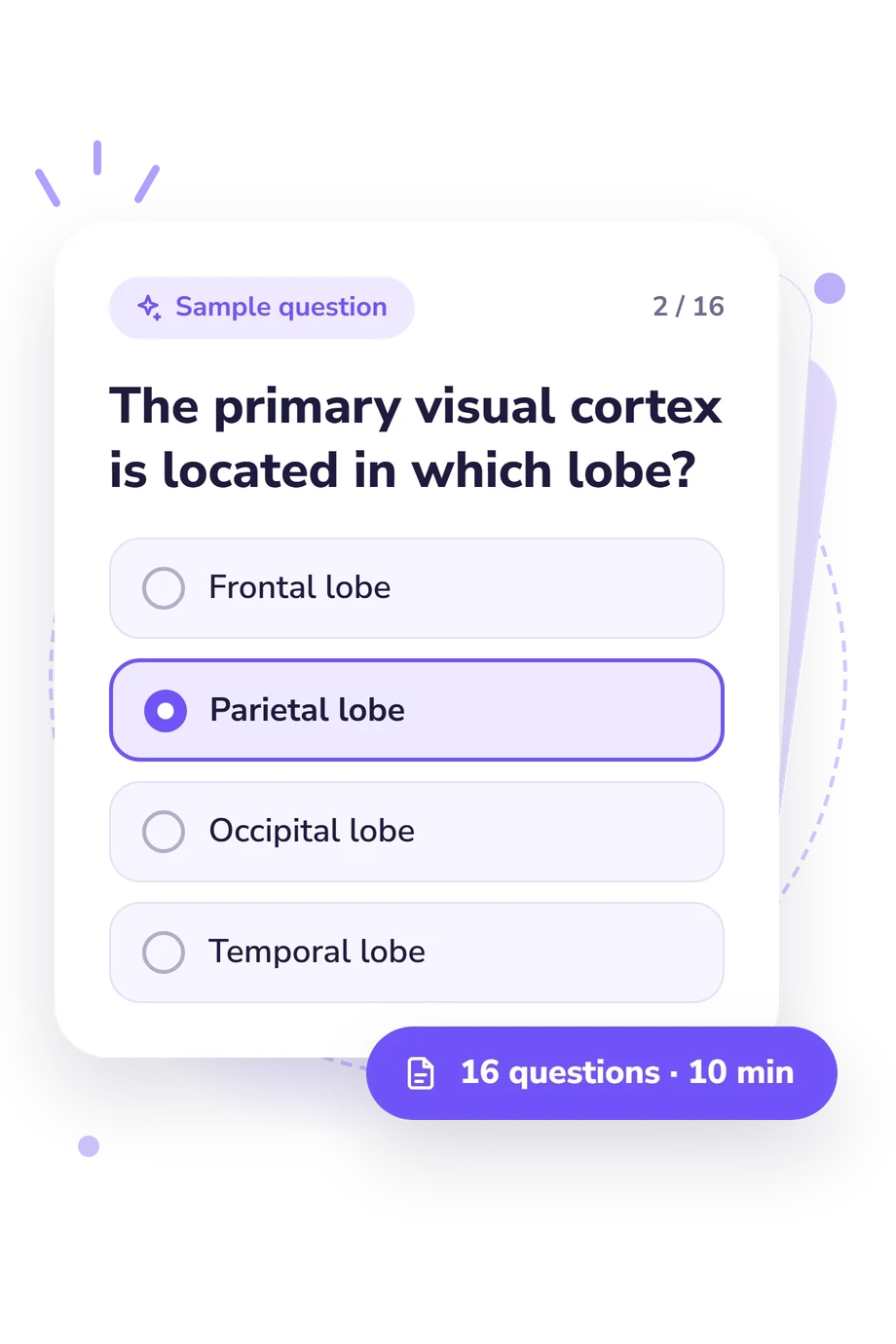
Example Questions From the Test
- Frontal lobe
- Parietal lobe
- Occipital lobe
- Temporal lobe
- Frontal lobe
- Temporal lobe
- Parietal lobe
- Occipital lobe
- Temporal lobe
- Parietal lobe
- Frontal lobe
- Occipital lobe
Lobes of the Brain Quiz - Description and methodology of the test
Students, curious learners, and anyone reviewing basic neuroanatomy can use the Lobes of the Brain Quiz to apply anatomical knowledge to short scenarios involving major brain regions and recognizable functions. As a quiz about brain lobes, it turns recall into practical review of sensory processing, movement, language, memory, attention, and executive control.
What This Assessment Measures
This assessment examines the four cerebral lobes while distinguishing them from the cerebellum. It links occipital regions with vision, parietal regions with bodily sensation and spatial attention, temporal regions with hearing, language comprehension, and memory, and frontal regions with planning, speech production, and voluntary movement.
Short clinical-style situations ask whether that knowledge can be applied to speech, attention, or coordination problems. Applied questions in the brain lobes and functions quiz produce an educational result, not a diagnosis or an explanation of anyone’s symptoms.
The displayed scale, Lobes of the Brain Knowledge (0-16), summarizes performance in three bands:
- Foundations to Build (0-6) indicates that the locations and broad functions need review.
- Developing Knowledge (7-12) indicates recognition of many functions with less consistent application.
- Strong Knowledge (13-16) indicates reliable links between regions and principal roles, including the cerebellum’s distinction from the cerebral lobes.
Methodology and Evidence Base
Each item presents a brain-anatomy question with four answer choices. One point is awarded for each correct response, making the result a direct knowledge total rather than a rating of personality, mood, or symptoms. Answering involves recognizing a location, function, or relationship, including the distinction between the cerebral lobes and cerebellum.
Content is conceptually consistent with the neuroanatomical organization described by Blumenfeld (2021). Localization of primary motor and sensory cortices also reflects the classic mapping work of Penfield and Boldrey (1937). The questions treat the cerebellum as a separate region associated with coordination, not as one of the four cerebral lobes. The quiz is conceptually consistent with these sources but is not an adaptation validated by them.
The questionnaire measures performance on anatomy items in this brain lobe functions quiz, rather than personality, mood, or symptoms. The score is an educational total, not a norm-referenced or clinical score, and reliability for this online questionnaire has not been established. Prior study, attention, wording, and interpretation of a scenario can affect performance, making the result most useful for choosing topics to review.
- Blumenfeld, Hal. Neuroanatomy Through Clinical Cases. 3rd ed. New York: Oxford University Press; 2021.
- Penfield, Wilder, and Edwin Boldrey. “Somatic Motor and Sensory Representation in the Cerebral Cortex of Man as Studied by Electrical Stimulation.” Brain 60, no. 4 (1937): 389-443. 10.1093/brain/60.4.389.
- Schmahmann, Jeremy D., and Janet C. Sherman. “The Cerebellar Cognitive Affective Syndrome.” Brain 121, no. 4 (1998): 561-579. 10.1093/brain/121.4.561.
Updated: