
Culture Quiz
How the Scales are Structured
Who Usually Takes This Test?
See How You Compare
Below is a preview of how scores are typically distributed across each scale.
Example Questions From the Test
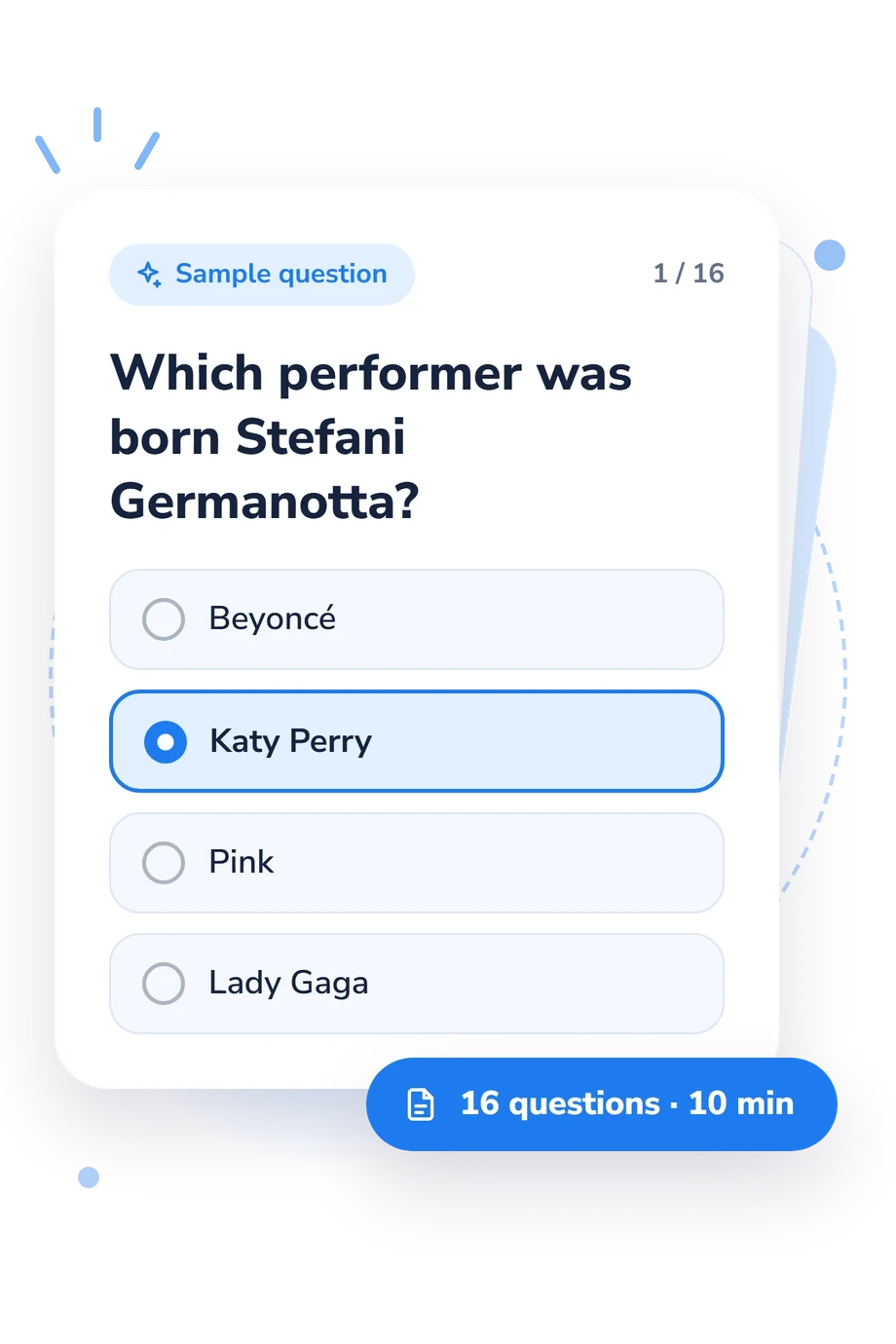
- Beyoncé
- Katy Perry
- Pink
- Lady Gaga
- The Wonderful Wizard of Oz
- Peter Pan
- The Chronicles of Narnia
- Alice’s Adventures in Wonderland
- Manchester
- Liverpool
- Birmingham
- London
Culture Quiz - Description and methodology of the test
People seeking a quick profile of familiarity with shared entertainment references may find this culture quiz useful. It is intended for casual self-reflection, not specialist expertise or cultural gatekeeping. The resulting cultural knowledge profile shows how confidently you identify the selected material and helps you decide which areas deserve more exploration.
What This Assessment Explores
This popular culture test samples familiar references rather than specialist expertise. Prompts ask you to connect performers, songs, settings, characters, plots, franchises, and game details with the correct title or name. It suits anyone curious about the entertainment knowledge they can readily recognize.
The questions cover several content areas within one overall result:
- Screen items ask you to identify films, series, franchises, characters, and settings.
- Music items ask you to connect performers, bands, songs, and albums with familiar titles.
- Books and games items ask you to recognize plots, fictional worlds, and game details.
All responses contribute to the single Pop Culture Knowledge result (0-16). Emerging (0-6) indicates recognition of some major references; Developing (7-12) indicates a solid spread with room to revisit unfamiliar media or eras; Strong (13-16) indicates recognition of a wide range of prominent references. The score describes this selection, not every area of culture.
Methodology and Evidence Base
Each item presents a prompt and four answer choices, with one intended answer. The displayed result summarizes performance across the recognition items as one overall score rather than separate media scores. Interpretation should stay close to the selected references, because the result is a snapshot of recognition on this quiz.
The recognition format has only limited conceptual parallels with Chesley's 2011 study, which links exposure to popular music with learning and recognition of cultural vocabulary, and with Flynn and Goldsmith's 1999 study, which distinguishes subjective knowledge from demonstrated knowledge. Neither study directly validates a broad quiz covering these media, and this questionnaire is not an adaptation of either study or a standardized version of their measures.
In practice, the cultural knowledge assessment captures performance on recognition items at completion. Performance may vary with language, regional context, media habits, recent exposure, attention, and guessing. A lower score can reflect different interests or less contact with the selected references, while a higher score shows familiarity with this set. Use the result as a focused snapshot when choosing media, eras, or genres to explore next.
- Chesley, P. (2011). You Know What It Is: Learning Words through Listening to Hip-Hop. PLoS ONE, 6(12), e28248. 10.1371/journal.pone.0028248
- Flynn, L. R., & Goldsmith, R. E. (1999). A Short, Reliable Measure of Subjective Knowledge. Journal of Business Research, 46(1), 57-66. 10.1016/S0148-2963(98)00057-5
Updated: