
Nephron Labeling Quiz
How the Scales are Structured
Who Usually Takes This Test?
See How You Compare
Below is a preview of how scores are typically distributed across each scale.
Example Questions From the Test
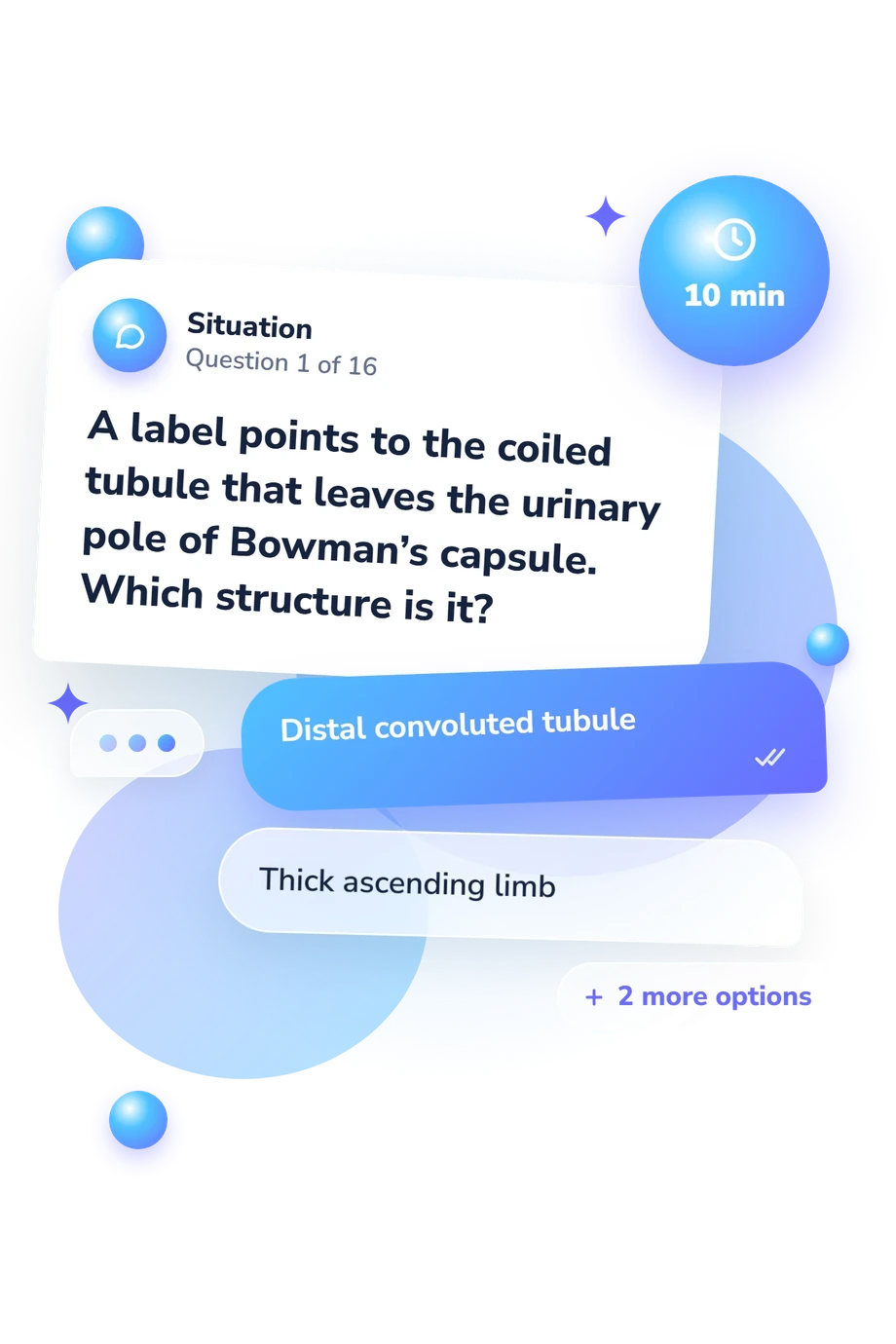
- Distal convoluted tubule
- Thick ascending limb
- Proximal convoluted tubule
- Collecting duct
- Efferent arteriole
- Afferent arteriole
- Vasa recta
- Peritubular capillary
- Renal corpuscle
- Collecting duct
- Distal convoluted tubule
- Loop of Henle
Nephron Labeling Quiz - Description and methodology of the test
Students reviewing renal histology and physiology can use this nephron labeling quiz to check whether anatomical relationships are secure enough for diagram-based recall. It suits learners who want a focused nephron anatomy quiz before class, laboratory review, or an exam. The result identifies current labeling knowledge and points to structures that deserve targeted revision.
What This Assessment Measures
The assessment examines whether you can connect names with locations and functions across the renal corpuscle, tubules, vessels, and juxtaglomerular region. As a nephron diagram quiz, it emphasizes spatial relationships as well as isolated vocabulary, making it suitable for learners who need to read cross-sections or simplified anatomical drawings.
The content falls into three practical areas:
- Renal corpuscle and filtration items test recognition of Bowman’s capsule, the glomerulus, capsular space, and the vascular pole.
- Tubular pathway items show whether you can follow filtrate through proximal and distal segments, the loop of Henle, and the collecting duct.
- Vascular and specialized-cell items assess distinctions among arterioles, peritubular capillaries, vasa recta, macula densa cells, and juxtaglomerular granular cells.
Taken together, these areas show whether anatomical terms remain connected to sequence, position, and nearby structures rather than being recalled as unrelated labels.
Methodology and Evidence Base
Each item presents a leader line, cross-section, or anatomical situation followed by four answer choices. Recognition depends on location, sequence, and relationships rather than free-response naming, so the nephron quiz practices terminology in context.
The displayed result is a single Nephron Labeling Knowledge score on a 0-16 range. Its feedback bands are Foundation to build (0-6), Developing knowledge (7-12), and Strong labeling knowledge (13-16). They provide study-oriented feedback about which nephron structures and relationships to revisit; the score is not a measure of laboratory or clinical competence.
The questionnaire is conceptually consistent with Mapping the Nephron Exercise (Hopper et al., 2017), which links nephron structures with multiple learning strategies, but it is not presented as a reproduction of that exercise. Kriz et al. (1988) supports the naming conventions used for kidney structures, while Carlström et al. (2015) contextualizes the vascular and autoregulatory relationships represented by the items.
Performance can vary with attention, memory, prior revision, and current context, so use the result to choose study topics rather than infer broad renal expertise.
- Hopper MK, Anderson MA, Lipp SN. Mapping the Nephron Exercise Incorporates Multiple Learning Strategies. MedEdPORTAL. 2017;13:10635. 10.15766/mep_2374-8265.10635
- Kriz W, Bankir L, Bulger RE, et al. A standard nomenclature for structures of the kidney. Pflügers Archiv. 1988;411(1):113-120. 10.1007/BF00581654
- Carlström M, Wilcox CS, Arendshorst WJ. Renal autoregulation in health and disease. Physiological Reviews. 2015;95(2):405-511. 10.1152/physrev.00042.2012
Updated: