
Preterite Quiz
How the Scales are Structured
Who Usually Takes This Test?
See How You Compare
Below is a preview of how scores are typically distributed across each scale.
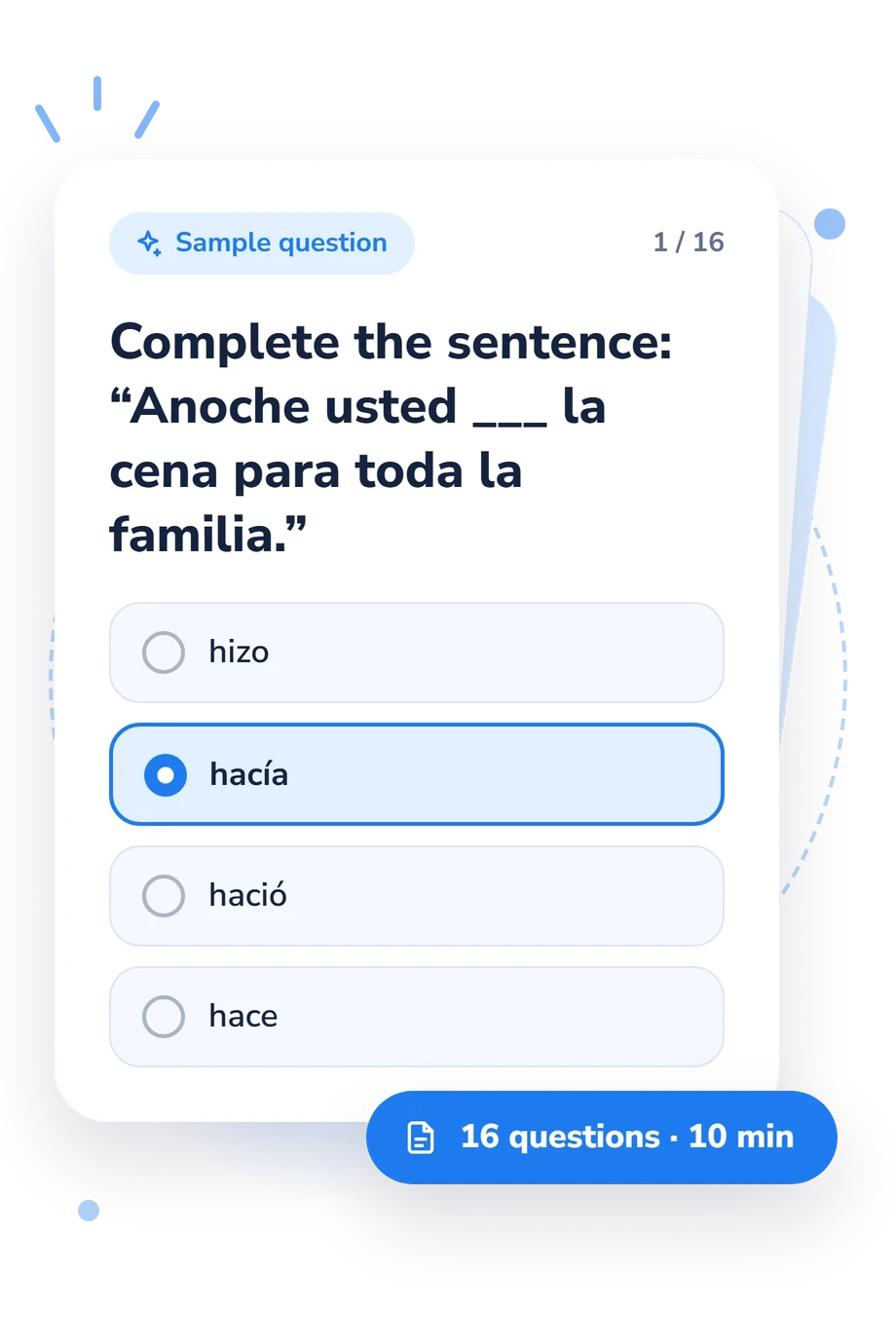
Example Questions From the Test
- hizo
- hacía
- hació
- hace
- llegé
- llegué
- llegaba
- llego
- pidió
- pedía
- pedió
- pide
Preterite Quiz - Description and methodology of the test
Spanish learners checking classroom progress, returning to study, or reviewing completed past events may use this preterite quiz to choose an appropriate review level. Its questions cover endings, irregular verbs, spelling changes, and past-time meaning, while the overall band guides the level of review rather than identifying each error's source. These context-based questions make this preterite conjugation quiz practical for planning study.
What This Assessment Measures
The questionnaire examines how respondents link completed or bounded past events with appropriate Spanish forms. Situations include yesterday’s actions, finished sequences, single experiences, irregular verbs, and contrasts between events and habitual or background activity. As a Spanish quiz on the preterite, it gives learners a practical picture of meaning-form connections.
The question themes cover three content areas, all contributing to the same overall score:
- Regular conjugations show whether subject endings are matched to completed actions.
- Items on irregular and spelling-changing verbs require accurate recognition of common forms.
- Items on tense and aspect contrasts require distinguishing finished events from habits, background, or interruptions.
The single displayed scale, Spanish Preterite Knowledge, runs from 0-16, with one point per correct answer: Foundations to review (0-6), Developing knowledge (7-12), and Strong knowledge (13-16). It is an educational summary of these tasks.
Methodology and Evidence Base
Each item presents a Spanish sentence or situation with answer choices. The respondent selects the form matching subject, spelling, time frame, or aspectual meaning. Completed actions, sequences, interruptions, and habitual backgrounds make the task contextual rather than isolated verb-table practice.
The focused format makes it a preterite tense Spanish quiz about Spanish knowledge rather than overall proficiency.
Choices do not produce separate rule scores; their content can suggest revision topics. This preterite practice quiz directs attention to endings, irregulars, spelling changes, or preterite-imperfect contrasts without identifying a particular error's source.
Butt and Benjamin’s 1994 grammar supports coverage of regular endings and irregular forms. Doiz’s 2013 work connects with items distinguishing completed events from habitual or background activity, while Cuza’s 2010 study of tense-aspect learning in Spanish as a second language supports these contrasts. The questionnaire is conceptually consistent with these works, not an adaptation of them.
Guessing, attention, prior instruction, and familiarity with verbs can affect accuracy. The overall band and tested forms can guide practice.
- Butt, John, and Carmen Benjamin. A New Reference Grammar of Modern Spanish. 2nd ed. London: Edward Arnold, 1994. 10.1007/978-1-4615-8368-4
- Doiz, Aintzane. "The Spanish Preterite and Imperfect from a Cognitive Point of View." In Research Design and Methodology in Studies on L2 Tense and Aspect, edited by M. Rafael Salaberry and Llorenç Comajoan, 57-88. Berlin and Boston: De Gruyter Mouton, 2013. 10.1515/9781934078167.57
- Cuza, Alejandro. "The L2 Acquisition of Aspectual Properties in Spanish." Canadian Journal of Linguistics/Revue canadienne de linguistique 55, no. 2 (2010): 181-208. 10.1353/cjl.2010.0007
Updated: