
Pop Culture Quiz
How the Scales are Structured
Who Usually Takes This Test?
See How You Compare
Below is a preview of how scores are typically distributed across each scale.
Example Questions From the Test
- Usher
- Prince
- James Brown
- Michael Jackson
- Final Fantasy
- Fire Emblem
- Dragon Quest
- The Legend of Zelda
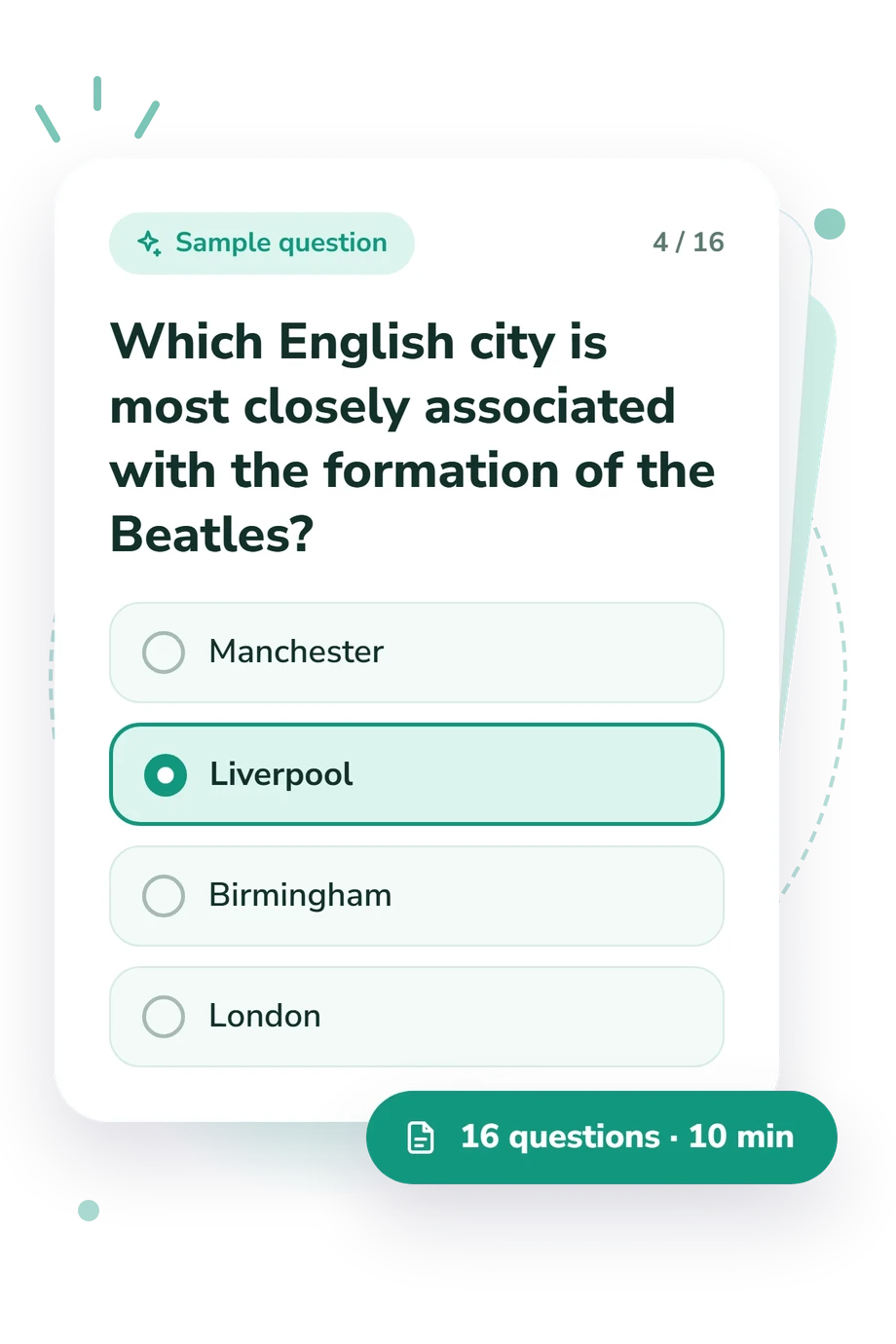
- Manchester
- Liverpool
- Birmingham
- London
Pop Culture Quiz - Description and methodology of the test
People who enjoy connecting familiar entertainment references can use this assessment to see how broadly their knowledge travels across popular media. The pop culture quiz is intended for casual fans, enthusiasts, and anyone curious about well-known works, characters, performers, and fictional worlds. Its broad mix makes it an ultimate quiz about pop culture, with results focused on recognition rather than taste.
What This Assessment Explores
Questions move across film, music, television, books, games, fictional worlds, characters, and memorable lines. As a pop culture trivia quiz, it tests links among names, settings, plots, performers, franchises, and landmarks rather than one narrow fandom.
The result shows where familiarity is strongest and which areas invite exploration. Four themes organize the content:
- Film and animation items test stories, visual motifs, and memorable scenes.
- Music and television items examine performers, characters, series, and recurring references.
- Books and games check links between settings, heroes, objects, and plots.
- Quotations and story worlds show whether clues connect to a recognizable franchise.
The displayed result is Pop Culture Knowledge (0-16). Curious Newcomer (0-6) means some major references were recognized; Culture-Savvy (7-12) reflects developing-to-strong breadth with room to expand; Pop Culture Expert (13-16) means most enduring references and connections were identified.
Methodology and Evidence Base
Each item presents a short prompt with four answer choices and asks for the best match. Recognition of people, works, settings, quotations, characters, and plot cues is tested instead of open-ended recall, so performance reflects accuracy within defined alternatives.
Within the popculture quiz format, answers across the mixed items are aggregated into the single displayed knowledge result. No separate scores are reported for individual content areas, so broad strength can coexist with uneven familiarity between topics.
Its evidence base is conceptually consistent with the DoKnow Test (Rusche & Ziegler, 2023), which treats knowledge as domain-specific rather than identical to general intelligence. Beier and Ackerman (2001) and Rolfhus and Ackerman (1999) likewise support reading knowledge as related to cognitive ability while also shaped by experience, interest, education, and exposure. This questionnaire is an online knowledge check, not a published adaptation or norm-referenced version of those instruments.
Prior exposure to particular films, artists, franchises, and media traditions can influence performance, as can attention, guessing, and current context. The bands summarize this response pattern rather than establish a fixed intellectual level.
- Rusche, Marianna Massimilla, and Matthias Ziegler. 2023. Measuring Domain-Specific Knowledge: From Bach to Fibonacci. Journal of Intelligence, 11(3), 47. 10.3390/jintelligence11030047
- Beier, Margaret E., and Phillip L. Ackerman. 2001. Current-events knowledge in adults: An investigation of age, intelligence, and nonability determinants. Psychology and Aging, 16(4), 615-628. 10.1037/0882-7974.16.4.615
- Rolfhus, Eric L., and Phillip L. Ackerman. 1999. Assessing Individual Differences in Knowledge: Knowledge, Intelligence, and Related Traits. Journal of Educational Psychology, 91(3), 511-526. 10.1037/0022-0663.91.3.511
Updated: