
Nursing Specialty Quiz
Discover which nursing setting fits how you think, connect, and work in just 10 minutes. Answer 20 realistic scenarios for a clear match or blended fit, free with no sign-up.


08:30
Scale Explorer
How the Scales are Structured
DATA-BASED USER COHORTS
Who Usually Takes This Test?
BASED ON AGGREGATED, ANONYMIZED DATA FROM TENS OF THOUSANDS OF FREUDLY USERS.
Benchmarking
See How You Compare
Once you complete the test, your results are compared with real-world data from people in your country.
Below is a preview of how scores are typically distributed across each scale.
Below is a preview of how scores are typically distributed across each scale.
Community and Public Health Nursing (CaPHN)
Community and Public Health Nursing (CaPHN)
Average
6.5
Normal range
4.6 — 8.4
min.
0
max.
12
This curve shows how scores are typically distributed.
Once you complete the test, your result will appear on the scale so you can see how you compare.
Once you complete the test, your result will appear on the scale so you can see how you compare.
Critical Care Nursing (CCN)
Critical Care Nursing (CCN)
Average
5.8
Normal range
3.8 — 7.7
min.
0
max.
12
This curve shows how scores are typically distributed.
Once you complete the test, your result will appear on the scale so you can see how you compare.
Once you complete the test, your result will appear on the scale so you can see how you compare.
Emergency Nursing (EN)
Emergency Nursing (EN)
Average
7.7
Normal range
5.9 — 9.6
min.
0
max.
12
This curve shows how scores are typically distributed.
Once you complete the test, your result will appear on the scale so you can see how you compare.
Once you complete the test, your result will appear on the scale so you can see how you compare.
Mental Health Nursing (MHN)
Mental Health Nursing (MHN)
Average
7.5
Normal range
5.3 — 9.7
min.
0
max.
12
This curve shows how scores are typically distributed.
Once you complete the test, your result will appear on the scale so you can see how you compare.
Once you complete the test, your result will appear on the scale so you can see how you compare.
Pediatric Nursing (PN)
Pediatric Nursing (PN)
Average
6.4
Normal range
4.3 — 8.5
min.
0
max.
12
This curve shows how scores are typically distributed.
Once you complete the test, your result will appear on the scale so you can see how you compare.
Once you complete the test, your result will appear on the scale so you can see how you compare.
Featured On
SAMPLE QUESTIONS
Example Questions From the Test
- How the separate signals fit together and what a subtle change could mean.
- The main trend lines, with specialists helping interpret the finer details.
- The patient's longer-term adjustment after the acute phase has passed.
- The wider social or environmental factors affecting health outside the unit.
- Knowing I built trust with the same patients over an extended period.
- Helping resolve several urgent problems and preparing patients for their next level of care.
- Contributing to a varied caseload while still having time for selected in-depth interactions.
- Completing a structured set of planned treatments with minimal interruption.
- Treating individual complications once patients arrive for hospital care.
- Giving patients information about existing follow-up options during discharge.
- Helping coordinate referrals while documenting the recurring barriers.
- Working with residents and services to redesign access around the pattern of barriers.
WHAT THE TEST MEASURES
About This Assessment
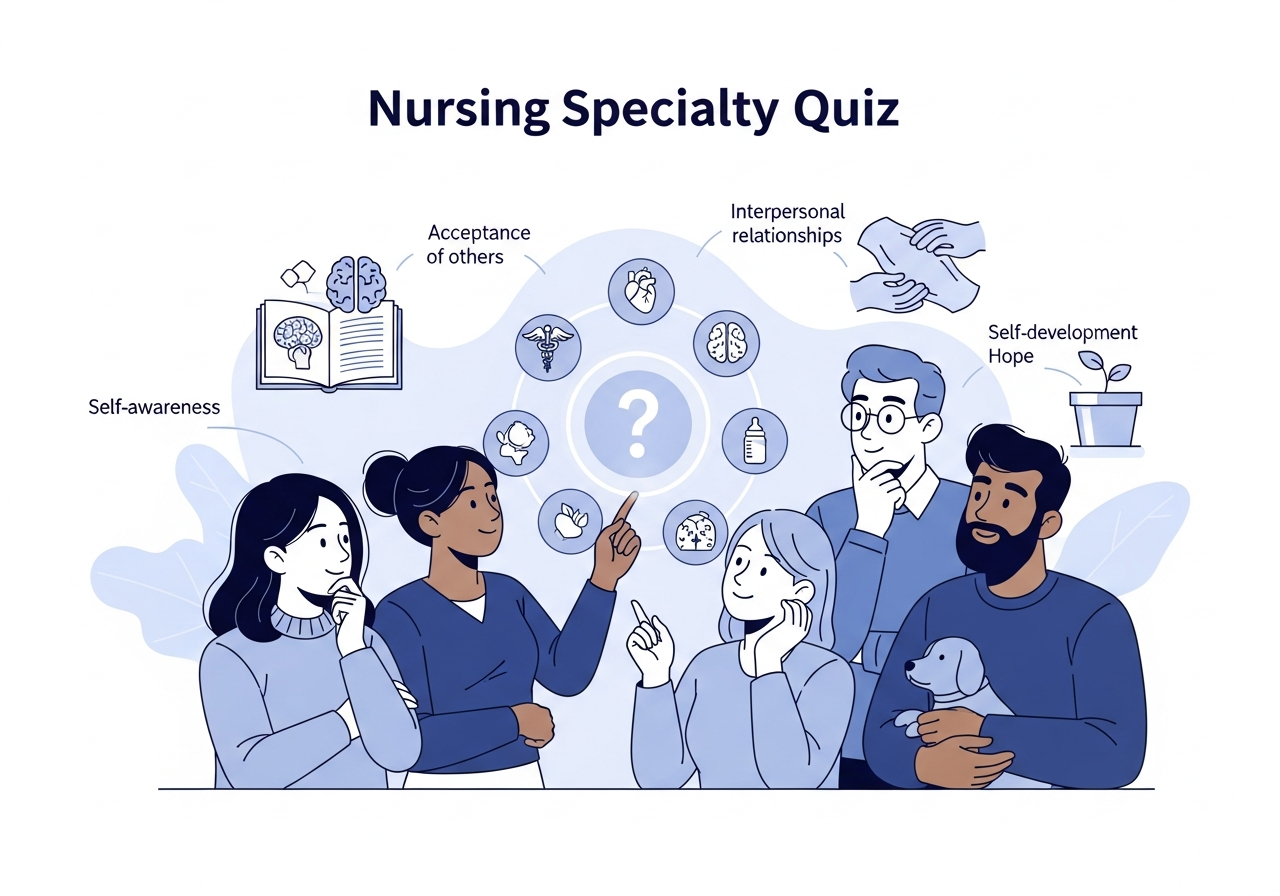
/https://cdn.freudly.ai/media/tests/3316/image/1785110609_day_image_20260727_000328.png "Nursing Specialty Quiz")
Nursing Specialty Quiz - Symptoms and Signs
Which nursing environment may fit the way you think, connect, and work? This free nursing specialty quiz compares your affinity for emergency, critical care, pediatric, mental health, and community/public health nursing through realistic preferences and workplace scenarios. Your highest score is your strongest current match, while results within one point indicate a blended fit. The quiz is reflective rather than a measure of clinical competence or career eligibility, and no sign-up is needed.
Popular tests
Comments
Leave a Comment