
MLB Teams Quiz
How the Scales are Structured
Who Usually Takes This Test?
See How You Compare
Below is a preview of how scores are typically distributed across each scale.
Example Questions From the Test
- Milwaukee Brewers
- Pittsburgh Pirates
- Miami Marlins
- Seattle Mariners
- Minnesota Twins
- Kansas City Royals
- Milwaukee Brewers
- Detroit Tigers
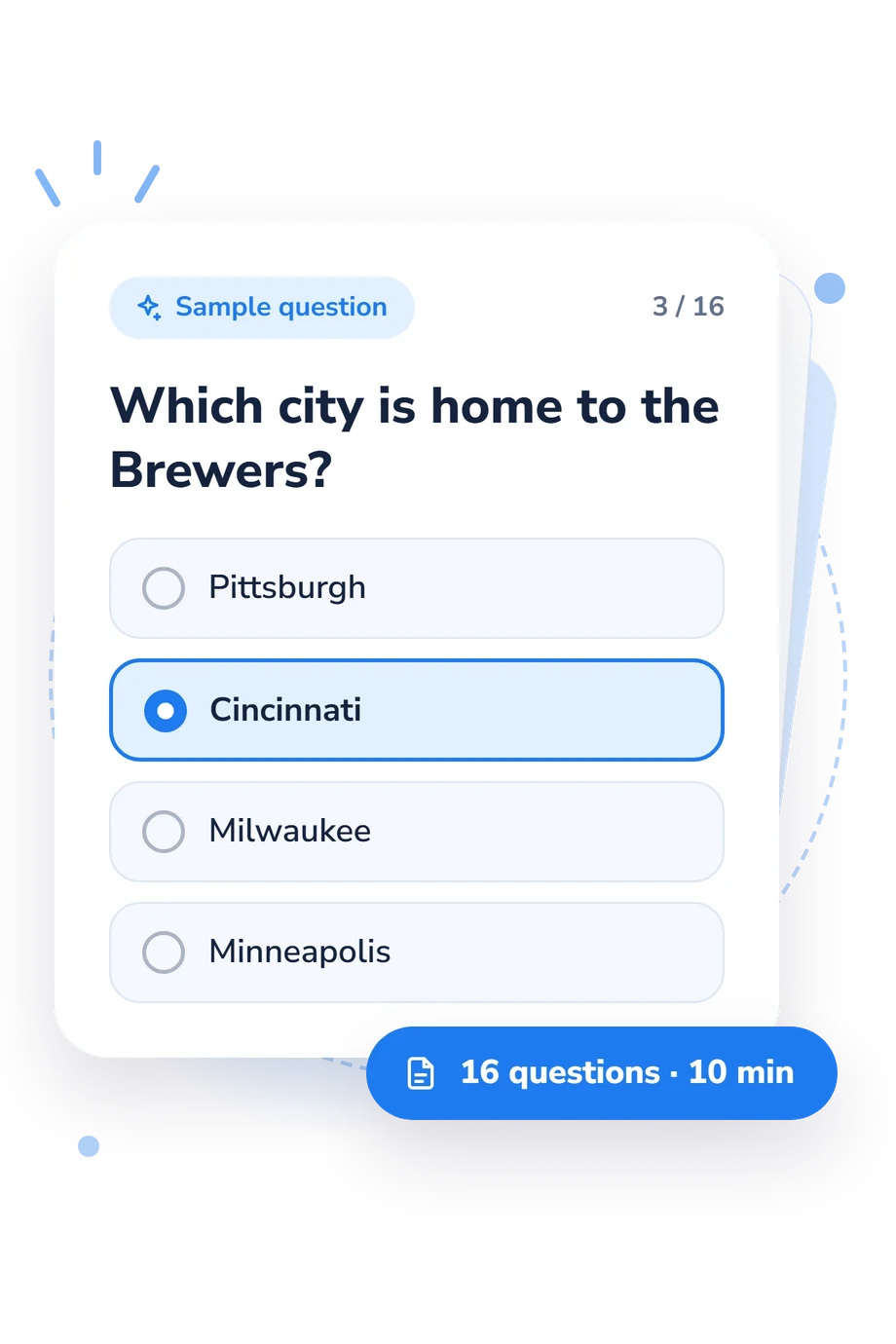
- Pittsburgh
- Cincinnati
- Milwaukee
- Minneapolis
MLB Teams Quiz - Description and methodology of the test
Readers who want to locate their MLB knowledge can use the MLB Teams Quiz to see how accurately they recognize teams across the league. This baseball team quiz suits curious followers and experienced supporters who want a clear benchmark for their recall rather than a fan-preference profile. Its clues test links among team names, cities, league membership, and franchise history.
What This Assessment Measures
These questions measure factual recognition of MLB franchises, not opinions about favorite clubs. They link names with cities, states, symbols, metropolitan areas, league affiliations, and changes in franchise identity. The approach suits anyone checking practical baseball knowledge.
The questions return to four recurring knowledge themes:
- Team identity shows whether you connect a nickname with its place, symbol, or meaning.
- Geography indicates how accurately you match clubs with cities, states, and regions.
- League and local pairings measure recognition of teams sharing a market or state.
- Franchise history reflects your grasp of relocations and successor identities.
The overall result from this MLB knowledge test is one MLB Teams Knowledge score (0-16), showing how accurately you recognized teams: Starting Lineup (0-6) means developing familiarity, Clubhouse Regular (7-12) means solid knowledge with some gaps, and Franchise Expert (13-16) means broad accuracy across team identities and histories.
Methodology and Evidence Base
Each item offers four answer options. Prompts ask about cities, team names, symbols, metropolitan areas, league membership, or franchise relocation. The score reflects correct answers and is read through the three descriptive bands; it measures factual knowledge, not personality, clinical symptoms, or playing ability.
Together, the items form a baseball trivia quiz linking team names with geography, league membership, symbols or meanings, and franchise history. Total Baseball (Thorn et al., 2001) provides a reference point for team names, locations, affiliations, and franchise records. Riess’s encyclopedia and Jozsa’s history support the treatment of club identities, relocations, and successor franchises.
Quinn and Bursik’s 2007 study adds historical context on expansion and relocation, not validation of this questionnaire. The questionnaire is conceptually consistent with these factual and historical sources, not an adaptation or reproduction of a published instrument.
The displayed bands describe performance on this questionnaire, while prior exposure, attention, language comprehension, and honest recall affect interpretation. Guessing or memory gaps can change one sitting’s score, so it is best read as a snapshot of MLB knowledge.
- Thorn, John, Pete Palmer, and Michael Gershman, eds., with Matthew Silverman, Sean Lahman, and Greg Spira. Total Baseball: The Official Encyclopedia of Major League Baseball. 7th ed. Kingston, NY: Total Sports Publishing, 2001. ISBN 978-1-930844-01-8.
- Riess, Steven A., ed. Encyclopedia of Major League Baseball Clubs. 2 vols. Westport, CT: Greenwood Press, 2006. ISBN 978-0-313-32991-3.
- Jozsa, Frank P., Jr. Major League Baseball Expansions and Relocations: A History, 1876-2008. Jefferson, NC: McFarland & Company, 2010. ISBN 978-0-7864-4388-8.
- Quinn, Kevin G., and Paul B. Bursik. "Growing and Moving the Game: Effects of MLB Expansion and Team Relocation 1950-2004." Journal of Quantitative Analysis in Sports 3, no. 2 (2007): 1-30. 10.2202/1559-0410.1054.
Updated: