
Lord of the Rings Character Quiz
How the Scales are Structured
Who Usually Takes This Test?
See How You Compare
Below is a preview of how scores are typically distributed across each scale.
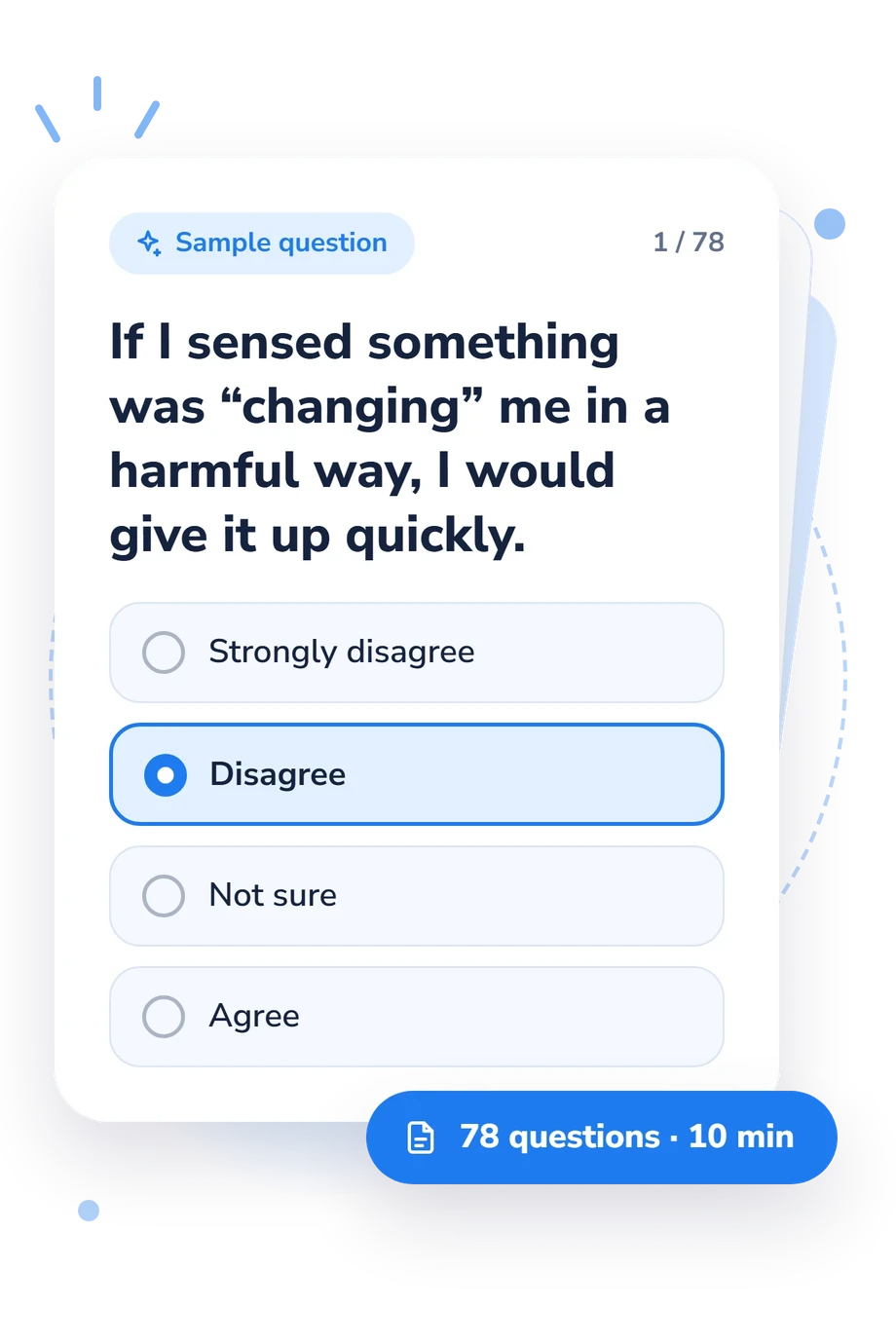
Example Questions From the Test
- Strongly disagree
- Disagree
- Not sure
- Agree
- Strongly disagree
- Disagree
- Not sure
- Agree
- Strongly disagree
- Disagree
- Not sure
- Agree
Lord of the Rings Character Quiz - Description and methodology of the test
For readers who enjoy Tolkien’s world and want to examine their own choices through it, the Lord of the Rings Character Quiz offers a character-style profile rather than a literary trivia result. It suits fans and newcomers curious about reactions to danger, group commitments, moral pressure, and the appeal of power. As a LOTR character quiz, it connects fictional themes with everyday attitudes toward values, hesitation, loyalty, and self-control.
What This Assessment Explores
Three story-linked tendencies organize the result: action under threat, commitment to others, and resistance to corrupting rewards. It suits fans and newcomers seeking a fictional-world lens on personal reactions, not a fixed identity label.
The displayed dimensions are:
- Courage Under Threat (0-30) shows whether danger brings steady action or caution. Its bands are Cautious (0-10), Measured Brave (11-20), and Bold (21-30).
- Loyalty to the Fellowship (0-30) shows how reliably you support friends, teamwork, and promises. Its bands are Independent (0-10), Situationally Loyal (11-20), and Steadfast (21-30).
- Temptation Resistance (0-30) shows how strongly values withstand power, ego, corruption, and immediate rewards. Its bands are Temptation-Prone (0-14) and Ring-Resistant (15-30).
Together, the scales form a pattern rather than a single match: bravery may coexist with caution, while loyalty may coexist with independence. As a Lord of the Rings personality quiz, it frames these combinations through recognizable moral choices.
Methodology and Scientific Basis
Each item is a self-report statement about a choice, reaction, or priority, answered on a four-point scale: Strongly disagree, Disagree, Not sure, or Agree. Direct and reverse-framed ideas appear, so agreement does not always indicate a higher result.
Responses combine into three dimensions and their descriptive bands. No per-answer point schedule is stated, so the ranges do not show how options are weighted. A Lord of the Rings character test is best read as a profile of tendencies across related situations, not a ranking of moral worth.
Conceptually, the questionnaire is consistent with Chen and Qiu (2022), whose analysis of Tolkien’s heroism supports the emphasis on courage, fellowship, sacrifice, and resistance to corruption. Tolkien’s trilogy supplies the fictional frame, while Huang and Fung (2024) provide context for identification with narrative characters. This questionnaire is not presented as an adaptation, validation, or reproduction of either published measure.
Scores are descriptive rather than population norms or clinical cutoffs. Self-report may reflect current mood, self-image, imagined situations, and familiarity with the story, so compare the profile with real-life contexts.
- Chen, Weichun, and Qiu, Qi. "An Analysis on the Heroism in The Lord of The Rings." Journal of Education and Culture Studies 6, no. 3 (2022): 14-20. 10.22158/jecs.v6n3p14
- Tolkien, John Ronald Reuel. The Lord of the Rings. London: George Allen & Unwin, 1954-1955.
- Huang, Kate Y., and Fung, Helene H. "Measuring identification with narrative characters: the development and validation of a new scale." Current Psychology 43 (2024): 24835-24849. 10.1007/s12144-024-06191-2
Updated: