
Graphing Quadratic Equations Quiz
How the Scales are Structured
Who Usually Takes This Test?
See How You Compare
Below is a preview of how scores are typically distributed across each scale.
Example Questions From the Test
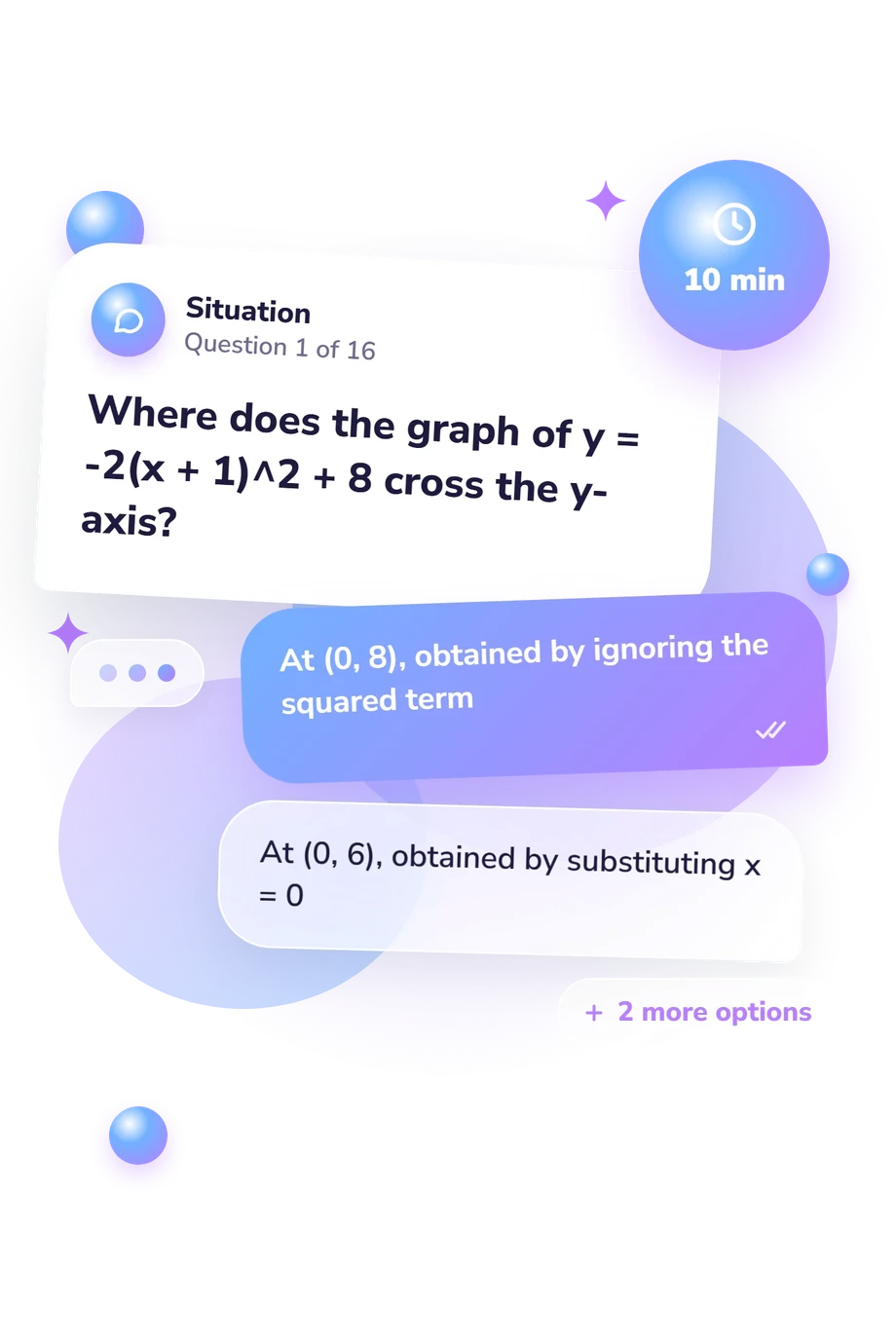
- At (0, 8), obtained by ignoring the squared term
- At (0, 6), obtained by substituting x = 0
- At (0, -6), obtained by reversing the calculated sign
- At (0, 10), obtained by adding 2 instead of subtracting it
- y = 0.5x^2, with absolute leading coefficient 0.5
- y = -x^2, with absolute leading coefficient 1
- y = 3x^2, with absolute leading coefficient 3
- y = -2x^2, with absolute leading coefficient 2
- At (1, 0) and (3, 0), from the factors (x - 1)(x - 3)
- At (-1, 0) and (-3, 0), using reversed root signs
- At (2, 0) and (6, 0), using coefficients as roots
- At (0, 1) and (0, 3), placing the roots on the y-axis
Graphing Quadratic Equations Quiz - Description and methodology of the test
Students who want to check how equations become visible features can use the Quiz 8 1 Graphing Quadratic Equations to connect algebraic forms with parabolas. It suits independent learners, classroom review, and anyone preparing for further algebra work. The result highlights secure skills and topics that may need more practice. Its practice questions can support focused revision of graphing quadratic equations.
What This Assessment Explores
This assessment checks how well you connect equations, tables, and contexts with visible parabola features. It is suited to learners reviewing vertices, intercepts, symmetry, transformations, and range, especially when they want to locate gaps before further algebra practice. This quadratic graphing skills test makes those gaps more concrete.
The main skill groups are:
- Equation forms show whether you can move between standard, factored, and vertex representations.
- Vertices and symmetry show whether you can locate turning points and axes.
- Intercepts and roots show whether you can identify where a parabola meets an axis.
- Transformations and models show how shifts, reflections, width, and extrema change meaning.
One displayed scale, Graphing Quadratic Equations Knowledge, runs from 0-16. Foundational (0-6) indicates review is needed; Developing (7-12) indicates many ideas are present but connections need practice; Strong (13-16) indicates consistent interpretation and application.
Methodology and Scientific Basis
Each item uses four-option multiple choice. Tasks ask you to substitute values, compare leading coefficients, read vertex form, interpret zeros, find an axis of symmetry, complete the square, and reason about maximum, minimum, or range. The score is the number correct, with one point for each correct answer.
The method is an educational knowledge check, not a self-report of feelings or habits. Its content is conceptually consistent with the Quadratic Functions Learning Progression, which emphasizes connections among representations. A study by Wilkie on graphing, generalization, and pattern construction offers conceptual context, while the Common Core standards provide a reference point for key features and equivalent forms. These sources frame the topics; they do not validate or standardize this quiz.
These tasks connect equations with plotted features and choices for sketching a parabola. Reviewing missed questions turns quadratic graphing practice into a more focused revision plan. The score describes performance on these questions and does not by itself establish reliability or diagnostic status. Performance may vary with calculation errors, current readiness, or unfamiliar representations, so item-level review gives a clear next step.
- Graf, Edith Aurora, James H. Fife, Heather Howell, and Elizabeth Marquez. (2018). The Development of a Quadratic Functions Learning Progression and Associated Task Shells. ETS Research Report Series, 2018(1), 1-28. 10.1002/ets2.12234
- Wilkie, Karina J. (2019). Investigating secondary students’ generalization, graphing, and construction of figural patterns for making sense of quadratic functions. Journal of Mathematical Behavior, 54, Article 100689. 10.1016/j.jmathb.2019.01.005
- National Governors Association Center for Best Practices, and Council of Chief State School Officers. (2010). Common Core State Standards for Mathematics. Washington, DC: National Governors Association Center for Best Practices and Council of Chief State School Officers.
Updated: