
Future Life Quiz
How the Scales are Structured
Who Usually Takes This Test?
See How You Compare
Below is a preview of how scores are typically distributed across each scale.
Example Questions From the Test
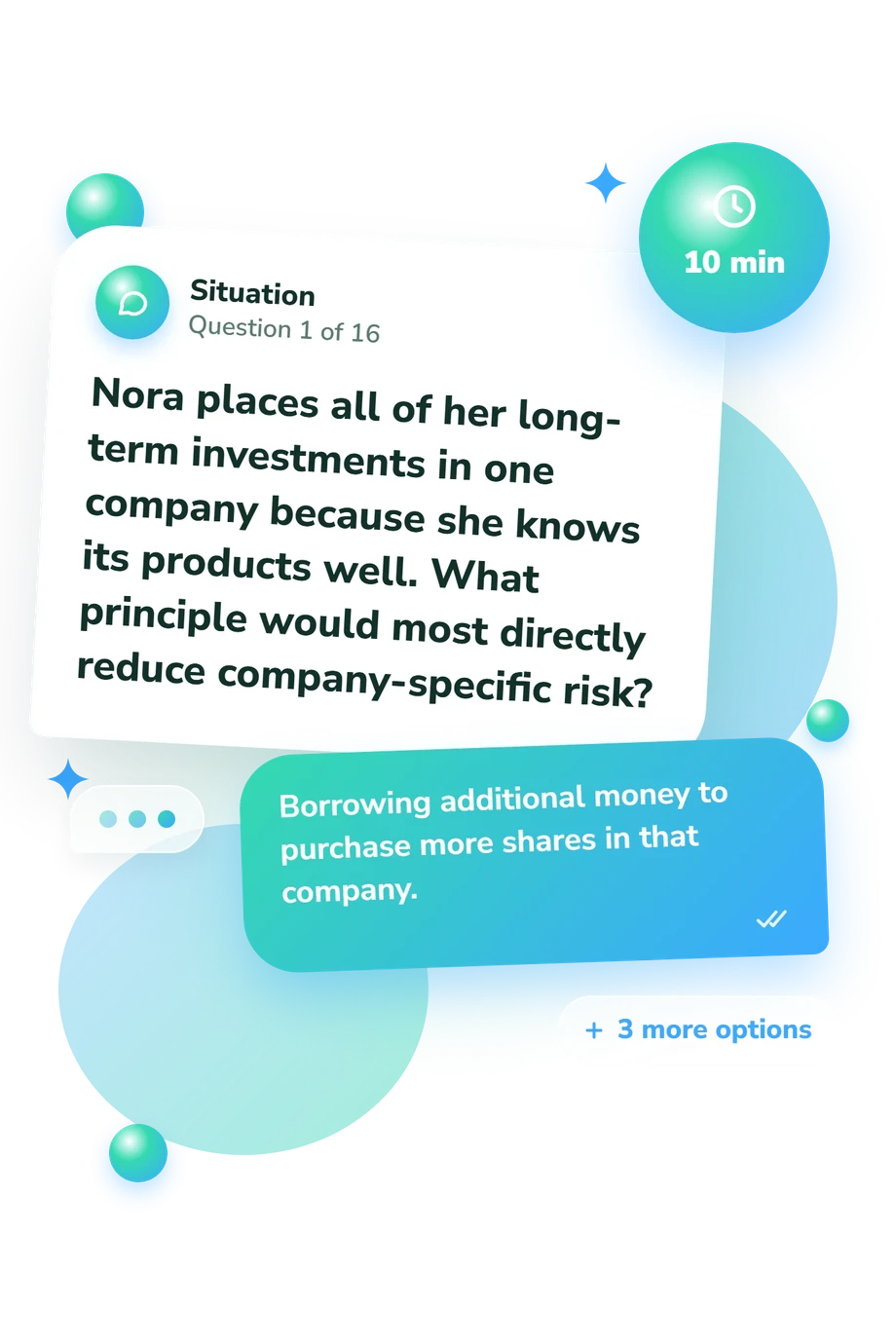
- Borrowing additional money to purchase more shares in that company.
- Checking the company’s price several times each day.
- Diversifying across different holdings rather than relying on one company.
- Choosing investments only according to brands she personally uses.
- The number of planned study sessions Sam completes each week.
- The certificate’s final completion status after six months.
- The job title Sam hopes to obtain several years later.
- The number of certificates completed by Sam’s coworkers.
- Only the original price charged for the course.
- The pay and other benefits Lee gives up by not taking the shift.
- Every expense Lee has incurred during the entire year.
- The future value of the course, whether or not it helps Lee.
Future Life Quiz - Description and methodology of the test
People who want to check their practical planning knowledge can use this life planning quiz to work through everyday scenarios in a concise online knowledge check. Rather than predicting a personal future, the future life quiz asks respondents to recognize planning principles and choose the soundest response when circumstances change.
What This Assessment Explores
The questions present future preparation as learnable practical reasoning, not a fixed personality trait. They cover money decisions such as diversification, inflation, reserves, compounding, insurance, opportunity cost, and scam warnings, alongside career adaptability, sustainable habits, healthcare directives, and scenario planning. This future planning quiz helps readers understand their future-planning literacy and what the displayed result band means, rather than providing separate feedback for each topic.
The main thematic groups are:
- Financial decisions show how risk, time, protection, and trade-offs affect long-term stability.
- Career and habit planning connect adaptability, repeatable actions, and measurable progress with follow-through.
- Health and contingency planning show how advance choices, plausible scenarios, and revision triggers improve readiness.
The overall result is Future Life Knowledge (0-16), reflecting future-planning literacy rather than separate topic scores. Foundations to Build is 0-6; Developing Knowledge is 7-12; Strong Planning Literacy is 13-16.
Methodology and Scientific Basis
Each item presents an everyday scenario with four answer choices. The respondent selects the option that best reflects sound planning, so the result tests recognition of practical principles rather than confidence or personality alone. As a long-term planning test, it uses a knowledge-check format: the total reflects the number of correct answers and is reported on the overall scale.
Its financial content is conceptually consistent with Alhenawi and Elkhal (2013), while the OECD/INFE framework supports attention to financial knowledge, preparation, and well-being. Its broader focus on planning, motivation, and evaluating possible futures is conceptually consistent with Nurmi (1989). The questionnaire is conceptually consistent with these works, but they do not establish that it is an adaptation of or validated against them.
Interpret the result as a snapshot of applied knowledge. Financial familiarity, education, guessing, and scenario interpretation can affect performance, while real decisions also depend on resources and changing circumstances. As an online educational knowledge check, the questionnaire is not diagnostic; its displayed score uses three fixed bands to describe performance on these items without establishing population-level standing.
- Alhenawi, Yasser, and Khaled Elkhal. (2013). Financial literacy of U.S. households: Knowledge vs. long-term financial planning. Financial Services Review, 22(3), 211-244. 10.61190/fsr.v22i3.4654
- OECD. (2026). OECD/INFE Toolkit for Measuring Financial Literacy, Inclusion and Well-Being 2026. OECD Publishing, Paris. 10.1787/92f2d439-en
- Nurmi, Jari-Erik. (1989). Planning, motivation, and evaluation in orientation to the future: A latent structure analysis. Scandinavian Journal of Psychology, 30(1), 64-71. 10.1111/j.1467-9450.1989.tb01069.x
Updated: