
Domain and Range Quiz
How the Scales are Structured
Who Usually Takes This Test?
See How You Compare
Below is a preview of how scores are typically distributed across each scale.
Example Questions From the Test
- Values greater than or equal to 5
- Values strictly less than 5
- Values less than or equal to 5
- Every value other than 5
- All real numbers less than or equal to -3
- All real numbers greater than or equal to 2
- All real numbers less than or equal to 2
- All real numbers greater than or equal to -3
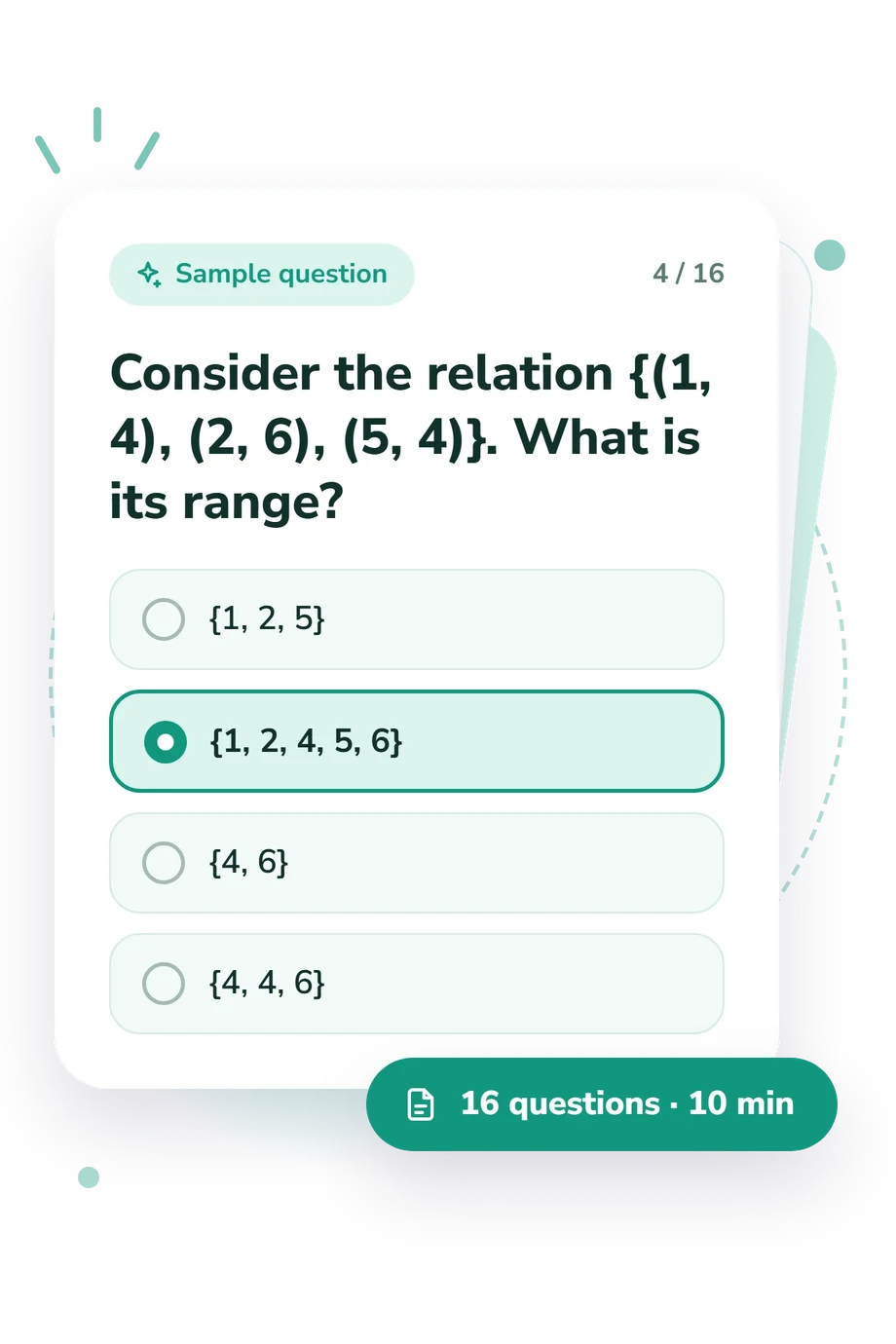
- {1, 2, 5}
- {1, 2, 4, 5, 6}
- {4, 6}
- {4, 4, 6}
Domain and Range Quiz - Description and methodology of the test
Students, teachers, and independent learners who want to check their grasp of function inputs and outputs can use this domain and range quiz as a focused review. It is intended for anyone revising relations, functions, notation, graphs, or algebraic restrictions. Used as a domain and range practice quiz, this assessment can show which ideas are secure and which need targeted review before more advanced algebra or precalculus work.
What This Assessment Explores
Its domain and range questions examine whether you can distinguish inputs from outputs in ordered pairs, mappings, tables, equations, graphs, and applied situations. They also address function rules and restrictions created by square roots, denominators, inverse relations, and limited quantities. The intended reader is anyone reviewing foundational algebra or precalculus concepts.
The displayed Domain and Range Knowledge scale covers 0-16 and reports three result bands:
- Foundations to strengthen (0-6) means you recognize some basic ideas but may confuse inputs, outputs, or restrictions.
- Developing knowledge (7-12) means you solve many standard problems but may need practice with notation, graphs, restrictions, or multistep reasoning.
- Strong knowledge (13-16) means you consistently identify valid inputs and possible outputs across symbolic, tabular, graphical, and applied representations.
Together, the bands show whether review should focus on definitions, representation changes, restrictions, or multi-step reasoning.
Methodology and Scientific Basis
Each item is multiple choice with four answer options. Prompts ask for a judgment: selecting a domain or range, deciding whether a relation is a function, or applying a restriction to an equation or context. The set uses ordered pairs, formulas, graphs, tables, and situations, asking you to apply concepts across different representations while checking terminology.
Scoring combines performance into one overall result rather than separate subscores. Use its band description to select review topics such as definitions, notation, restrictions, or graph interpretation. In this domain and range assessment, revisiting relevant concepts and explaining why an answer works can make the result more useful than relying on the band alone.
Cho, Norris, and Moore-Russo (2017) provide the closest connection by examining how students determine domain and range from graphs and where errors arise. Jay Abramson's Precalculus 2e supplies conventional treatment of functions, restrictions, and representations. The questionnaire is conceptually consistent with these sources, not a reproduction or validated adaptation. The bands describe performance on this task set, not population comparisons; results may reflect prior instruction, notation familiarity, and the formats presented rather than permanent mastery.
- Cho, Peter, Benjamin Norris, and Deborah Moore-Russo. "A Study of Common Student Practices for Determining the Domain and Range of Graphs." Investigations in Mathematics Learning 9, no. 4 (2017): 202-219. 10.1080/19477503.2017.1285658
- Abramson, Jay. Precalculus 2e. Houston, Texas: OpenStax, 2021.
Updated: