
Digestive System Quiz
How the Scales are Structured
Who Usually Takes This Test?
See How You Compare
Below is a preview of how scores are typically distributed across each scale.
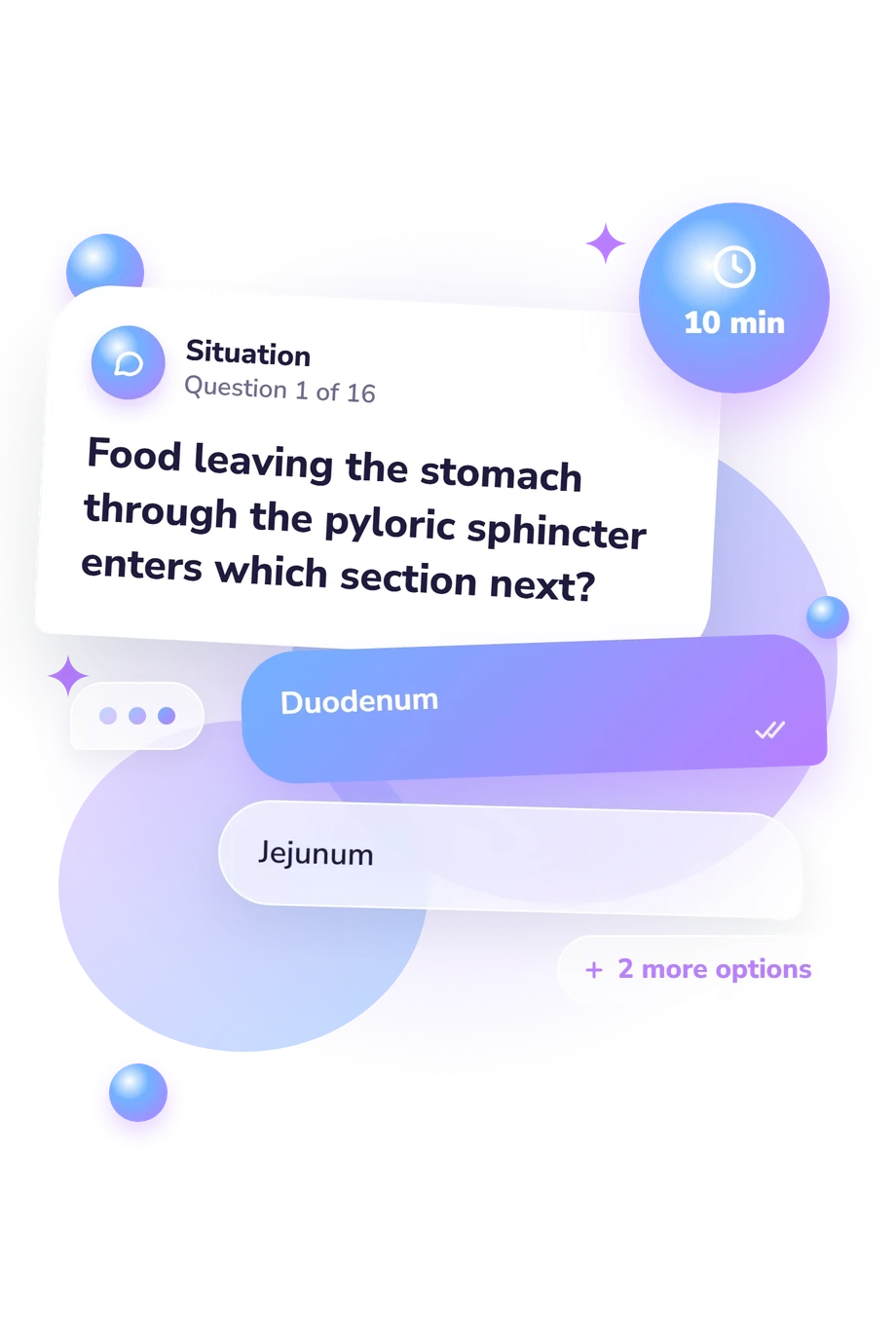
Example Questions From the Test
- Duodenum
- Jejunum
- Cecum
- Ileum
- Pancreas
- Gallbladder
- Liver
- Spleen
- Trachea
- Esophagus
- Duodenum
- Colon
Digestive System Quiz - Description and methodology of the test
Students, curious learners, and anyone reviewing basic human biology can use this assessment to connect digestive organs with their functions. The digestive system quiz turns those links into a focused knowledge check and indicates areas that may deserve further study. The result emphasizes learning priorities. It can support review before or after a lesson. This digestion quiz keeps the task focused on learning.
What This Assessment Measures
The items identify whether you can connect digestive organs, structures, and functions in brief biological situations. They cover movement, secretions, digestion, absorption, and elimination, so the result reflects basic digestive anatomy and physiology, not symptoms.
The main learning areas are:
- Organ identification shows how well you connect major structures with their roles.
- Food movement indicates whether swallowing, peristalsis, storage, and passage follow the correct sequence.
- Digestive chemistry shows enzymes break down food, bile disperses fats, acid aids digestion, and bicarbonate regulates acidity.
- Villi support nutrient absorption; the colon, rectum, and anus support water handling, storage, and elimination.
In practice, questions in this digestive-system quiz test connections through identification and cause-and-effect reasoning. The scale Digestive System Knowledge runs 0-16: Foundations to build (0-6), Developing knowledge (7-12), and Strong knowledge (13-16). These bands summarize performance on the tested content.
Methodology and Evidence Base
Each item uses a selected-response format with four alternatives and one keyed answer. The questions range from identifying structures to applying functions in brief scenarios, making the task a check of factual recall and basic physiological reasoning.
For review, this digestive system practice quiz applies each item to a specific connection, from organ location to function. Conceptually, the test aligns with Reinoso Tapia and colleagues' flipped-classroom study on digestive anatomy, processes, and inquiry; that study supplies subject-matter context, not an adaptation or validation of this questionnaire. Organ functions and physiological relationships also correspond with an OpenStax anatomy and physiology textbook.
Scoring is transparent: the total equals the number of correct responses, with one point for each correct response. The displayed bands are educational summaries of performance on the tested content. Each item tests a specific connection; the total becomes an educational band.
Because it is an online knowledge tool, performance can vary with prior instruction, attention, terminology familiarity, and testing context. The result is a snapshot of present knowledge, not a clinical assessment or broader evaluation.
- Reinoso Tapia, Roberto; Collazos Martínez, Miguel Ángel; Martínez Martínez, María del Carmen; Delgado Iglesias, Jaime. (2021). Flipped classroom for teaching digestive system to high school students: Performance, perception and inquiry competence level. Journal of Technology and Science Education, 11(1), 194-209. 10.3926/jotse.1122
- Betts, J. Gordon; Young, Kelly A.; Wise, James A.; Johnson, Eddie; Poe, Brandon; Kruse, Dean H.; Korol, Oksana; Johnson, Jody E.; Womble, Mark; DeSaix, Peter. (2022). Anatomy and Physiology 2e. Houston, TX: OpenStax
Updated: