
Cardiac Axis Quiz
How the Scales are Structured
Who Usually Takes This Test?
See How You Compare
Below is a preview of how scores are typically distributed across each scale.
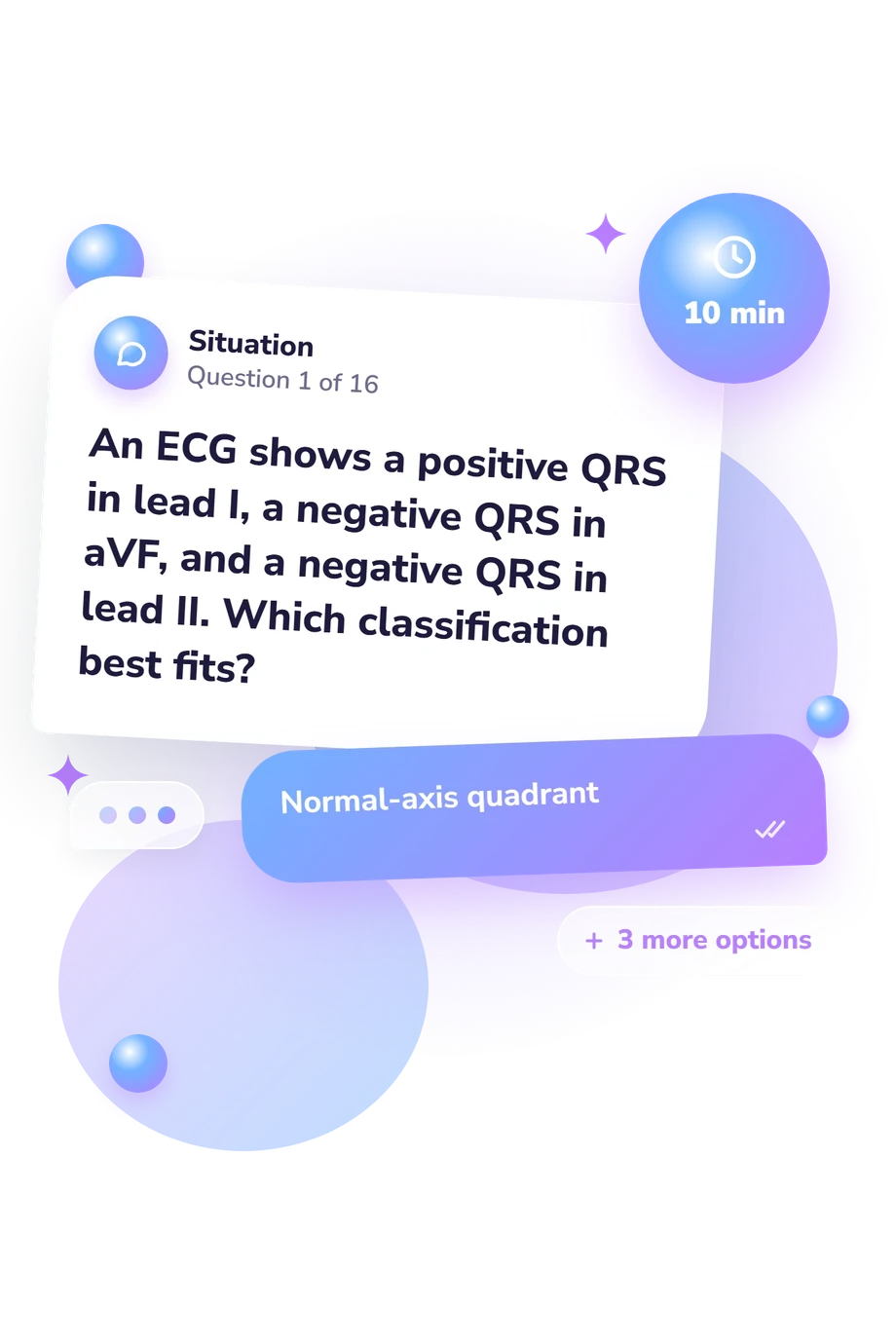
Example Questions From the Test
- Normal-axis quadrant
- Right axis deviation
- Left axis deviation
- Extreme axis deviation
- A predominantly negative QRS complex
- A predominantly positive QRS complex
- An absent QRS complex
- A QRS complex determined only by the T-wave direction
- A horizontal rightward axis near 0°
- An inferior vertical axis near +90°
- A mildly superior-left axis near −30°
- A superior vertical axis near −90°
Cardiac Axis Quiz - Description and methodology of the test
Designed for students and clinicians-in-training who want to check their grasp of frontal-plane ECG reasoning, this cardiac axis quiz turns common interpretation steps into a focused knowledge check. It is also a practical cardiac axis test for self-directed revision: the result indicates which level of QRS-axis knowledge your answers currently support and points toward concepts that deserve another review.
What This Assessment Explores
The assessment examines how limb-lead QRS polarity relates to the frontal-plane vector’s direction and how that relationship supports axis categories or approximate angles. It suits learners revising ECG fundamentals and covers quadrant reasoning, the hexaxial reference system, equiphasic complexes, net deflection, lead placement, and how a wide QRS affects axis interpretation.
This ECG axis quiz assesses one educational construct rather than a disorder. Its displayed Cardiac Axis Knowledge scale runs from 0-16 and groups performance into these bands:
- Foundations to review (0-6) indicates that net QRS deflection, limb-lead angles, and the quadrant method need revision.
- Developing knowledge (7-12) indicates that key principles are present but estimates and exceptions need more practice.
- Strong knowledge (13-16) indicates a consistent grasp of common adult frontal-plane QRS-axis methods.
The result therefore describes current knowledge level within this topic.
Methodology and Evidence Base
Each item presents an ECG scenario or principle with four answer choices. The options ask the learner to select a classification, direction, angle, calculation, or safeguard, so the format tests recognition and application rather than derivation. The result is reported on the displayed educational scale and interpreted through its bands.
Li et al. relate lead display order to diagnostic accuracy, evidence conceptually consistent with this questionnaire’s frontal-plane axis focus but not an adaptation of it; the study does not establish this questionnaire’s scoring or validity. Meek and Morris explain the lead relationships and axis framework used in basic ECG teaching. Abreu-Lima et al. examined common frontal-plane approximations, while Okamoto et al. addressed individual axis determinations. These studies support the content domain, but they do not validate this online questionnaire.
This ECG axis deviation quiz emphasizes classification practice rather than diagnostic confirmation. Performance can reflect study familiarity, attention, and current context. The bands are educational descriptors, not a validated measure of clinical competence; interpretation of clinical ECG findings requires the full ECG, symptoms, and qualified professional judgment.
- Li G, Banarsee K, Laukkanen JA, Hao L. Orderly display of limb lead ECGs raises Chinese intern’s diagnostic accuracy when determining frontal plane QRS axis. Medical Education Online. 2018;24(1):1549923. 10.1080/10872981.2018.1549923
- Meek S, Morris F. Introduction. I-Leads, rate, rhythm, and cardiac axis. BMJ. 2002;324(7334):415-418. 10.1136/bmj.324.7334.415
- Abreu-Lima C, Marques de Sa JP, Coelho G, Almeida J, Silva-Carvalho F, Hernandez C. Frontal-plane QRS axis revisited: accuracy of current approximations and reappraisal of their merit in the diagnosis of right ventricular hypertrophy. Journal of Electrocardiology. 1988;21(4):369-375. 10.1016/0022-0736(88)90114-8
- Okamoto N, Kaneko K, Simonson E, Schmitt OH. Reliability of individual frontal plane axis determination. Circulation. 1971;44(2):213-219. 10.1161/01.CIR.44.2.213
Updated: