
Bookkeeping Quiz
How the Scales are Structured
Who Usually Takes This Test?
See How You Compare
Below is a preview of how scores are typically distributed across each scale.
Example Questions From the Test
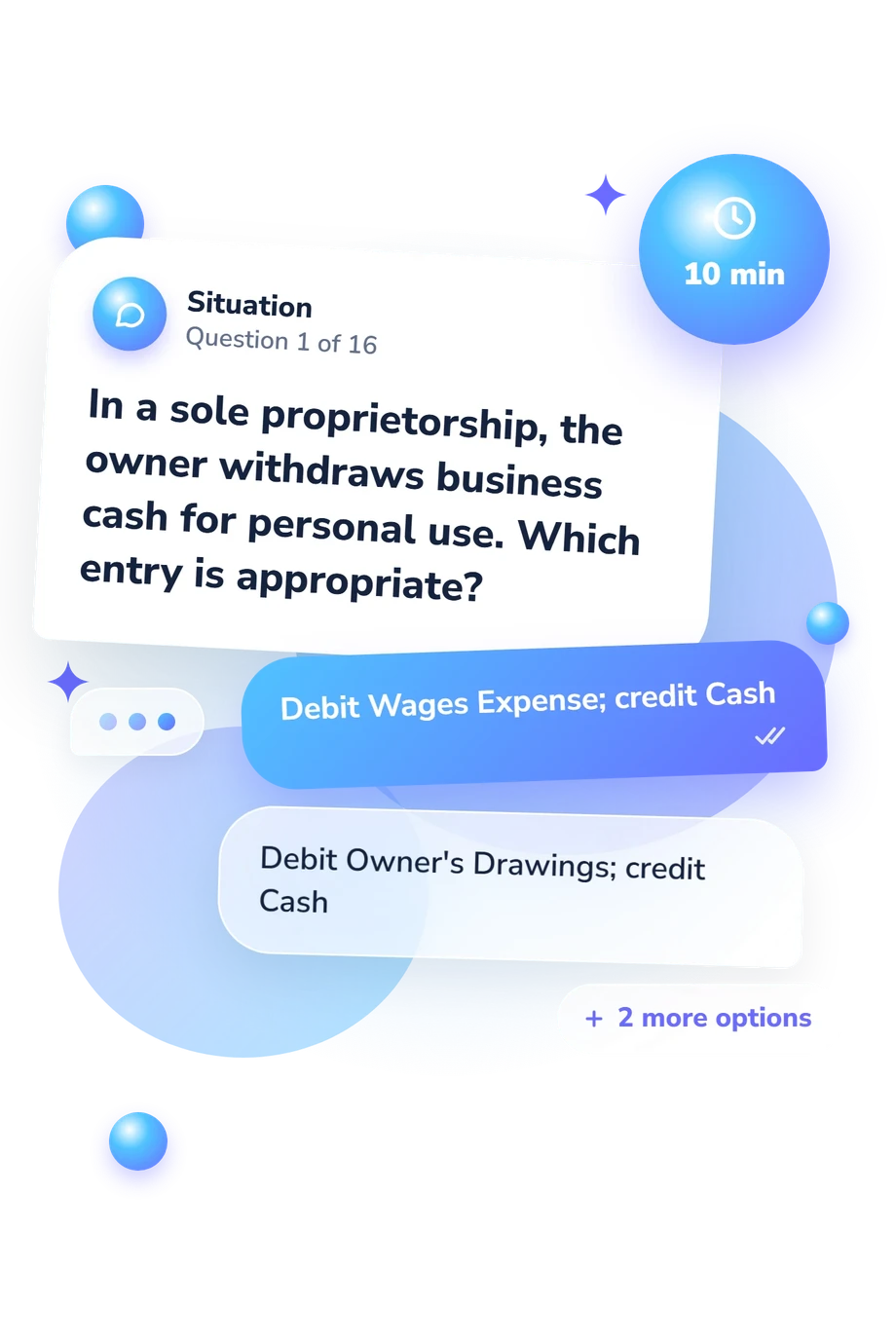
- Debit Wages Expense; credit Cash
- Debit Owner's Drawings; credit Cash
- Debit Owner's Capital; credit Sales Revenue
- Debit Cash; credit Owner's Capital
- Debit Accumulated Depreciation; credit Depreciation Expense
- Debit Equipment; credit Depreciation Expense
- Debit Depreciation Expense; credit Accumulated Depreciation
- Debit Depreciation Expense; credit Equipment Purchases
- Debit Sales Revenue; credit Accounts Receivable
- Debit Accounts Receivable; credit Cash
- Debit Cash; credit Sales Revenue
- Debit Cash; credit Accounts Receivable
Bookkeeping Quiz - Description and methodology of the test
People who record transactions, support monthly close, or study introductory accounting can use this bookkeeping quiz to examine whether core rules are ready for routine application. It is useful for learners, trainees, and small-business staff who want a focused picture of how they handle entries, adjustments, controls, and ledger concepts. As a bookkeeping test, it points to areas worth reviewing without claiming to measure every aspect of the job.
What This Assessment Measures
Short workplace scenarios make the quiz questions about bookkeeping practical, asking you to choose the correct debit-and-credit treatment or accounting action. They cover routine transactions, timing differences, documentation, and controls that affect the reliability of records.
The result focuses on Bookkeeping Knowledge, scored from 0-16 with one point for each correct answer. The displayed bands are Foundations to build (0-6), Developing knowledge (7-12), and Strong working knowledge (13-16). They describe performance on the tested concepts: lower results identify topics for review, while higher results indicate a consistent grasp of core principles.
The main themes are:
- Transaction entries show whether you can record withdrawals, sales, purchases, and customer payments in the correct accounts.
- Adjustments and accruals show how you handle depreciation, prepaid costs, unpaid bills, and revenue earned before collection.
- Reconciliations, controls, documents, and ledgers show whether you can resolve timing differences, support records, and organize account information.
Methodology and Scientific Basis
Each item presents a bookkeeping situation with four answer choices. You select the entry or explanation that fits the facts, so the format checks applied understanding rather than vocabulary recognition alone. Scoring is additive: one point per correct response, with no stated weighting or penalty.
The method is conceptually consistent with WBB (Helm and Wimmer, 2012), which treats accounting competence as knowledge demonstrated through task-based performance. This questionnaire is not presented as an adaptation of WBB. Helm (2015) examines competence development in accounting education, while Herawati, Meitriana, and Nopiyani (2026) describe diagnostic assessment of basic accounting concepts. These sources support the educational focus but do not establish standardization, norms, or psychometric properties for this online version.
For focused review, it works as a bookkeeping practice quiz, giving a snapshot of selected concepts rather than complete workplace readiness. Performance may reflect guessing, wording, prior instruction, and familiarity with accounting conventions. The result does not assess software skill, speed, unusual-case judgment, or broader professional responsibilities; it is an educational profile, not a professional certification.
- Christoph Helm and Barbara Wimmer, “How Can Learning Success in Accounting Be Measured? Development of a Measurement Instrument,” Wissenplus: Austrian Journal for Vocational Education, no. 5 (2012): 24-29.
- Christoph Helm, “Determinants of Competence Development in Accounting in Upper Secondary Education,” Empirical Research in Vocational Education and Training 7, article 10 (2015). 10.1186/s40461-015-0022-8
- Nyoman Trisna Herawati, Made Ary Meitriana, and Putu Eka Nopiyani, “Development of a Diagnostic Assessment to Measure University Student’s Understanding of Basic Accounting Concepts,” Journal of International Education in Business 19, no. 2 (2026): 290-308. 10.1108/JIEB-03-2025-0030
Updated: