
Book Genre Quiz
How the Scales are Structured
Who Usually Takes This Test?
See How You Compare
Below is a preview of how scores are typically distributed across each scale.
Example Questions From the Test
- A coded file containing the names of several suspects
- An heirloom linked to both family history and an old legend
- A sentient map that redraws itself according to your choices
- A practical field kit suited to a difficult journey
- A hidden motive that changes how an earlier scene is understood
- A vivid setting with its own legends and customs
- A tense pursuit that keeps the characters moving
- A personal disagreement that gradually comes into the open
- How ordinary routines and personal choices reflect the era
- Whether the letters contain a coded confession
- The emotional bond between the correspondents
- How the events could be reimagined in a different world
Book Genre Quiz - Description and methodology of the test
Readers who want to choose stories more deliberately can use the book genre quiz to examine the settings, conflicts, relationships, and ideas that hold their attention. Readers building a reading list can use this quiz to answer: What kind of books do I like? The result presents a leading affinity or blended profile.
What This Assessment Explores
Genre is attraction, not identity. Scenarios reveal which settings, conflicts, relationships, or ideas engage you; the result describes taste. These dimensions are:
- Fantasy (0-12) measures magic and invented realms: Grounded Wanderer (0-4), Enchanted Explorer (5-8), or Realm Weaver (9-12).
- Historical Fiction (0-12) measures past eras and social context: Contemporary Spirit (0-4), Time Traveler (5-8), or Era Immersed (9-12).
- Mystery & Thriller (0-12) measures clues, motives, and suspense: Open Book (0-4), Clue Follower (5-8), or Master Investigator (9-12).
- Romance (0-12) measures intimacy and transformative bonds: Independent Arc (0-4), Connection Seeker (5-8), or Heart-Led Protagonist (9-12).
- Science Fiction (0-12) measures future possibilities and technology: Present-Focused Thinker (0-4), Future Curious (5-8), or Frontier Visionary (9-12).
The genre quiz connects these dimensions to your pull.
Methodology and Evidence Base
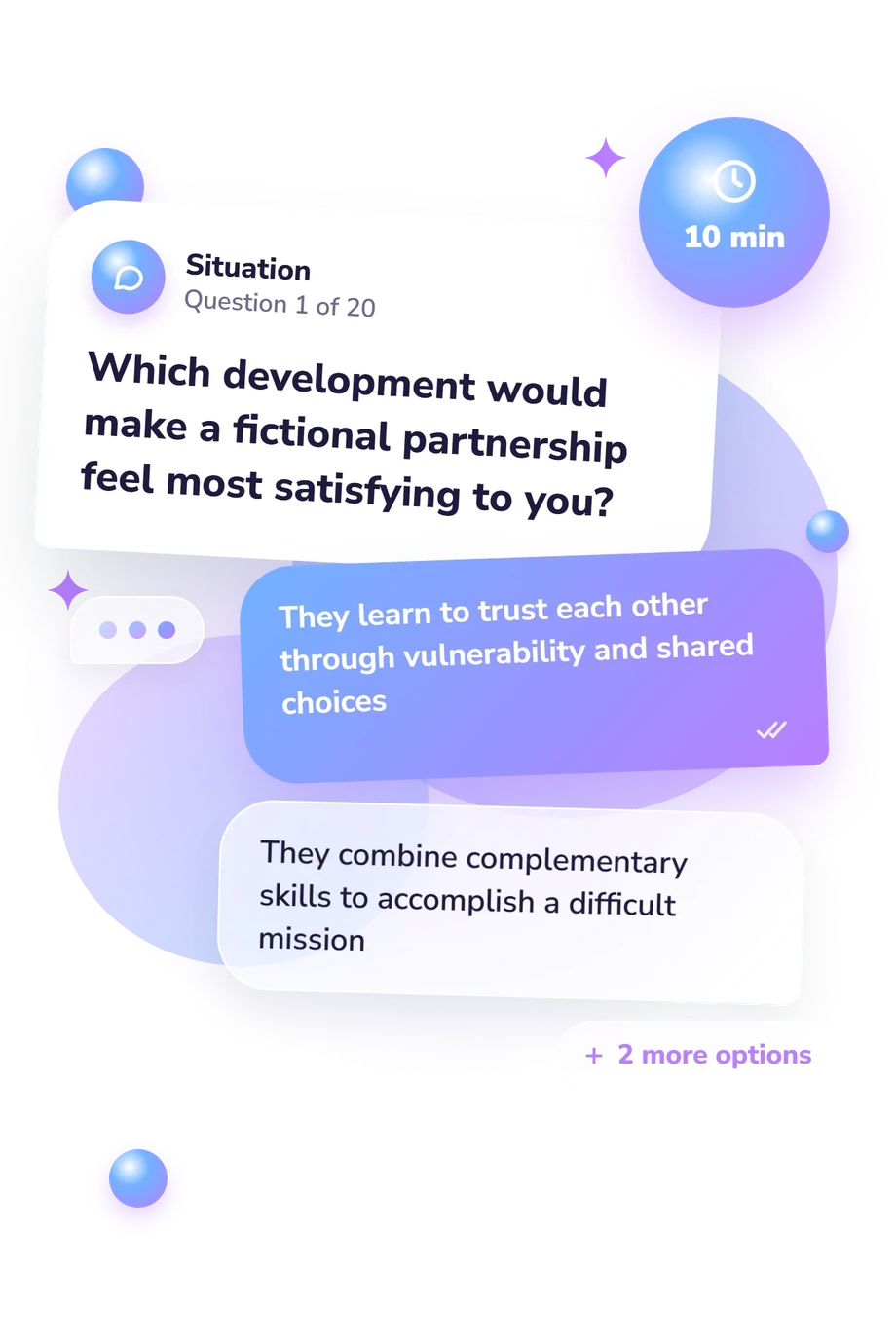
Each item presents a fictional situation with four response options. Choices concern a development, motive, setting, or emotional turn, asking which would be most engaging. Respondents compare preferences rather than knowledge, so the self-report format uses imagined reactions and does not require literary expertise.
Scoring separates responses into the five genre totals. The highest score represents the strongest affinity, while scores within one point form a blended result. The questionnaire does not state how many points each answer contributes; item weights should not be inferred.
Conceptually, the dimensions are consistent with Tirre and Dixit (1995), who treated reading interests as distinguishable preference dimensions, and with Rentfrow, Goldberg, and Zilca (2011), whose model examined entertainment preferences across media. Those studies support a multidimensional view of taste, but this online questionnaire is not a direct adaptation or validation of either source.
The profile helps readers use the quiz to answer: What book genre should I read next? Mood, recent reading, self-awareness, and scenario interpretation can affect answers, and the displayed bands are descriptive categories for this questionnaire; the result should not be treated as population-normed evidence unless that status is documented.
- Tirre, William C., and Sharvari Dixit. "Reading interests: Their dimensionality and correlation with personality and cognitive factors." Personality and Individual Differences 18, no. 6 (1995): 731-738. 10.1016/0191-8869(94)00211-A
- Rentfrow, Peter J., Lewis R. Goldberg, and Ran Zilca. "Listening, Watching, and Reading: The Structure and Correlates of Entertainment Preferences." Journal of Personality 79, no. 2 (2011): 223-258. 10.1111/j.1467-6494.2010.00662.x
Updated: