
Beach Quiz
How the Scales are Structured
Who Usually Takes This Test?
See How You Compare
Below is a preview of how scores are typically distributed across each scale.
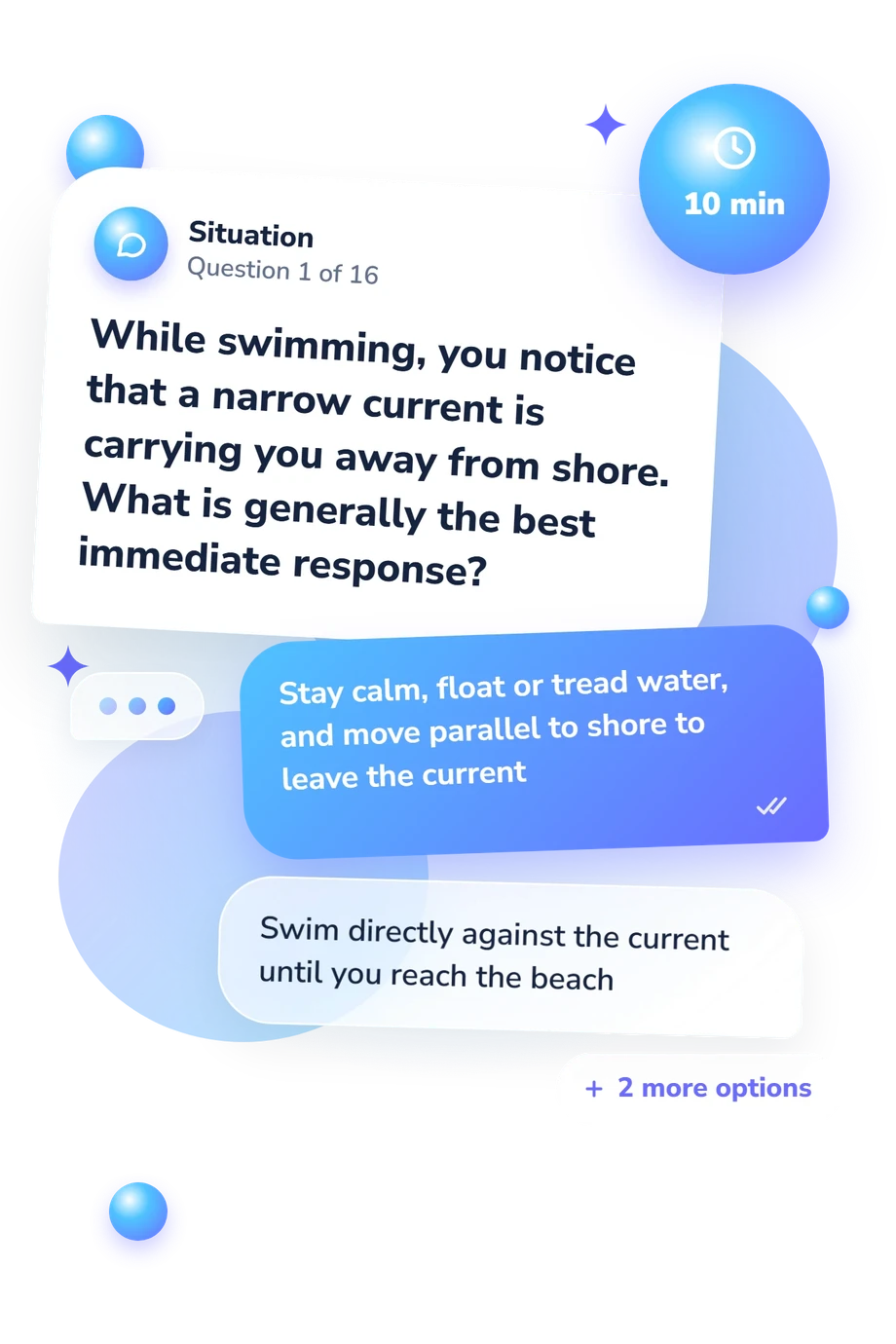
Example Questions From the Test
- A storm surge
- A rip current
- Longshore drift
- A tidal bore
- Bleached fragments of coral limestone
- Quartz crystals stained by seawater
- Dark basaltic lava broken into small particles
- Compressed layers of coastal peat
- Move it into deeper water before the tide changes
- Detach it briefly and return it to a different rock nearby
- Observe it without pulling it off the rock or relocating it
- Carry it to a shaded pool so it is not exposed to sunlight
Beach Quiz - Description and methodology of the test
For readers who want to understand what happens along a shoreline and make safer, more responsible choices, the beach quiz provides a focused knowledge check. It suits curious beachgoers, students, educators, and anyone building practical ocean awareness. These beach-quiz questions show how confidently you connect coastal processes with hazards, wildlife protection, and everyday decisions.
What This Assessment Explores
Natural beaches are systems shaped by waves, tides, currents, sediment, storms, geology, and living organisms. This beach knowledge test checks whether you connect coastal processes with sensible actions.
The items use shoreline situations involving moving water, dune plants, wildlife, beach materials, and emergencies. The result shows whether you recognize relationships and responsible responses.
The questions group into areas:
- Coastal processes and materials show whether you understand waves, sediment transport, dunes, berms, tides, and beach geology.
- Hazards and safety show whether you recognize rip currents, storm surge, tsunami risk, and protective action.
- Ecology and stewardship show whether you protect wildlife and judge shoreline interventions responsibly.
Beach Knowledge runs from 0-16: Shoreline Starter (0-6) means beach basics need strengthening; Beach Explorer (7-12) means developing knowledge of science, safety, and ecology; Coastal Connoisseur (13-16) means strong practical understanding of beach formation, change, and responsible enjoyment.
Methodology and Scientific Basis
Each item presents a short situation, process description, or safety choice with four response options. Choosing an answer requires applying a concept to a likely outcome or responsible action, so the format measures knowledge through fixed-choice performance rather than self-rated confidence.
This coastal science quiz uses one displayed knowledge dimension. The result is a single total, but no separate weighting, normative conversion, or formal cutoff method is stated. It helps identify learning strengths and gaps rather than compare a respondent with a reference population.
Conceptually, the questionnaire aligns with Woodward et al. (2015), whose work examines recognition of rip-current hazards and beach-safety responses. It also fits the ocean-literacy perspective of SOLE discussed by Markos et al. (2017), while the National Marine Educators Association (2010) provides an educational framework connecting ocean processes, human impacts, and responsible action. It is conceptually consistent with these sources, not a validated or standardized administration of them.
Guessing and prior experience may shape results. Use the score to guide learning, since beaches differ in hazards, wildlife rules, weather, and emergency guidance.
- Woodward, Eleanor, Emily Beaumont, Paul Russell, and Ross MacLeod. (2015). Public Understanding and Knowledge of Rip Currents and Beach Safety in the UK. International Journal of Aquatic Research and Education, 9(1), Article 6. 10.25035/ijare.09.01.06
- Markos, Angelos, Theodora Boubonari, Athanasios Mogias, and Theodoros Kevrekidis. (2017). Measuring ocean literacy in pre-service teachers: psychometric properties of the Greek version of the Survey of Ocean Literacy and Experience (SOLE). Environmental Education Research, 23(2), 231-251. 10.1080/13504622.2015.1126807
- National Marine Educators Association. (2010). Ocean Literacy Scope and Sequence for Grades K-12. Ocean Literacy Campaign Special Report #3. College Park, MD: National Marine Educators Association.
Updated: