
Architecture Quiz
How the Scales are Structured
Who Usually Takes This Test?
See How You Compare
Below is a preview of how scores are typically distributed across each scale.
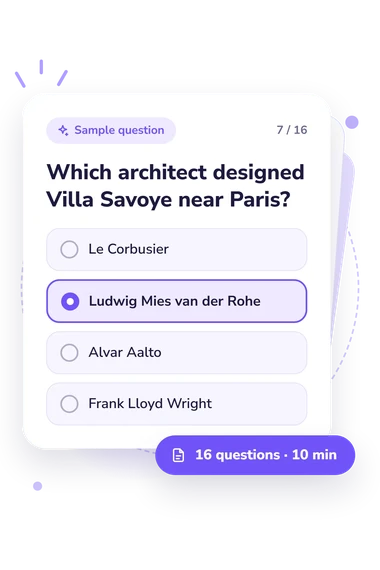
Example Questions From the Test
- A barrel vault
- A cantilever
- A tensile membrane
- A flying buttress
- Firmness, utility, and delight
- Mass, surface, and space
- Form, function, and economy
- Rhythm, symmetry, and hierarchy
- Le Corbusier
- Ludwig Mies van der Rohe
- Alvar Aalto
- Frank Lloyd Wright
Architecture Quiz - Description and methodology of the test
People considering study in architecture can use this architecture quiz to decide whether their foundations are ready for advanced material. It is useful when the next step might be a course, a design project, or targeted review rather than a broad introduction. In that sense, this architect quiz checks foundational architectural knowledge rather than an individual's professional identity or practice. The result points to areas that merit closer attention.
What This Assessment Explores
The assessment checks practical architectural knowledge rather than taste. Its scenarios ask readers to recognize structural behavior, climate responses, drawing conventions, construction systems, and historical ideas. As an architecture knowledge test, it suits learners who want to strengthen or refresh a foundation in the subject.
The result draws on four areas:
- Structural reasoning shows whether you recognize trusses, cantilevers, arches, buttresses, and curtain walls.
- Environmental design shows whether you identify orientation, flood protection, and cross-ventilation as responses to place.
- Representation and construction examine whether you understand sections and systems that explain how buildings work.
- History and principles show whether you recognize Vitruvian ideas, architectural orders, movements, notable buildings, and adaptive reuse.
One Architecture Knowledge score runs from 0-16: Foundation to build (0-6), Developing knowledge (7-12), or Strong knowledge (13-16). It describes educational command of core concepts.
Methodology and Scientific Basis
Each item presents an architectural situation or prompt with four choices. Selecting an option requires recognition and application: a reader may identify a structural form, interpret a drawing, connect a design response to climate, or place an idea in history.
The questionnaire produces one overall score and no separate subscores. As an architecture test, it is an educational summary rather than a professional qualification measure, and it can help choose topics to review.
The Rule Space Methodology study by Katz and colleagues provides conceptual context for distinguishing content knowledge from reasoning. This questionnaire is a separate online assessment whose items cover structures, drawings, climate responses, construction systems, historical movements, notable buildings, and design principles, asking readers to recognize forms, interpret architectural vocabulary, and connect design decisions with their setting. Ching's works support its treatment of form, space, order, and construction, while Watkin supplies the historical frame for movements, buildings, and traditions.
Interpret the band with the questions in mind: a lower result can identify foundations to revisit, while a higher result indicates broader recognition across the sampled material. Scores can reflect prior education, cultural exposure, and momentary uncertainty, so difficult concepts deserve more attention than the number alone.
- Katz, Irvin R., Michael E. Martinez, Kathleen M. Sheehan, and Kikumi K. Tatsuoka. "Extending the Rule Space Methodology to a Semantically-Rich Domain: Diagnostic Assessment in Architecture." Journal of Educational and Behavioral Statistics, 23(3), 1998, 254-278. 10.3102/10769986023003254
- Ching, Francis D. K. Architecture: Form, Space, and Order. 4th ed., Wiley, 2015.
- Ching, Francis D. K. Building Construction Illustrated. 6th ed., Wiley, 2020.
- Watkin, David. A History of Western Architecture. 5th ed., Laurence King Publishing, 2011.