
Am I Basic Quiz
How the Scales are Structured
Who Usually Takes This Test?
See How You Compare
Below is a preview of how scores are typically distributed across each scale.
Example Questions From the Test
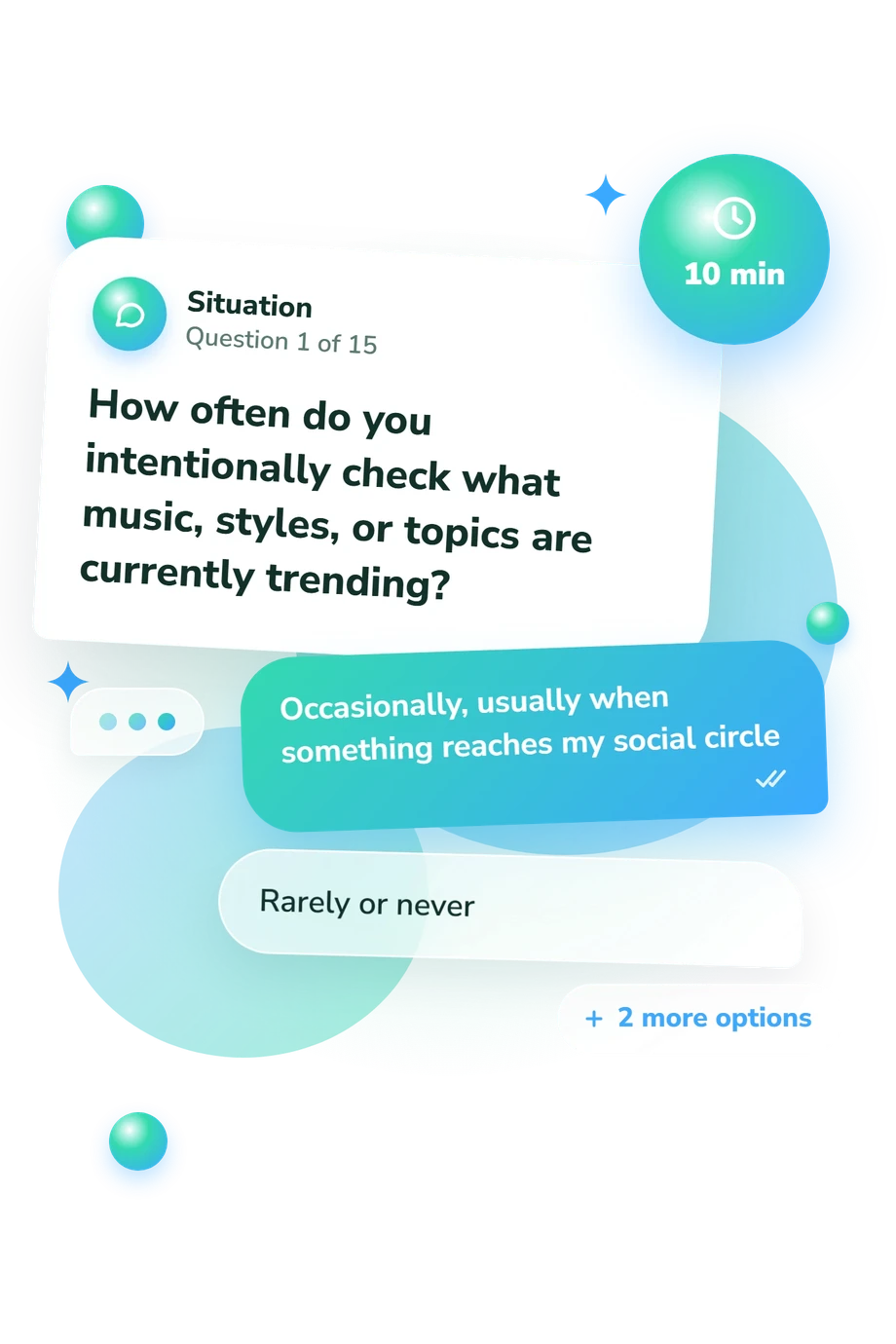
- Occasionally, usually when something reaches my social circle
- Rarely or never
- Regularly, because I enjoy keeping up with what is new
- Sometimes, but mostly within a narrow interest of mine
- The signature bestseller that appears in most customer photos
- A familiar favorite with one interesting variation
- A less-promoted drink recommended by the barista
- The most unusual flavor combination on the menu
- I understand it eventually but rarely use it myself
- I start using it once it becomes familiar in my circles
- I usually do not notice that it has become a trend
- I try it early while it still feels new
Am I Basic Quiz - Description and methodology of the test
Readers curious about how basic they are can use this questionnaire to examine why everyday choices lean toward convenience, shared tastes, personal meaning, or emerging trends. The Am I Basic Quiz organizes familiar situations into a profile that helps a person notice the influences behind choices in style, entertainment, food, and social participation. It offers language for reflection without treating any preference as a measure of worth.
What This Assessment Explores
Everyday choices are read through three dimensions, and someone wondering how basic their preferences are receives a profile rather than a verdict.
These are the result dimensions:
- Individual Expression (0-15) measures how strongly personal interests guide choices over convenience, familiarity, or coordination: Easygoing Coordinator (0-5) favors simplicity; Personal-Touch Balancer (6-10) balances expression with context; Signature-Style Creator (11-15) follows distinctive interests and personal meaning.
- Mainstream Taste Affinity (0-15) measures gravitation toward familiar, widely enjoyed choices, not knowledge or originality: Selective Explorer (0-5) seeks less-popular options; Flexible Mixer (6-10) combines familiar and uncommon choices; Popular-Taste Fan (11-15) favors shared favorites.
- Trend Engagement (0-15) measures how quickly and actively someone notices, tries, and participates in current trends regardless of mainstream taste: Trend-Detached (0-5) rarely follows them; Casual Participant (6-10) joins selectively; Trend-Connected (11-15) readily joins emerging trends.
Methodology and Scientific Basis
Each item presents an everyday choice or social situation with four plausible responses. The options contrast convenience, familiar or popular choices, personal meaning, and active trend participation; no answer is objectively correct. This self-report format captures stated preferences rather than knowledge.
Responses are grouped into separate displayed dimensions rather than a single overall label. Rather than deciding whether you are basic, the result needs context because its bands describe preferences, not judgments of authenticity, originality, personal worth, or social value. Mood, social setting, cultural familiarity, recent exposure, and self-awareness can shape responses, so the profile describes reported preferences at completion rather than fixed traits.
The evidence base is conceptually consistent with Berger and Heath (2007), which connects product choices with identity signaling and differentiation. Bearden, Netemeyer, and Teel (1989) addresses interpersonal influence, while Bikhchandani, Hirshleifer, and Welch (1992) explains how visible adoption can accelerate fads and fashion. These sources support the framework; the questionnaire is not presented as an adaptation of any one instrument.
- Berger, Jonah, and Chip Heath. 2007. "Where Consumers Diverge from Others: Identity Signaling and Product Domains." Journal of Consumer Research 34(2):121-134. 10.1086/519142
- Bearden, William O., Richard G. Netemeyer, and Jesse E. Teel. 1989. "Measurement of Consumer Susceptibility to Interpersonal Influence." Journal of Consumer Research 15(4):473-481. 10.1086/209186
- Bikhchandani, Sushil, David Hirshleifer, and Ivo Welch. 1992. "A Theory of Fads, Fashion, Custom, and Cultural Change as Informational Cascades." Journal of Political Economy 100(5):992-1026. 10.1086/261849
Updated: